The Nord Stream Conspiracy Quotes
by Bojan Pancevski
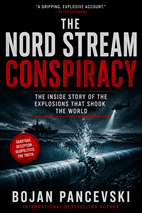
This collection pulls together the most striking lines from Bojan Pancevski's account of the Nord Stream sabotage. You'll find moments of raw tension, dark humor, and quiet reflection that cut through the noise of a sprawling geopolitical mystery.
What makes the book so quotable is how it threads high stakes with very human details. One line might make you wince at the scale of the operation, the next might surprise you with an absurd cover story or a soldier's private pride. There's no fluff here, just the kind of writing that sticks.
Top Quotes from The Nord Stream Conspiracy
“The industrial locomotive of Europe and the world’s third-largest economy had never prepared for a future without Russian gas.”
The narrator describes Germany's lack of contingency plans after Olaf Scholz's administration searched for them in vain.
This line starkly illustrates the breathtaking hubris and strategic failure of Europe's largest economy, making the subsequent crisis feel both inevitable and avoidable.
“You cannot work in counterintelligence and remain a good person, even if you once were a good person to start with. But you can remain motivated by a good cause.”
General Valeriy Kondratyuk, former chief of Ukraine's military and foreign intelligence services, reflects on the moral cost of spycraft.
It encapsulates the ethical trade-off inherent in intelligence work and the necessity of a higher purpose to justify it.
“No one, and nothing, was safe.”
Describing the aftermath of the SBU's drone attack on Russia's strategic bombers in June 2025.
This short, stark sentence conveys the revolutionary impact of the attack and a new era of vulnerability in warfare.
“Four men and one woman in a yacht full of tech-diving equipment are making a porno movie on the high seas.”
The Colonel reveals the cover story for the team if stopped by police.
The absurdity and audacity of the legend make it both humorous and unforgettable, highlighting the boldness of the operation.
“Steel and concrete snapping like giant bones in a violent agony, triggered by a single small cylinder that Freya and The Iceman placed there only days earlier.”
The narrator describes the destruction of the Nord Stream 1 pipeline after the explosions.
The visceral, anthropomorphic imagery conveys the immense power and consequence of the act, leaving a haunting impression.
“The CIA Station Chief knew almost everything about the plot, but that didn’t prepare him for the sight of its real-world outcome. And he thought it had been canceled.”
Reaction of the CIA Station Chief upon seeing the actual explosion.
The contrast between his prior knowledge and the shocking reality, plus the revelation that he believed it was canceled, creates dramatic irony and underscores the unpredictability of covert operations.
“Even some Russians with appropriate security clearance believed that their old foe the CIA blew up their pipelines.”
Observation about Russian perceptions near the end of the chapter.
It highlights the ironic persistence of misinformation even among those with high-level access, revealing how conspiracy narratives can surpass official evidence.
Themes Behind the Quotes
A central theme is the collision between grand strategy and human fragility. The book shows how national security decisions, from energy policy to covert operations, depend on the choices of individuals under pressure. It also explores how distrust, both within governments and between nations, can spiral into paranoia and unintended consequences.
Another thread is the cost of war on ordinary people and the surprising resilience that emerges in response. The quotes reveal a world where courage and corruption coexist, where the line between heroism and ruthlessness blurs. And beneath it all runs a quiet warning about the fragility of modern infrastructure, and how a single act can reshape the global order.
Quotes by Chapter
Chapter I: The Earthquake
“Come then, kobzar, strike up a merry tune— let the very earth quake, let my Cossacks rejoyce!”
Opening epigraph from Taras Shevchenko's poem 'The Haidamaks.'
It sets a dramatic, violent tone foreshadowing the attack and connects to Ukrainian/Cossack heritage.
“Confusion, anxiety, and suspicion spread quickly.”
Narrator describing the immediate aftermath of the pipeline attack.
It captures the rapid spread of uncertainty and fear that often follows mysterious geopolitical events.
“The lack of official information fueled speculation and elaborate conspiracy theories, quickly amplified by social media.”
Narrator on the information vacuum after the attack.
It highlights how absence of facts breeds speculation and conspiracy, a central theme of the book.
Chapter II: The Investigators
“His personal contacts across government, and across Europe—and his knowledge of their respective legal systems—would soon be of great benefit to the career-defining investigation that was about to land on his desk.”
Describing Dieter Romann, the head of Germany's Federal Police, as he prepares for the Nord Stream sabotage investigation.
This line underscores the value of deep institutional knowledge and cross-border relationships in solving a complex geopolitical crime, making it memorable for its foreshadowing of the investigation's scale.
“He understood this could be the biggest case of his life, and that it was certain to trigger a political earthquake irrespective of who perpetrated it.”
Romann's realization after viewing the first footage of the pipeline explosions.
The visceral language of 'political earthquake' captures the inevitable fallout of the attack, highlighting the high stakes and universal impact beyond the crime itself.
“The violent attack on the country's energy supply could “impact the external and internal security of Germany,” the prosecutor's office said. It was a grave charge. It added political weight to the investigation. Romann knew this meant no politician would ever interfere.”
After the federal prosecutor opened an investigation into sabotage harming the constitutional order.
This passage reveals how legal classification protects investigative independence, and the phrasing 'grave charge' resonates with readers as a stark reminder of the attack's severity.
“He also knew it could have been much worse. Legally, the attack on critical infrastructure could also have been interpreted as an act of war.”
Romann reflecting on the legal implications of the pipeline sabotage.
The chilling suggestion that the incident bordered on an act of war elevates the stakes dramatically, leaving readers with a sense of the precarious balance between peace and conflict.
Chapter III: Nord Stream: From Peace Through Trade to All-Out War
“It signaled to Putin that he had a short window of opportunity to act before Ukraine came under the Western nuclear umbrella.”
The narrator explains the catastrophic outcome of Merkel's decision to insulate energy trade after Russia's 2014 invasion of Ukraine.
This sentence crystallizes how Western inaction and continued dependence on Russian gas directly emboldened Putin to launch a full-scale war.
“Merkel would even treat Putin to a Radeberger, the East German beer he enjoyed as a young KGB operative.”
The narrator describes the cordial personal relationship between German Chancellor Angela Merkel and Russian President Vladimir Putin despite geopolitical tensions.
This vivid, almost absurd detail humanizes the fatal complacency of German leadership—sharing a beer with a former spy while enabling his aggression.
“Germany's change through trade approach failed to change Russia's imperial self-perception, or the expansionist policies it has pursued since its inception as a state.”
The chapter's concluding analysis of the failure of Wandel durch Handel as a policy.
This line delivers a damning verdict on decades of German foreign policy, exposing the core illusion that economic interdependence could tame an imperial power.
Chapter IV: The Masterminds
“Fighting Russia, he would say, means fighting corruption.”
The Colonel's belief about the link between battling Russia and rooting out internal corruption.
It ties the external war to an internal struggle, revealing Russia's corruption as a key weapon and the need for integrity.
Chapter V: Operation Diameter
“It was the Cossack spirit that won the day.”
The narrator summarizing the early Ukrainian resistance.
It succinctly captures the nationalistic pride and determination that defined Ukraine's initial defense.
“My heart sank,” The General said. “How will I explain this to my wife when she comes back? But I was bursting with pride. My boy had volunteered!”
The General speaking about his son volunteering to fight.
It powerfully conveys a father's anguish and pride, humanizing the war's personal cost.
“The Colonel opened the NLaw missile launcher, stood up, and aimed. He then attached the battery to the launcher, as he had been instructed. But the weapon malfunctioned.”
The Colonel's first attempt to fire an NLaw missile during a combat encounter.
It highlights the chaotic reality of war, where even advanced weapons fail, and reveals the courage under fire.
“Zelensky's inner circle, the thinking went, could not be trusted.”
The thinking among The Startup and General Zaluzhny regarding President Zelensky's office.
It underscores the operational secrecy and distrust within Ukraine's leadership during the war.
Chapter VI: The Crew
“The horror of total war forced Freya, like most Ukrainians, to discover steel within herself.”
Narrator's reflection on Freya's transformation after war began.
It encapsulates the theme of resilience and the profound change war forces upon ordinary people.
“They would then emerge from the hole in the ice they had carved, and toast with beers and vodka shots to wash down a snack of sausage, all while still in their diving gear, floating in the icy water.”
Description of the divers' unusual Christmas and New Year celebrations.
The vivid imagery conveys the deep camaraderie and eccentric passion of the diving community.
“Ultimately, it would be the only successful part of the operation. And it wouldn't have succeeded without her.”
Narrator's summary of the Nord Stream mission's outcome and Freya's pivotal role.
It highlights the irony and importance of Freya's contribution to the operation's sole success.
“She would also fit a good legend, as the alibi of undercover operatives is called, said The Colonel.”
The Colonel explaining why the female diver is useful for the mission's cover story.
It reveals the strategic thinking behind using personal relationships as operational cover.
Chapter VII: The Dutch Gambit
“Despite a major breach in an extraordinarily high-risk operation, they not only pressed on, but opted to strike Germany's critical infrastructure from inside the country—after Berlin had been warned that such a plot was underfoot.”
The author describes how The Startup reacted after Operation Diameter was leaked.
This line captures the astonishing audacity and recklessness of the plotters, making the reader question the boundaries of covert action.
“No, don't write elaborate essays—just send me a quick and simple text message saying you're not doing it!”
The Station Chief pleads with The General to stop drafting a long reply and instead send a short cancellation message.
The exasperated plea humanizes the high-stakes negotiation and highlights the bureaucratic absurdity within a clandestine operation.
“A solitary leisure yacht full of divers setting sail in inclement weather would be glaringly suspicious.”
The author explains why The Startup had a narrow weather window for their attack.
This vivid, understated observation paints a clear picture of the operation's precariousness and the thin line between cover and exposure.
Chapter IX: The Fallout
“The realization that the unlikely plan had actually succeeded was reverberating like the concentric circles of waves emanating from the Baltic geysers.”
Describes the aftermath of Operation Diameter, six months later.
The vivid simile captures the spreading shock and significance of the event, making the abstract concept of fallout tangible and memorable.