The Nerd Reich Quotes
by Gil Durán
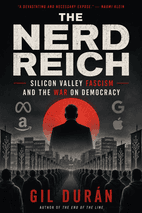
The Nerd Reich by Gil Durán is the kind of book that keeps you stopping mid page. It is packed with lines that feel both over the top and strangely accurate. You will find sharp attacks on Silicon Valley, dark jokes about Bitcoin, and blunt descriptions of money in politics. There are also uncomfortable ideas about who the tech elite think should rule.
What makes the book so quotable is its willingness to say the quiet part out loud. Durán names the players, follows the money, and treats absurd situations with total seriousness. The result is a collection of statements that people will want to share, argue about, and read aloud. These quotes capture a moment when technology and power collide in public.
Top Quotes from The Nerd Reich
“The Trump family gorges on crypto profits as the tech oligarchs gorge on government contracts in an orgy of corruption distinguished by both its unprecedented scale and its radical transparency.”
The narrator describes the open corruption surrounding the purge of federal workers and immigrants.
The parallel between crypto profits and government contracts captures the brazen merger of tech wealth and state power.
“So certain are they of their power—so unafraid of consequences—that they are not even trying to hide their misdeeds from the public eye.”
The narrator reflects on how openly the tech oligarchs and the Trump circle operate.
The inversion of power and consequences makes the threat feel immediate and terrifying.
“While the Internet continues to provide new opportunities, it will also make the mediocre middle-class expendable and the uneducated, paupers.”
Jaan vanValkenburgh writes in a 1997 review of The Sovereign Individual.
It crisply summarizes the book's dystopian class politics and predicts a future where technology abandons the middle class.
“You have no sovereignty where we gather.”
John Perry Barlow writes in his 1996 manifesto The Declaration of the Independence of Cyberspace.
It is a concise assertion that digital space exists beyond state control, the heart of cyberlibertarianism.
“As with a Ponzi scheme, Bitcoin's value relies entirely on finding new people to believe in this story and pay an ever-higher price for it.”
The narrator is explaining how Bitcoin derives its value.
It turns crypto's origin story into a damning economic insight: without a growing pool of believers, the value collapses.
“Vance's lips moved, but Yarvin's ideas came out of his mouth.”
After Vance outlined neoreactionary plans on a right-wing podcast.
It distills the chapter's point that Vance is a mouthpiece for the ideology of his benefactors.
“Crypto’s real political innovation was the creation of a towering corruption machine through which the president of the United States could be openly bribed.”
The author says this while analyzing crypto's influence after Trump embraced the industry.
This line distills the book's thesis into a single damning image, connecting crypto's rise directly to corruption at the highest level.
Themes Behind the Quotes
One major theme is the fusion of wealth and politics. The quotes show a ruling class that sees government as a marketplace, crypto as a tool for bribery, and data as leverage. Democracy is treated as an obstacle or an illusion. The powerful prefer to build alternative systems, make their own rules, and dare anyone to stop them. This is not old-fashioned corruption. It is corruption with a mission, and it happens in plain sight.
Another theme is ideological capture in Silicon Valley. The tech elite are no longer satisfied with building products. They want to remake society, and some have decided that the right wing is their best vehicle. The quotes also highlight a series of contradictions: freedom from government means control by billionaires; innovation gets mixed with reactionary politics; and the people who promise to disrupt everything fall back on authoritarian habits. The book keeps returning to those tensions.
Quotes by Chapter
Introduction
“When a nation is betrayed by its wealthiest citizens—men who believe their money and technology entitle them to rule—existential crisis follows.”
The narrator concludes a passage about the Silicon Valley network's influence over the Trump administration.
It names the core betrayal as a belief in entitlement to rule, turning political analysis into moral warning.
“They see a world in decline and seek to profit by hastening its collapse—and remaking it in their own image.”
The narrator describes tech fascism's global ambitions near the end of the introduction.
It succinctly exposes how the oligarchs weaponize decline for private reconstruction.
Chapter 1: The Sovereign Individual
“Faster than all but a few now imagine, microprocessing will subvert and destroy the nation-state, creating new forms of social organization in the process.”
The book's authors warn readers in the introduction to The Sovereign Individual.
It is the book's central apocalyptic thesis, capturing the fusion of technological determinism and anti-government radicalism that later shaped Peter Thiel.
“The people in DC are completely backwards. They don’t understand any of the technology, and even to the extent they can, it can’t be stopped.”
Peter Thiel tells the Independent Institute in 1999 that Washington cannot stop encryption.
It captures the tech elite's contempt for government and the belief that technological change is unstoppable.
Chapter 2: The Acid Story
“Replacing your own ideology is a lot like do-it-yourself brain surgery. It requires patience, tolerance, a high pain threshold, and very steady hands.”
Yarvin wrote this in the first post of his blog Unqualified Reservations.
It perfectly captures the seductive self-mythology of the online ideologue. He presents reckless intellectual reinvention as a brave, surgical craft.
“Our goal, in short, is a humane alternative to genocide.”
Yarvin wrote this while discussing his Patchwork vision, after joking about turning unproductive people into biodiesel.
The line is chilling because it reframes mass murder as a design problem with a 'humane' solution. It exposes the grinning nihilism beneath the intellectual jargon.
“Its spires are the lvy League and the New York Times, whose faculty and news desk respectively are endowed with an almost pure connection to the Inner Light—lesser institutions, of course, following their lead.”
It is from Yarvin's 'Patchwork' essay, where he describes the conspiracy he called the Cathedral.
It renders the diffuse power of universities and media as a single quasi-religious enemy. The image is vivid, self-flattering, and easily weaponized—which is exactly why it became a favorite of the tech right.
“I think it is only a small exaggeration to say that the government is so fundamentally evil that to deny the evil nature of the government is equal to denying the existence of the devil.”
Thiel said this at the 2010 Libertopia conference.
It strips away pretense and reveals the intensely religious, anti-democratic conviction behind his politics.
Chapter 3: Exit
“Voice is basically changing the system from within, whereas exit is leaving to create a new system, a new start-up, or to join a competitor.”
Balaji Srinivasan said this during his 2013 Startup School speech.
It frames leaving democracy as the ultimate disruptor. This sentence helped rebrand an anti-government agenda as a normal tech career path.
“We don’t actually want to fight them... wouldn't be smart. So we want to show what a society run by Silicon Valley would look like without actually affecting anyone who still really believes the Paper Belt is actually good. And that's where exit comes in.”
Srinivasan explaining why Silicon Valley's exit would be a demonstration project rather than a military confrontation.
It is a rare moment of strategic candor, admitting the goal is not a violent revolution but a separate society. The phrase 'without actually affecting anyone' exposes the deliberate insulation of Silicon Valley power.
“Drones—warfare is going to become software. Law is going to become code. Management, via robotics, is going to become automation. And property rights are going to become a network effect.”
Srinivasan's closing predictions at Startup School.
The rhythmic, manifesto-like predictions are unforgettable. They frame the state as an outdated layer that code, drones, and networks will replace.
Chapter 4: The New Reality
“The pandemic marked Musk's transformation from electric vehicle champion beloved by liberals into the world's most prominent right-wing social media troll.”
The author summarizes Elon Musk's turn during the pandemic.
It crystallizes the chapter's central arc: a liberal icon transformed into the emblem of the tech right.
“Though thin on specifics, Andreessen’s superficial essay wowed many in Silicon Valley, where vibes matter more than substance.”
The author assesses Marc Andreessen's 2020 essay 'It's Time to Build.'
It captures Silicon Valley's preference for vibes over substance, and the emptiness behind the tech-right's sweeping rhetoric.
“I looked at these chats as a good investment of my time to radicalize tech elites who I thought were the most likely and high-impact new coalition partners for the right.”
Chris Rufo, a right-wing provocateur, says why he joined the Silicon Valley group chats.
Its candid admission of a deliberate plan to radicalize tech elites is chilling, and it exposes how the tech-right alliance was engineered.
“It was classic “astroturfing”—billionaire money laundered through nonprofits to create the illusion of organic neighborhood activism—and it worked.”
The author describes the billionaire-funded recall campaigns in San Francisco.
It names the exact mechanism—laundered money faking grassroots anger—and notes that the strategy succeeded.
Chapter 5: The Unicorn
“The most important thing to understand about JD Vance is that he is almost entirely a creation of Peter Thiel.”
Opening line of the chapter.
It immediately establishes the book's central argument and reframes Vance's rise as the product of Thiel's backing.
“Vance, writing from his vantage point as a Yale-educated lawyer and Silicon Valley executive in San Francisco, was more “Thielbilly” than hillbilly.”
The author's assessment after critics argued that Hillbilly Elegy misrepresented Appalachia.
The coinage “Thielbilly” memorably captures the contradiction between Vance's crafted persona and his actual background.
“We need, like, a de- Baathification program—a de-wokeification program—in the United States, right?”
Vance on the Jack Murphy Live podcast, arguing that conservatives should purge liberal institutions.
The phrase “de-wokeification” turns an authoritarian purge into a casual slogan, revealing how radical ideas are mainstreamed.
Chapter 6: Apokálypsis
“The apokdlypsis is the most peaceful means of resolving the old guard's war on the internet, a war the internet won.”
Peter Thiel wrote this in a Financial Times essay before Trump's 2025 inauguration.
It captures Thiel's blend of apocalyptic rhetoric and tech-libertarian triumphalism, framing state secrecy as a war the internet has already won.
“America is not an exceptional country. It is no longer even a great one.”
Thiel concluded his Financial Times essay with this assessment of the US.
It is a stark, provocative rejection of American exceptionalism from a billionaire who helped shape the new political order.
“In the world that you created over time, democracy that we had set up with our Founding Fathers, that provides for the passage of laws and the enforcement of those laws through our democratic process, did not exist.”
Judge Katherine B. Forrest said this while sentencing Silk Road founder Ross Ulbricht.
It powerfully contrasts the vision of a stateless digital realm with the constitutional democracy that crypto entrepreneurs sought to bypass.
Chapter 7: Antichrist
“You build domestic surveillance technology to surveil our friends and neighbors. And then your other pet passion is the Antichrist.”
Comedian Tim Dillon, roasting Thiel on The Joe Rogan Experience just before his San Francisco lectures.
It turns the book’s central contradiction into a punchline: the man warning about the Antichrist is building surveillance and military technology.
“Wouldn't the Antichrist be like, ‘Great... we're not going to have any more technological progress, but I really like what Palantir has done so far,’ right? Isn't that a concern? Wouldn't that be the irony of history... that the man publicly worrying about the Antichrist accidentally hastens his or her arrival?”
New York Times columnist Ross Douthat presses Thiel on whether the tech billionaire’s own tools resemble the Antichrist’s.
The question forces the irony of Thiel’s crusade into the open, and the image of an Antichrist who likes Palantir is unforgettable.