The Nerd Reich Key Takeaways
by Gil Durán
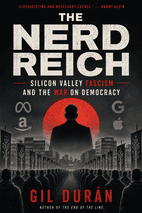
5 Main Takeaways from The Nerd Reich
Silicon Valley's sovereign-individual prophecy now runs the US government.
The Sovereign Individual supplied the founding prophecy that turned tech fortunes into a political project aimed at making the nation-state obsolete. Durán shows this ideology moved from Thiel's network into the operational core of the executive branch, with the vice presidency itself inside the fold.
The exit movement hides an authoritarian program behind libertarian freedom language.
Yarvin's supposedly voluntary corporate city-states leave residents with no vote and only the freedom to leave. The book reveals a frank call for a national CEO or dictator, making clear that exit rhetoric is a cover for concentrated power, not liberation.
Network-state plans have been enacted as official policy under innocuous labels.
By 2025, the movement's program was adopted through names like Freedom Cities, DOGE, and Stargate rather than open revolutionary language. Crypto cash had purchased the presidency and AI had taken over the state, bypassing voters through executive orders and federal legislation.
Thiel manufactured Vance as his power-law return on political capital.
Vance was relocated, funded, and supplied with the Hillbilly Elegy storyline that made him electable. Thiel's refusal to fund 2024 was not withdrawal but triumph: his investment had already cashed out in a vice-presidential nominee, making further spending redundant.
Saving democracy means breaking billionaire rule, not taxing or regulating it.
The book argues that democracy and billionaire rule are mutually exclusive, so reformism is insufficient. The path forward requires structural moves: breaking monopolies, banning crypto, treating network-state ideology as an extremist threat, and prosecuting elites the way Brazil and South Korea did.
Executive Analysis
Across these five takeaways runs one central argument: the post-democratic project born in The Sovereign Individual is no longer a fringe fantasy but the operating system of the current American right. Durán shows that the ideology was deliberately financed, networked, and disguised—Thiel turned PayPal and Palantir fortunes into political assets, Yarvin supplied the authoritarian blueprint, and Vance became the manufactured vehicle who carried it into the vice presidency. By 2025 crypto and AI insiders had captured the executive branch and implemented network-state policies under names like Freedom Cities, DOGE, and Stargate. The book's thesis is that this is an engineered coup, not a drift, and that its logic is accelerationist: collapse is the mechanism for installing a stateless elite.
The book matters because it reframes familiar tech-world controversies as components of a coherent extremist threat. It gives readers the intellectual genealogy and the private infrastructure—from seasteading and Clubhouse to Founders Fund's venture bets—needed to recognize authoritarianism in libertarian clothing. Unlike conventional tech criticism, it treats ideology as material: money, networked apps, and legal loopholes are the weapons. In the field of Silicon Valley political analysis, The Nerd Reich is closest to a counterintelligence report, warning that the language of innovation and exit is now a cover for ruling by scapegoat. Its practical impact is to move readers from moral alarm to structural diagnosis, showing why democracy requires dismantling oligarchic power.
Chapter-by-Chapter Key Takeaways
Introduction (Introduction)
Biden’s farewell warning about tech billionaires was not a rhetorical flourish but a response to a concrete ideological movement with a twenty-five-year pedigree.
The Sovereign Individual supplied the founding prophecy that transformed Silicon Valley fortunes into a political project aimed at rendering the nation-state obsolete.
The same intellectual lineage that produced Thiel’s network has now migrated from the fringe to the operational core of the executive branch, with the vice presidency itself inside the fold.
The movement’s strategy is deliberately accelerative: it treats collapse as the mechanism through which a stateless elite can seize the ruins and rebuild governance from scratch.
Try this: Trace every Silicon Valley political donation back to its ideological source code before dismissing it as eccentric.
The Sovereign Individual (Chapter 1)
The Sovereign Individual is the ideological source code for the alliance between Silicon Valley wealth and post-democratic politics, not a marginal oddity.
The book's pedigree runs from eugenics and Ayn Rand to cypherpunk cryptography, and its prophecy of a sovereign elite follows the five-part millenarian template Norman Cohn found in medieval sects.
Thiel's career converts the book's prescriptions into practice: PayPal as cybercash, Palantir as private intelligence, and seasteading as an attempt to make government a customer-service industry you can exit.
The seasteading project and Thiel's other escape routes share a single premise: democracy is not worth winning, only leaving.
The convergence of cyberlibertarianism with MAGA is not a misreading of Thiel's ideas but their political realization.
Try this: Study The Sovereign Individual to recognize the prophecy behind crypto, surveillance, and seasteading talking points.
The Acid Story (Chapter 2)
Yarvin's politics are the rationalized biography of an outsider: the grade-skipping prodigy, the relentless Usenet troll, and the founder who dropped acid as his start-up collapsed, prizing the experience for being maximally disturbing.
The Cathedral is an unfalsifiable conspiracy by design: since every denial from universities, think tanks, or the press is taken as further proof of its hold, no evidence could ever count against it.
Beneath the rhetoric of exit and voluntary association sits an authoritarian program: corporate city-states whose residents have no vote and only the freedom to leave, wholesale dismissal of federal employees, and a national CEO who is frankly called a dictator.
Neo-reaction's arsenal was secondhand: Carlyle's monarchism, Pareto's elite theory, Schmitt's jurisprudence, and Burnham's managerial thesis reappeared, repackaged for a blog-reading tech audience.
The movement's ascent ran on capital and patronage, not argument: the author reports that Founders Fund and Andreessen Horowitz led a $1.1 million round in Yarvin's company, and once his pro-slavery and dictatorial writings went public, the strategy was to decouple the ideology from its author's face.
Try this: Demand observable evidence whenever an insider dismisses institutions as the Cathedral; unfalsifiable conspiracy theories are authoritarian weapons.
Exit (Chapter 3)
Srinivasan's exit pitch was a rehash of Yarvin's patchwork, with seasteading and Mars as test runs for corporate-run governments.
The a16z venture machine profits from law-defying startups, so its celebration of exit conveniently legitimizes the industry's own rule-breaking.
Bitcoin functions like a Ponzi scheme, rewarding wasted computation to manufacture belief-backed scarcity, and the Mt. Gox collapse exposed its fragility.
The attempt to install Srinivasan as FDA commissioner reveals that the exit movement's leaders actually sought to seize federal power.
Srinivasan's prescient COVID warning was repurposed to argue that the pandemic proved governments must be dismantled.
Try this: Ask whether any tech exit proposal expands your actual freedom or just hands power to unaccountable corporate cities.
The New Reality (Chapter 4)
The pandemic provocations of Musk and Andreessen were not disruptions of the Silicon Valley mainstream but its turning point, the moment a new right-wing class identity replaced the old liberal self-image.
The movement's real infrastructure was private: Clubhouse and the encrypted spin-off chats hardened a dispersed elite into a coordinated faction with enemies it targeted, from district attorneys to the press.
The techno-optimist creed is best read as a political religion: its veneration of Marinetti, Rand's John Galt, and the e/acc founders exposes the right-wing market faith beneath the talk of abundance, with TESCREAL as its eschatology.
The network-state project is a literal bid for territorial power, not a metaphor: the San Francisco plan to absorb the police, purge the Blue tribe, and rebrand the city's geography is the same technique applied to Twitter, scaled up.
The Gray-Red alliance became operational during the 2024 campaign, when Heritage's federal purge plan and the Trump-Vance ticket put the network-state blueprint within reach of the executive branch.
Try this: Monitor private chat platforms and venture-backed lobbying as part of political infrastructure, not just social media.
The Unicorn (Chapter 5)
Treat Vance as a manufactured asset rather than an organic politician: Thiel relocated him, funded him, and supplied the story that made his ascent legible to voters before steering him into office.
Read the power law as the unifying logic of the chapter: a firm tolerates failures like AppHarvest and Blake Masters because one spectacular hit is meant to repay all losses, and Vance was that hit, cashed out in political rather than financial return.
Understand Hillbilly Elegy as the credential that converted Thiel's capital into cultural authority, giving a middling venture career the storyline that carried a Senate bid and then the vice presidency.
Recognize Thiel's refusal to fund 2024 as an outcome of triumph, not withdrawal: his money had already found its return in the vice-presidential nominee, making further spending redundant.
Try this: Analyze political stars as manufactured ventures by tracing their funders, biographies, and expected returns.
Apokálypsis (Chapter 6)
The apocalypse Thiel announced in 2025 was real, but its subject was his own camp: crypto cash had purchased the presidency, the AI industry had taken over the state, and the network-state program had been adopted as official policy under the "Freedom Cities" label.
Crypto's takeover was the mature stage of a decade-long venture pipeline, from early bitcoin stakes and the Ethereum fellowship to the PAC machine, so the 2025 payoff was the culmination of an engineering project, not an improvisation.
The network-state movement treats defeats as experiments: each failed prototype, from Préspera to California Forever, sheds its weakest legal form while the campaign shifts toward federal legislation and executive orders that bypass voters entirely.
The public unveilings delivered were financial records, while the actual program traveled under innocuous labels like Stargate, DOGE, and Freedom Cities, which the press reported as ordinary politics; the absence of naming was itself a condition of success.
AI, not crypto, became the engine of the program, and its rise reproduced the very concentration of power its founding rhetoric claimed to break, with a tiny elite capturing the gains while the costs fell on billions.
Try this: Read policy names like Freedom Cities, DOGE, and Stargate as ideological programs, not neutral administrative labels.
Antichrist (Chapter 7)
Thiel's Antichrist is a self-portrait: the velocity and deception that win totalitarian power by marketing "peace and safety" as the remedy for the very crises he invokes are the accelerationist method, and his eighteen-second pause on whether humanity should survive gives the confession away.
The heresy verdicts from Innsbruck and Rome were warranted: Thiel's borrowed theology inverts its sources, turning the scapegoating diagnosis he took from Girard and Palaver into an operating manual, and "American Heresy" correctly identifies a machine that governs the planet by designating scapegoats.
Boyle's playbook pieces the coalition together by casting democratic government as the enemy of the family, tech as the champion of decentralized authority, and the "authoritarian state" as the shared target, a moral war for which the Seven Mountain Mandate has prepared the ground: Denison's 2024 poll puts belief in it at 41 percent of American Christians.
The Authoritarian Stack is operational: Y Combinator incubates a cruise missile startup, a June 2025 UN report found reasonable grounds that Palantir's platform enabled genocide in Gaza, and the lone Norwegian divestment shows how untouchable this infrastructure has become.
Once the theology is stripped away, Thiel and Dugin preach the same gospel: America is the Antichrist, multipolarity is the instrument for killing it in its crib, and the wager on collapse, apocalypse capitalism, escalates disaster capitalism by treating the wreck of the liberal order as the payoff.
Try this: Identify the scapegoats in any peace and safety political marketing; scapegoating theology operates as an authoritarian manual.
The Future (Chapter 8)
Democracy and billionaire rule are mutually exclusive; the only way to preserve one is to dismantle the other, and taxing wealth will not get there.
Authoritarian backsliding is not inevitable: Brazil and South Korea show that prosecution and commemoration work, and the US's refusal to do either is itself a political choice.
The tech oligarchy's control of media and state machinery means that resisting it requires structural moves, not just regulation: break up monopolies, ban crypto, and treat network-state ideology as an extremist threat.
Capitalist growth has become openly suicidal, so a livable future depends on reimagining property and prosperity, with the idea of universal extreme wealth as a radical tool to be seized from its own proponents.
Try this: Pressure representatives to pursue structural moves such as breaking monopolies, banning crypto, and prosecuting elites rather than symbolic reform.