The Mirror of Infinite Endings Quotes
by Stephanie Garber
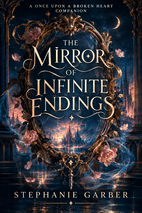
If you came looking for lines that linger after the last page, this collection from Stephanie Garber's The Mirror of Infinite Endings has plenty. You'll find banter between characters, aching inner thoughts, and narration that turns ordinary moments into something enchanted. Some lines are playful and sharp, while others sit with love, longing, and the fear of losing what matters most.
What makes this book so quotable is how it blends romantic fantasy with very human feelings. The dialogue can be teasing one minute and devastating the next, and the inner monologue often says the quiet part out loud. Whether you are here for magical bargains, complicated devotion, or a sentence that feels like a sigh, these quotes are easy to return to.
Top Quotes from The Mirror of Infinite Endings
“Some loves, once found, are never lost. It’s an incredible gift to possess a love like this. A feeling so deep and unwavering that no amount of time, no act of nature or man can destroy it. The love remains, even when the person is gone. Which makes this gift so beautiful and so treacherous.”
Narrating the endurance of Evangeline's love for Jacks, the chapter contrasts its permanence with the fragility of people.
It captures both the gift and danger of a love that cannot be lost even when a person can be.
“For so long, Evangeline had used her mother's stories to guide her. Those fairytales had always ended with promises of happily ever after. But they never actually showed the ever afters. And her gentle mother had never told her what to do after falling in love.”
Evangeline reflects on fairy tales and her parents while preparing the inn for its reopening.
It names the gap between the promise of an ending and the work of living afterward. Readers feel her grief and uncertainty in a single, universal observation.
“But I've started to wonder: If some loves truly are meant to be, then perhaps there are some loves that are also doomed to never be. Maybe all the impassible obstacles are there for a reason. Maybe they aren’t meant to be overcome. Maybe love is not supposed to be something we fight for.”
— LaLa
LaLa walks through Merrywood Village with Evangeline, grieving over love and wondering whether some loves are doomed.
It articulates the painful possibility that not every love is meant to be fought for, making LaLa's heartbreak feel both personal and universal.
“Real love is always worth fighting for.”
— Evangeline
Evangeline responds sharply after LaLa suggests love may not be something to fight for.
It is a clear, defiant counterpoint to LaLa's despair and captures Evangeline's hard-won faith in love.
“When it's real, the only thing that feels impossible is giving up.”
— Evangeline
Evangeline explains to LaLa how to recognize real love.
It reframes love's difficulty as a reason to persevere rather than surrender, and it echoes Evangeline's own devotion to Jacks.
“Evangeline was many things, but one could not call her practical or sensible. She was kindling in love with a spark. A moth to a flame. A mortal drawn to immortal things.”
As Evangeline feels pulled toward the mirror despite her misgivings, the narrator explains her attraction to risk.
The metaphors are vivid and memorable, capturing a love and curiosity that are impossible to resist.
“The sudden loss was like forgetting how to breathe and then remembering again, only to feel as if the air was too thin, insubstantial, the oxygen sucked out of it.”
When Jacks suddenly senses Evangeline’s absence through the mark on her wrist, the loss hits him physically.
The simile captures grief as a bodily function interrupted and barely restored, lending Jacks’s panic a visceral clarity.
Themes Behind the Quotes
These pages keep circling love as both a gift and a risk. It can feel fated and permanent, yet also tangled with fear, sacrifice, and the knowledge that time does not treat everyone equally. Mortal and immortal lives brush against each other, making devotion feel urgent and bittersweet. The quotes also explore what happens after the fairy tale promise, when characters must decide what they are willing to fight for and what they may have to let go.
Another thread is the pull between magic and humanity. Fairy bargains, curses, and enchanted places create wonder, but they also expose raw emotions like jealousy, longing, and grief. Characters wrestle with whether love should be protected at any cost or whether some obstacles are warnings. Underneath the sparkle, there is a quiet ache about memory, change, and the pieces of ourselves we hide while pretending to be fine.
Quotes by Chapter
1. Evangeline
“The Hollow was the place where Evangeline had stopped falling and was just in it: in love with him. No more falling. Her feelings were here to stay.”
Evangeline reflects on the tavern as the place where her feelings for Jacks settled into lasting love.
It reframes love not as endless falling but as a steady, chosen place to remain.
“Jacks was a Fate. She didn’t have to worry about him dying. He would never grow old. She would. But Evangeline did a good job of not thinking about that.”
Evangeline avoids dwelling on the fact that Jacks, as a Fate, will never age while she will.
It quietly names the bittersweet cost of their happy ending without breaking the moment.
“It was just a bunch of words. Not anything that mattered.”
— Jacks
After Evangeline accidentally sets the letter Jacks was reading on fire, he dismisses its contents.
The casual reply sounds like reassurance, but it also hints that Jacks is hiding something.
2. Evangeline
“There could be no poisonings, no evil princes or bloodthirsty vampires, no curses or stolen memories, no Wanted posters with her or Jacks's pictures. There was no room for those things in a happily ever after.”
— Evangeline
Evangeline imagines the perfect grand reopening and the peaceful future she wants with Jacks.
It captures the longing to leave trauma behind and the belief that a real happily ever after has no room for old dangers. The list of horrors makes the wish feel both fragile and defiant.
“Maybe that was the part that was missing. Maybe Evangeline just wanted one more piece of advice from her mother or her father, telling her what she was supposed to do now.”
— Evangeline
After worrying over pies and details, Evangeline realizes what she really misses is guidance from her parents.
It turns a small domestic worry into a tender admission of grief. The line is memorable for how plainly it asks for help after the story is supposed to be over.
“Gooseflesh covered her arms as she stood there, holding a fistful of brilliant, bright red berries, so fresh their deep red juice dripped down her hands onto the wooden tavern floor.”
After a sudden whirlwind tears through the tavern, Evangeline is left alone holding mysterious red berries.
The vivid sensory image turns the cozy inn abruptly eerie. It is a striking cliffhanger that suggests the story is not finished with Evangeline yet.
3. Evangeline
“The berries didn’t leave any stains, just a few lingering questions.”
After Evangeline tosses away the mysterious berries and washes her hands, no stain remains.
It turns a small oddity into a haunting image of unanswered danger.
“She did not think she was going to be taken down by a fistful of berries.”
— Evangeline
After Jacks sharply warns her to throw out the too-ripe berries, Evangeline reflects on how much she has survived.
It captures Evangeline's hard-won resilience and dry defiance in the face of Jacks's overprotectiveness.
“Fairy bargains are notoriously dangerous and misleading. You must always be careful with what you say to a fae. They have a way of turning words into magic, and they are easily offended.”
Evangeline reads a magically altered book whose page warns about fairies and their bargains.
The warning feels like a rulebook for the story's magic, making words themselves dangerous.
“Except Jacks didn't look not-worried. The line of his jaw remained tight, clenched, as if he were biting back words that were perhaps at odds with what he’d just said.”
After Jacks tells Evangeline not to worry about the fairy book, his tightened jaw contradicts his reassurance.
It exposes the gap between Jacks's comforting words and the fear he is trying to hide.
4. Evangeline
“LaLa was another Fate, the Unwed Bride. People always thought of the Unwed Bride as a tragic figure, but LaLa was more of an exclamation point at the end of a sentence. She was all sequined skirts and daring smiles and reckless choices. And Evangeline adored her.”
The chapter introduces LaLa, the Unwed Bride, as Evangeline's dazzling Fate friend.
It reframes a tragic archetype into a force of reckless joy and makes LaLa instantly iconic.
“We have both made mistakes, Jacks. And only one of her curses was my fault. You really need to get past it. I think all of this worry is giving you some wrinkles.”
— LaLa
LaLa brushes off Jacks's distrust as she prepares to take Evangeline shopping.
It captures her irreverent wit and the complicated history between the three characters.
“I've seen you two together. You're like two sexy little magnets.”
— LaLa
As they leave the Hollow, LaLa teases Evangeline about her relationship with Jacks.
It is a playful, vivid line that sums up Evangeline and Jacks's irresistible pull toward each other.
“I say we keep this one a secret. Jacks only thinks he needs to know everything.”
— LaLa
After finding a map on the mysterious postcard, Evangeline asks whether they should tell Jacks.
It reveals LaLa's reckless secrecy and the growing tension around what Jacks does not know.
5. Evangeline
“Love could be devastating. And LaLa looked devastated.”
Evangeline watches LaLa's tear-filled face and remembers how love can hurt.
The repetition of 'devastated' makes an abstract truth suddenly visible in LaLa's expression.
6. Evangeline
“This wasn't the whimsical magic of the Hollow. But it felt like magic nonetheless—old magic, the magic of fairytales before they were cursed and forests before they were tamed.”
Evangeline and LaLa walk the glowing path toward the Emporium of Else.
It contrasts refined Hollow magic with wild fairytale magic and sets the Emporium's eerie beauty.
“He made her think of Jacks before he was her Jacks.”
Evangeline studies the sharp-faced young man at the Emporium’s entrance who may be a fairy.
It captures both Evangeline's affection for Jacks and the shadow of who he used to be.
“As much as Evangeline liked fairytale magic, there was an intoxicating quality to this magic that made her feel as if it would not be wise to drink in too much of it.”
Evangeline pauses in a room full of tempting ribbons and considers leaving the Emporium.
It warns that the Emporium's allure is dangerous even as it enchants.
“There was nothing in the room save for the fog and a mirror, which the fog was pouring out of. Clearly, this was fairy magic.”
Evangeline follows a furry dragon into a fog-filled room and finds a mirror.
It closes the chapter on an ominous image of fairy magic pouring out of a mirror.
7. Evangeline
“She and Jacks had never spoken about getting married. Just as they never talked about how Evangeline would grow older and Jacks would not.”
While Evangeline watches the mirror show her in a wedding dress, she reflects on what she and Jacks have never discussed.
It captures the tender, unspoken grief beneath their love: Evangeline will age while Jacks will not.
“It felt as if maybe this pang was always there, and she was just very good at pretending it was not.”
Looking at her mirrored self in the wedding dress, Evangeline senses an ache she has long tried to ignore.
The line names a quiet, persistent sorrow that can hide beneath everyday happiness.
“It was a dress that looked like fairytale love, and it made her think of a simple garden wedding where people tossed flower petals and ate sweet cake while the couple only had eyes for each other.”
The mirror shows Evangeline wearing an alternate wedding dress that embodies the romance she longs for.
Its lush, simple imagery contrasts with her disastrous first wedding and makes the alternate future feel painfully desirable.
8. Jacks
“Most people knew that vampires lusted for blood, but few knew that they longed for their former humanity with nearly the same intensity.”
As Jacks reflects on Chaos’s vampire nature, the narration explains what vampires truly long for.
It reframes vampires as grieving their lost humanity, making their curse both bloody and heartbreaking.