The Marked Son Themes
by Simon Gervais
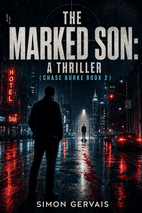
Underneath its action plot, The Marked Son is really about who gets to watch whom and who gets to decide what stays hidden. It keeps returning to surveillance tech, manipulated trust, political backroom control, and the costly secrets people keep for duty, loyalty, or family. Violence is never just violence here; it is professional, justified, and personal all at once.
This page breaks down those themes using concrete threads like Tanya's career, Chase's search for Michael, and Johnstone's handler, then traces the recurring symbols that carry them: Canary and Wallflower devices, the Misericordia knife, the Architect's phone, and Johnstone's storage card and private vault.
Major Themes in The Marked Son
Surveillance, Covert Technology, and Countersurveillance
The book repeatedly shows both sides using hidden technology to watch, track, and identify targets. Surveillance is not just a tactic but a source of vulnerability, as characters are watched while they themselves watch others.
- Michael plants Wallflower listening devices disguised as outlet devices and a Canary disguised as a pen while Chase watches multiple camera feeds from the Escalade.
- Chase spots a lurker near Balthazar, tails him, finds photos of Tanya on the man's phone, deletes them, crushes the phone, and photographs the man's face.
- Chase and Michael pose as Chamber of Commerce representatives and plant a Canary pen that clones Dr. Naimi's phone.
- Wetherby watches the rooftop through a drone while Chase spies on the terrorists from behind parked cars.
Trust, Deception, and Manipulation
Personal and political relationships are repeatedly undermined by hidden agendas, fronts, and manipulated loyalty. Characters must decide whom to trust while discovering that friends, contacts, and institutions are not what they appear.
- Tanya believes Esme is a close friend until Esme admits their meeting was not an accident and that she sought Tanya out.
- Reza says Hemsworth believes she is in control and that her ideas are her own, but she does not know she is being manipulated.
- Chase identifies the Institute for Peace and Cultural Dialogue as a front for the Iranian Ministry of Intelligence.
- Marina shoots Alice Doyle through the windshield, takes the folder, asks who else knows about it, and leaves.
Political Manipulation and Hidden Control
The novel portrays politics as a arena where foreign intelligence, covert programs, and financial power quietly shape outcomes. Tanya's career, the attack, and even market reactions are treated as pieces in larger designs.
- Khatib and Reza discuss the asset's approval ratings and committee assignments, with Khatib focused on placing her on the Foreign Affairs Committee.
- Esme reveals that Project XIII was meant to elevate Tanya politically and that her father ordered the Chrysalis shooting only to wound Tanya, not kill her.
- Johnstone explains he was ordered to help the terrorists succeed and then kill them to provoke a war with Iran and profit from it.
- Connor Williams warns that the emergency blockchain legislation gives a few institutions control over the monetary system and says FATHOM may have engineered the crisis.
Secrecy versus Duty and Loyalty
Characters repeatedly withhold information to protect loved ones, careers, or operations, but those secrets create dangerous costs. The tension between personal promises and professional responsibility drives many of the central conflicts.
- Chase withholds Tanya's role in the Younesi meeting until Doyle and Michael confront him, saying he gave Tanya his word.
- Michael lies to Alice about estate business to meet Chase.
- Tanya refuses to let Chase loop in Michael or Alice until they know what Esme wants to discuss.
- Connor Williams gives Chase seventy-two hours to bring actionable evidence without exposing Tanya, warning that a political scandal could collapse bipartisan cooperation.
Family, Personal Loyalty, and Protection
The story repeatedly ties larger political violence back to intimate relationships and the impulse to protect family. Chase's search for Michael, Doyle's care for Ava, and Johnstone's fear for Ashley and his unborn child give the thriller its emotional stakes.
- Chase sees Michael Burke bound to a chair inside the garage and rescues him.
- The Architect threatens Ashley and the baby to keep Johnstone compliant.
- Doyle goes alone to tell Ashley Loome about Johnstone's death and comforts Ashley through her grief and contractions.
- Michael, bloodied and unsteady, tells Chase he is fine and urges him to go after Esme because she has the wallets.
Professional Violence and Moral Justification
Violence in the book is often carried out by professionals who justify it through orders, loyalty, or a claimed larger order. The novel links brutal acts to signature methods and to characters telling themselves they are preventing worse outcomes.
- Johnstone kills the two women and Tony after receiving the order to eliminate all witnesses, while telling himself he is on the side of order and trusting the Architect.
- Chase identifies the attacker's ring-pommel knife as a Misericordia and links it to Younesi's murder.
- Doyle kills both shooters in a brutal close-range fight at the storage unit.
- Johnstone kills a civilian after the man shoots Wetherby, choosing his partner's life over a stranger's.
Symbols and Motifs
Canary and Wallflower devices
Ordinary-looking objects that conceal surveillance and technical intrusion, representing the hidden observation and information-gathering that shapes the plot.
- Michael plants Wallflowers disguised as outlet devices and a Canary disguised as a pen.
- Chase and Michael plant a Canary pen that clones Dr. Naimi's phone.
- Alice explains the Canary has not locked on because the men must wake their phones.
The Misericordia knife
A distinctive professional killer's weapon that marks acts of trained violence and links separate killings to the same hidden world of assassins.
- Chase identifies the attacker's ring-pommel knife as a Misericordia, a knife for a professional killer.
- Johnstone plans to use an Extrema Ratio Misericordia knife and later kills the knocked-out man with it.
- Johnstone's knife collection has one conspicuous empty slot matching the knife found near his body.
The Architect's phone
A device of hidden control and untraceable authority, tethering Johnstone to a handler who may be software, a committee, or no single person.
- Johnstone's work phone is described as his 'ball and chain' tethering him to the Architect.
- The Architect orders Johnstone to dial 49234 and move away.
- Johnstone realizes the Architect's voice may be AI software or a committee rather than one person.
- Chase tackles Johnstone when he tries to dial 4923 on the gray phone.
Johnstone's storage card and private vault
A hidden insurance policy and repository of evidence, representing the secrets and leverage characters bury away for survival.
- Ashley recalls Johnstone's instruction and says there is a card on the refrigerator; Chase finds a Metropolitan Secure Storage card with a unit number and access code.
- Michael finds the client key on a pegboard, and he and Chase leave for the private vault.
- Michael calls the storage card and client key Johnstone's 'insurance policy.'
- They open a private Midtown storage vault and recover a box containing cash, documents, and a Pelican case with six hardware crypto wallets.