The Marked Son Book Club Questions
by Simon Gervais
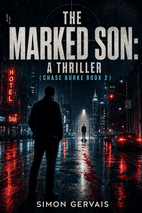
These questions assume everyone has finished the book and contain spoilers, including the ending.
This novel works well for book club because it pairs fast-paced thriller plotting with messy ethical choices. Reza's loyalty, Tanya's compromises, Chase's secrecy, Doyle's instincts, Michael's captivity, and Johnstone's contradictions all invite disagreement rather than easy consensus.
Use these questions as a menu, not a checklist. Pick the clusters that interest your group, ask everyone to point to specific scenes, and let the conversation move between character motives and the bigger questions about surveillance, loyalty, and political pressure. The questions work best when people defend competing readings.
Power, Loyalty, and Project XIII
- 1.Reza kills Khatib and Davani after Khatib demands that Tanya Hemsworth introduce legislation condemning Israel and cutting US military aid. Did Reza act to protect Project XIII, or was he overstepping by eliminating his minister? How did that choice shape Esme's later claim that her father's assassination activated a fail-safe operation?
- 2.Johnstone feels guilt after the RBS 70 missile deal because he thinks of Ashley and their coming child, yet he later kills the two women and Tony at the motel on orders. What does that contradiction reveal about his self-justification and his loyalty to the Architect? Did you sympathize with him at any point?
- 3.Esme seizes the Pelican case of crypto wallets, shoots Javeed Ghorbani, and argues that unlocking the wallets would only prove Tehran funded the attack. Was her damage-control rationale credible, and did her later death at Reza's hands make her more sympathetic or deepen the sense that she was manipulating Tanya and Chase?
- 4.Connor Williams warns Chase and Michael that the market crash was an engineered unwind tied to the attack and that emergency blockchain legislation may give a few institutions control over the monetary system, saying they are living in FATHOM's world. How does that warning, combined with Tanya's rising political status and Chase's steak-dinner text, shape your view of the book's ending?
Trust, Secrecy, and Relationships
- 5.Tanya refuses Esme's recruitment in Antalya, throws away the card, but memorizes the phone number and later takes Esme's Signal call. Did you agree with Tanya's choice to contact Esme again in New York, or did that decision make her too compromised to credibly warn Chase about the sleeper cell?
- 6.Chase withholds Tanya's role in the Younesi meeting from Doyle and Michael, and Connor Williams gives him seventy-two hours to produce actionable evidence without exposing Tanya. Was Chase right to protect Tanya, or did his secrecy dangerously delay the investigation?
- 7.Doyle worries that letting Michael into her and Ava's life could mean another heartbreak, while Michael lies to Alice to meet Chase about the sleeper cell. How well does the novel balance Doyle's fear of vulnerability with Michael's professional secrecy, and did their relationship feel earned by the end?
- 8.Alice Doyle finds a shocking metadata detail in Johnstone's recovered phone data and leaves Chase a message saying they have had it wrong before Marina shoots her through the windshield. How did that ending recontextualize FATHOM, and what did Marina's role suggest about the people closest to Tanya?
The Investigation and Surveillance
- 9.Tommy Russo's call about the Newark motel quadruple homicide and the longshoremen's container irregularities leads Doyle to question the obvious gang-shooting narrative. How convincing was that investigative thread, and did Doyle's instincts justify her decision to look into the case discreetly?
- 10.Chase roughs up Mahmoud Younesi and smashes his phone before Younesi is murdered, and Doyle later criticizes him for destroying evidence. Did Chase's reactive mistake cost the team its best lead, or was he already right that the threat was moving faster than procedure could handle?
- 11.Chase and Michael pose as Chamber of Commerce representatives, plant Canary devices, and narrow the Queens dentist list to Dr. Naimi and Javeed Ghorbani, but the Canary only locks on once the men wake their phones. How effectively did the novel use surveillance technology to drive the plot, and did the ethics of planting devices bother you?
- 12.Doyle enters storage unit 317, finds a missile-launcher manual, and kills two shooters in a close-range firefight. How did that scene change her role in the story, and was the sergeant's decision to release her with her weapons after the explosions believable?
Captivity, Violence, and the Final Confrontation
- 13.Michael is tased, bound, hooded, and interrogated by Johnstone with the Misericordia knife, yet he tells his captor that he is a federal agent and not working alone. How did that captivity sequence change your view of Michael, and did you believe he would survive long enough for Chase and Doyle to find him?
- 14.During the rooftop missile attack, Johnstone's missed shot spooks the Iranians, Chase tackles Ghorbani to break the laser lock, and Wetherby is killed after shooting police and a civilian. Which choice in that sequence was the real turning point, and did Johnstone's decision to cover Wetherby make him more or less sympathetic?
- 15.At the rental house, Johnstone refuses to surrender, asks to call Ashley, dials 4923, and takes Chase's pistol without putting his finger on the trigger before Doyle shoots him. Do you agree with Chase's belief that Johnstone chose suicide by cop to protect Ashley and the baby, and did Doyle have a realistic alternative?