The MAGA Doctrine Quotes
by Charlie Kirk
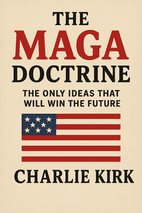
This collection pulls together some of the most memorable lines from Charlie Kirk's book. You will find statements that challenge political assumptions, question foreign policy, and defend a particular vision of America. The book is full of sharp, direct language that aims to stir debate and get people thinking.
What makes these quotes so shareable is their confidence and clarity. Kirk writes with a voice that doesn't hedge or apologize. Whether you agree or disagree, each line lands with force. That's why they stick with you long after you put the book down.
Top Quotes from The MAGA Doctrine
“All individuals are created equal—but not all cultures and ideas are equal, and we need to be able to compare and contrast intelligently.”
The author defends free speech against leftist calls for enforced equality.
It articulates a core conservative principle that merit and truth should be judged openly, rejecting the notion that all cultural expressions are morally equivalent.
“He’s not a barbarian at the gates, to be fended off by the New York Times or the Ivy League. Trump is a man already comfortably at home in America, at home with its people and its institutions.”
The author defends Trump against media portrayals as a dangerous outsider.
It reframes Trump not as an anti-establishment wrecking ball but as someone deeply rooted in American culture, which resonates with supporters who see him as authentic.
“The US government can barely run our own country, so it should be very cautious about trying to run others.”
The chapter opens by stating the MAGA Doctrine's principle of humility in foreign intervention.
This line crystallizes the core argument of the chapter in a simple, relatable way, contrasting domestic incompetence with overseas hubris.
“We now live in a world where our alliances are more likely to push us into war than to keep us out of one.”
The author explains the MAGA Doctrine's critique of NATO and other alliances.
It challenges the long-held assumption that alliances guarantee peace, making readers question the value of automatic commitments. The line is direct and provocative, cutting through diplomatic clichés.
“If I start getting higher poll numbers in Europe, I'm doing something wrong.”
Trump said in his TPUSA speech, explaining his low popularity in Europe.
It perfectly encapsulates his nationalist, America-first attitude and his rejection of seeking approval from foreign elites.
“America has made mistakes, but America is not a mistake.”
This line appears in the chapter as the author summarizes the balance between acknowledging flaws and maintaining national pride.
It encapsulates the central thesis of the chapter in a single, memorable phrase, rejecting both blind patriotism and nihilistic criticism.
“There’s never been a better time to be a black American than during the Trump administration.”
The author makes this claim after citing record low black unemployment and other economic gains under President Trump.
This bold, counterintuitive statement challenges mainstream liberal narratives and forces readers to reconsider the impact of conservative policies on minority communities.
Themes Behind the Quotes
One major theme is a deep skepticism toward political elites and established institutions. The quotes consistently portray the establishment as out of touch, self serving, and unwilling to speak hard truths. Another theme is a strong embrace of national sovereignty and practical self interest in foreign policy. The idea is that alliances and interventions should be judged by whether they actually benefit the country, not by abstract ideals.
Economic nationalism and cultural confidence also run through these lines. There is a focus on bringing back industry, energy independence, and defending traditional values against a perceived left wing attack. At the same time, the tone is often optimistic about America's potential, insisting the country is not a mistake but a force for good that just needs the right leadership.
Quotes by Chapter
Chapter 1: The Great Disruptor
“Trump was the first real disruption to that decrepitude in a long, long time.”
The author describes the two-party cartel's stagnation and Trump's role as a breaker.
It succinctly captures Trump's central achievement as a political outsider who shattered a stale establishment that had grown comfortable with gridlock.
“The tragedy of the left is that while they may envision, or claim to envision, an America of happy equals, they also want endless conflict—anger instead of gratitude.”
The author criticizes the left's vision of equality as contradictory and divisive.
It highlights the paradox of leftist politics, which preaches unity while fostering resentment, making it a memorable indictment of progressive hypocrisy.
“Trump was saying the forbidden things that the two-party cartel had for so long rendered, by mutual agreement, unspeakable.”
The author explains why Trump resonated with voters tired of political correctness.
It captures how Trump broke the tacit censorship of the political elite, giving voice to concerns that had been suppressed for decades.
Chapter 2: The Outsider from the Inside
“The scariest thing about him to the elite is that he has been inside with them, and he’s exposing their secrets to the outside.”
The author describes why Trump's insider knowledge threatens the establishment.
This line succinctly captures the core tension between Trump and the elite, framing his outsider-insider position as a unique threat.
“If the establishment senses in our times something akin to ancient Rome, I suggest they look to a figure very different from Nero for Trump comparisons. They should look a century earlier, to the influential orator Cicero.”
The author draws a historical parallel between Trump and Cicero, who was declared an enemy of the state for warning of Rome's decline.
This analogy elevates Trump's struggle to a centuries-old battle between popular freedom and aristocratic privilege, giving it historical weight and moral urgency.
“When the noise of the current generation of pundits and analysts has long since faded away and historians assess the Trump presidency, I think they will see the broad strokes that his critics wish to deny. They will see the love of country, the defense of freedom, and the irreverence toward the false pieties of our day (and the elites who peddle them).”
The author offers a vision of how future historians will view Trump's legacy.
This passage is powerfully optimistic and defiant, appealing to readers who believe current criticism will be forgotten while Trump's core values endure.
Chapter 3: No More Accepting Decline
“If Making America Great Again means asking whether government spending is benefiting our nation, even the military defense of that nation must be open to critical scrutiny.”
The author reflects on the need to question even defense spending under the MAGA Doctrine.
It challenges the sacred cow of military spending, asserting that no part of government is exempt from accountability.
“The MAGA Doctrine is not a threat to other nations but an invitation to deal with each other out of practical self-interest instead of ultimatums, displays of might, reckless adventures, and big crusades against small-bore enemies such as Afghan villagers or Latin American coca farmers.”
The author defines the foreign policy vision of the MAGA Doctrine.
It reframes the movement as pragmatic rather than aggressive, contrasting grand strategies with grounded realism.
“The days when fragile American pride required that we fight every imaginable enemy to the end of days are, I think, fading into history along with duels and empires.”
The author discusses the shift away from endless wars.
This line captures a hopeful sense of national maturity and the end of costly, pride-driven conflicts.
“Trump makes no such assumption. He is a skeptic, and his skepticism is directed at the powerful, not at those who suffer beneath the edicts of the powerful. He’s on our side.”
The author contrasts Trump's regulatory skepticism with the left's trust in bureaucracy.
It positions Trump as a populist champion questioning elite authority, resonating with distrust of institutions.
Chapter 4: America First
“To add insult to injury, as the Financial Times reported in November 2016, the hotel and an adjacent apartment building both ended up not only abandoned but constantly guarded by US security, since the abandoned shells’ proximity to the US embassy would make them perfect staging areas for terrorist attacks on the embassy.”
The author describes the final ironic outcome of the Kabul Grand Hotel project.
It vividly illustrates the absurd waste and counterproductive consequences of nation-building, turning a supposed showcase into a security liability.
“It is a mature recognition that we—or at least government—cannot get things done just by wishing it were so.”
After detailing the Kabul Grand failure, the author reflects on the lesson it teaches.
This line distills the anti-utopian, pragmatic worldview that underpins the America First doctrine, rejecting wishful thinking in policy.
“The answer, as with domestic government boondoggles, is not to pour more money in and “this time get it right.” The answer is to stay out of these quagmires in the first place.”
The author directly addresses the proposed solution to such foreign spending failures.
It offers a clear, decisive policy prescription that resonates with frustration over endless, failed interventions.
Chapter 5: Ending the Endless Wars
“Better a statesman who finds a way out of war than one who too eagerly relishes looking statesmanlike in war.”
The author contrasts President Trump's approach with that of previous establishment politicians.
This aphorism reframes leadership as the pursuit of peace over vanity, a memorable moral judgment. It resonates with readers tired of leaders who posture rather than solve conflicts.
“There is nothing unpatriotic about staying out of fights that do our nation no good, or ones that have no clear moral purpose.”
The author argues against unnecessary military interventions, invoking just-war theory.
It reclaims patriotism for those who oppose endless wars, striking a chord with readers who feel their love of country is questioned. The line is simple, principled, and rhetorically powerful.
“The United States, like all NATO members, would be committed to getting involved militarily against Russia over Montenegro in the event of such a clash—over a nation that most Americans likely can't find on a map.”
The author criticizes NATO expansion to small nations like Montenegro.
It highlights the absurdity of automatic war obligations for obscure places, appealing to common sense. The vivid image of Americans unable to locate Montenegro underscores the disconnect between treaty promises and national interest.
Chapter 6: Making the Economy Work Again
“Socialism cannot survive when people are free to think for themselves, and America will never be a socialist country.”
Trump told the TPUSA crowd in his July 2019 speech.
This line distills the core ideological opposition to socialism and appeals to American exceptionalism and individual liberty.
“Sixty thousand factories “didn't cease to exist. They moved to places that are easier to operate.””
Trump said in his TPUSA speech, explaining the cause of factory closures.
It succinctly argues that overregulation, not trade itself, drove manufacturing away, framing the problem as solvable by domestic reform.
“It’s not about Trump bossing people around like a tyrant—it’s about him demolishing obstacles so that the rest of us are free to rebuild. And even to skate.”
The concluding lines of the chapter summarizing the MAGA Doctrine.
This powerfully contrasts accusations of authoritarianism with a vision of enabling individual freedom, using the memorable Wollman rink anecdote.
Chapter 7: No More Low-Energy Nation
“The MAGA Doctrine means defending our soldiers and the average Joe filling up his gas tank instead of putting them in harm's way, no matter what the big oil companies, radical environmental groups, or Middle Eastern despots want.”
Author Charlie Kirk articulates the core principle of the MAGA Doctrine regarding energy and foreign policy.
This line crystallizes the populist, America-first vision by juxtaposing the interests of everyday Americans and soldiers against powerful elites and foreign adversaries.
“When Trump says we are living in a “golden age of American energy dominance,” he's not announcing a triumphalist oil-wars regime like that in the mad dreams of some of the neoconservatives. He's announcing the foundation for a new century of peace.”
Kirk interprets President Trump's boast about energy dominance as a call for peace through self-sufficiency.
It reframes a common political slogan as a peace-oriented strategy, challenging both hawkish neoconservatives and critics who see energy dominance as militaristic.
“The philosophy of America First means that we no longer have to look outside our shores to fuel our ambitions or make strategic decisions.”
Kirk summarizes the strategic implication of energy independence for the America First doctrine.
This succinct statement connects energy policy directly to national sovereignty and reduced foreign entanglements, a central theme of the chapter.
“I for one would take more pride in the United States coming up with whole new methods of producing energy—whether from oil, fusion, clean coal, or other methods we haven’t even imagined yet—than in teaching a rising generation it needs to stop using light bulbs and driving cars.”
Kirk contrasts a forward-looking, innovation-driven energy vision with environmentalist calls for conservation.
It captures the tension between technological optimism and environmentalism, appealing to readers who value human ingenuity over sacrifice and restraint.