The MAGA Doctrine — Interactive Mindmaps

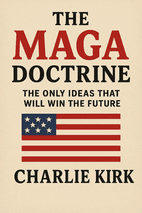
The MAGA Doctrine by Charlie Kirk  Book Cover

by Charlie Kirk

Charlie Kirk's The MAGA Doctrine outlines the America First political philosophy, defining its core tenets like economic nationalism and border security for readers interested in the populist conservative realignment within the Republican Party.

On Insta.page you also get an Apply This Book tool that lets you combine insights from up to 3 books to solve your specific situation.

Chapter mindmaps

Free preview: chapters 1–4 are fully interactive. Click any node to expand or collapse. Subscribe to unlock the rest.

Chapter 1: Chapter 1: The Great Disruptor

Key concepts: Chapter 1: The Great Disruptor

1. Chapter 1: The Great Disruptor

Turning Point USA's Political Ascent

  • Trump Tower meeting with Donald Trump Jr. solidified crucial alliance post-2016 election
  • Budget exploded from $2M to $20M annually with expansion to 1,600 campuses
  • Endorsements from Trump family and allies acted as powerful growth catalyst
  • Tapped into generational shift providing counterbalance to liberal youth culture dominance

The Stagnant Two-Party Cartel

  • Pre-Trump establishment depicted as self-serving political cartel
  • Parties engaged in theatrical conflict while collaborating on expanding government
  • Political gridlock made genuine change impossible
  • George H.W. Bush's vote for Hillary Clinton symbolized interconnected ruling class

Trump's Ideological Disruption

  • Trump shattered stagnant system as populist disruptor sensing 'market opportunity'
  • Rewrote Republican platform with skepticism of foreign wars and strategic trade approach
  • New formula: free speech/entrepreneurial/pro-peace vs old theocratic/corporate/warlike model
  • Exposed hollowness of prior conservative efforts and neoconservative 'American Empire' push

The Backlash from the Right

  • Established conservative institutions viewed Trump and TPUSA with suspicion
  • Accused movement of diluting intellectual principles for 'clickbait'
  • Backlash interpreted as resentment from those comfortable with losing stalemate
  • Internal conflict framed as necessary part of disruption process

The MAGA Doctrine Impact

  • Presented as necessary positive disruption liberating American politics
  • Offered last chance to counter rise of socialism
  • Fundamentally changed conservative agenda priorities
  • Created viable alternative to stagnant establishment politics

Chapter 2: Chapter 2: The Outsider from the Inside

Key concepts: Chapter 2: The Outsider from the Inside

2. Chapter 2: The Outsider from the Inside

Overview

  • Overview This chapter opens with a thought experiment, asking readers to envision a world where Hillary Clinton presided over a period of unprecedented economic growth and policy success.

  • The narrative then pivots to reveal that every single achievement described—from record-low unemployment across diverse demographics to significant tax cuts and deregulation—was actually accomplished under Donald Trump’s administration.
  • The core argument explores why these tangible successes are often met with skepticism or outright dismissal by the political and media elite.

The Hypothetical and the Real

  • The chapter vividly contrasts a potential media narrative for a President Hillary Clinton with the actual reception of President Trump’s identical accomplishments.
  • It lists a comprehensive set of economic and policy wins, including a surging stock market, historic lows in unemployment for minority groups and women, massive tax cuts, deregulation, energy independence, and foreign policy successes like the defeat of ISIS.
  • The central question posed is why these outcomes, which would likely be hailed as a masterclass in governance if achieved by a conventional politician, are so frequently downplayed or criticized when attributed to Trump.

Understanding the Elite Backlash

  • The text delves into the psychology of Washington’s permanent class, suggesting their perplexity and alarm are not rooted in policy disagreements but in a threat to their very existence.
  • Trump’s ability to achieve results without relying on the traditional network of lawyers, lobbyists, and consultants reveals that their roles are not indispensable.
  • The elite’s definition of competence—polished appearances and risk-averse behavior—is fundamentally challenged by a leader who operates on instinct and direct appeal to the public.

The Man from the Middle

  • Contrary to his portrayal as a philosophical blank slate, Trump is presented as a figure whose instincts are deeply informed by American tradition and his lived experience.
  • His career as an entrepreneur provided a practical education in economics and the stifling nature of overregulation that surpasses theoretical knowledge.
  • Having witnessed New York’s cycles of safety and crime, his stance on border security and law enforcement is framed as a reflection of mainstream, decent impulses rather than nativism.

Historical Parallels and Deeper Struggles

  • The narrative elevates the contemporary political conflict by comparing Trump to Cicero, the Roman orator declared an enemy of the state for warning that Rome was abandoning its republican principles.
  • This analogy positions Trump not as a destroyer but as a restorer, targeted by a “Deep State” that mistakes itself for the guardian of the republic while actually contributing to its decay.
  • The comparison to Kathy Griffin’s infamous photo stunt is used to underscore the violent symbolism often directed at him.

The Battle for America’s Soul

  • The final sections frame Trump’s presidency as the latest chapter in a centuries-old conflict between self-rule by the common people and the persistent claim to power by a self-appointed aristocracy.
  • His critics are portrayed as fundamentally opposed to the principles of the Founding Fathers, viewing them with the same suspicion they reserve for Trump.
  • The chapter expresses confidence that future historians will recognize his love of country, his defense of freedom, and his record of promises kept.

Key Takeaways

    •   Donald Trump’s administration delivered a wide array of measurable economic and policy successes that are often overlooked or minimized due to his unconventional style and outsider status.
    •   The intense opposition from the political and media establishment is rooted less in policy disputes and more in a perceived threat to their influence and the Washington power structure.
    •   Trump’s instincts are shaped by practical business experience and a deep-seated belief in core American principles, making him a unique threat to elite orthodoxies.

Chapter 3: Chapter 3: No More Accepting Decline

Key concepts: Chapter 3: No More Accepting Decline

3. Chapter 3: No More Accepting Decline

Global Resonance of MAGA Ideals

  • Hong Kong protestors adopted MAGA symbols as emblems of Western liberty
  • Parallels historical moments where freedom symbols crossed borders
  • Reflects genuine recognition of free markets and individual rights values
  • Contrasts with American media's misplaced concerns about infiltration

Military-Industrial Complex Critique

  • U.S. defense spending increased 44% since Cold War ended
  • $1 trillion allocated in 2020 for defense-related departments
  • Wasteful expenditures like $14,000 toilet seats highlight systemic issues
  • Trump's conflict reluctance framed as peace push, not isolationism
  • Challenges status quo that profits from perpetual war

Diplomatic Strategy Shifts

  • Critiques decades of failed expert-led diplomacy
  • North Korea as case study of hollow past agreements
  • Trump's personal outreach breaks from bureaucratic strategies
  • USMCA refines NAFTA with reduced tariffs and labor protections
  • Faces partisan delays despite addressing previous criticisms

Economic Deregulation Philosophy

  • Trump's regulatory freeze saved $23 billion annually
  • Contrasts with Obama's $245 billion in regulatory costs
  • Builder mindset trusts market forces over government decrees
  • Revisits gold standard for monetary stability
  • Challenges fiat currency system empowering bureaucrats

Political Philosophy Contrast

  • Trump's optimism counters left's narrative of American decline
  • Democrats favor regulation in daily life but permissive on borders
  • Government as solution vs. individual freedom champion
  • Practical deal-making to spur growth and national confidence
  • Border wall and agency reforms exemplify action-oriented approach

Chapter 4: Chapter 4: America First

Key concepts: Chapter 4: America First

4. Chapter 4: America First

The Kabul Grand Hotel Debacle

  • $85 million taxpayer-funded hotel project resulted in empty shell
  • Funds funneled through opaque offshore entities with poor oversight
  • Abandoned structure required ongoing U.S. security against terrorist threats
  • Symbol of nation-building became monument to waste and mismanagement

Systemic Reconstruction Failures

  • $750 million electrification project built on land not owned by U.S.
  • $210 million ministry building with nonfunctional systems
  • Multi-million-dollar natural gas station in country with no demand
  • Pattern of poor planning, corruption, and disconnect between intentions and outcomes
  • SIGAR oversight reveals broader ineptitude of foreign intervention

Pragmatic Foreign Policy Shift

  • Rejects both left-leaning globalism and right-wing interventionism
  • Focuses on American interests through real-world feedback over diplomatic rhetoric
  • Seeks diverse perspectives to avoid groupthink in decision-making
  • Challenges post-WWII foreign policy consensus and international organizations
  • Advocates decentralized decision-making over top-down control

Critique of Global Leadership Illusion

  • International institutions like IMF and World Bank perpetuate dependency
  • U.S. debt exacerbated by foreign spending undermines national strength
  • Charity abroad unsustainable when domestic infrastructure crumbles
  • Emphasizes sovereignty and local control for accountable governance
  • Rejects American submersion into international systems

America First Philosophy Core Principles

  • Prioritizes domestic needs and cost-benefit analysis over idealistic intervention
  • Fosters sovereignty by reducing reliance on flawed international institutions
  • Not isolationism but recalibration toward tangible national interests
  • Addresses public frustration with wasteful spending and unaccountable power
  • Government inefficiency at home makes it ill-suited for complex projects abroad

Continue exploring The MAGA Doctrine