The Lost Empire of Emanuel Nobel Quotes
by Douglas Brunt
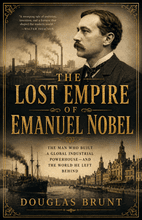
This collection brings together thirty of the most striking lines from Douglas Brunt's book about the Nobel family's lost Russian empire. You will find moments of high drama, personal reflection, and sharp observations on power, wealth, and survival. What makes the book so quotable is its blend of revolutionary upheaval, oil industry intrigue, and the intimate struggles of the Nobels. The quotes capture the tension between innovation and oppression, the weight of family legacy, and the human cost of history's turning points.
Top Quotes from The Lost Empire of Emanuel Nobel
“Only a few months earlier Communist guards had dragged Nicholas, his wife Alexandra, and their five young children to the basement of the house where they’d been imprisoned and shot the huddled family point-blank.”
The narrator describes the recent murder of the Romanov family.
This line vividly captures the brutal reality of the Bolshevik terror, setting a grim backdrop for Emanuel's dilemma. It underscores the life-or-death stakes of his decision.
“In the wake of this terror, Emanuel received word that Joseph Stalin's secret police had arrested Emanuel’s two younger half brothers and were holding them in a dank cell in the Peter and Paul Fortress in Petrograd, only a stone's throw from the headquarters of Nobel's family business.”
The narrator explains the immediate threat to Emanuel's family.
The proximity of the prison to Nobel's business emphasizes the personal danger and the collapse of the old order. It also introduces Stalin as a direct antagonist, making the conflict deeply personal.
“In my opinion, Ludvig has the greatest genius, Alfred the greatest capacity for industry, and Robert the greatest courage for speculation.”
Immanuel Nobel writing to his brother-in-law in 1848, assessing the talents of his three oldest sons.
This remarkable early prophecy, accurate about each son's future, reveals Immanuel’s perceptiveness as a father and foreshadows the divergent paths of the Nobel brothers. It also gives readers a quick, memorable snapshot of their personalities.
“He freed more slaves than anyone else in history, before or since.”
Describes Tsar Alexander II's emancipation of twenty-three million serfs in 1861.
This stark, superlative claim reframes a moment of autocratic reform as a world-historical act of liberation, challenging common assumptions about slavery's geography.
“I owe my entire career to Alexander II, but I still say: it’s a good thing they got rid of him, otherwise where would he have led Russia with all his liberalism?!”
General P. A. Cherevin, deputy minister of internal affairs and close friend of the new Tsar, remarks after the assassination.
This shocking admission reveals the deep ideological divide within the Russian elite and the raw cynicism that fueled the return to autocracy.
“Several times during the day one of the workers, sitting in an ordinary pail, would have to dive down into the bore-hole, a procedure which meant death nine times out of ten.”
Journalist Essad Bey describing the perilous working conditions in the Baku oil fields.
The vivid, gruesome detail underscores the extreme human cost behind the oil wealth, making the reader viscerally feel the danger.
“Capital in pure money form left as inheritance to children is pure moral corruption. Capital in industrial form is a good weapon in the struggle for existence.”
Ludvig Nobel's letter to his brother Alfred shortly before his death, explaining his philosophy on inheritance.
This powerful statement encapsulates Ludvig's values of hard work and responsibility, directly shaping Emanuel's inheritance and the Nobel legacy of productive enterprise over idle wealth.
Themes Behind the Quotes
A central theme is the collision between personal ambition and political revolution. The quotes reveal how the Nobels navigated the brutal realities of communist takeover, with family members imprisoned and killed even as the business empire crumbled. Another theme is the burden of inheritance, both in terms of wealth and moral responsibility. Several lines wrestle with whether passing down capital corrupts or empowers, a tension that shaped the Nobel legacy.
Innovation and risk also run through the quotes, from dangerous oil drilling techniques to the invention of dynamite. The family's drive to create and compete internationally is set against the backdrop of a society in chaos. Finally, the theme of human cost emerges vividly, whether through the execution of royals, the deaths of workers, or the emotional wounds of childhood. These quotes collectively paint a portrait of a world where fortune and tragedy are inseparable.
Quotes by Chapter
Prologue
“Then Emanuel Nobel quietly informed them of his decision as to whether he would remain in Russia and face down Stalin or if it was time to run.”
The narrator reports Emanuel's final moment of choice before his advisors.
This line creates suspense and frames the entire chapter as a turning point in Emanuel's life. It encapsulates the central conflict between defiance and survival, leaving readers eager for the outcome.
Chapter 1: Prison or Russia
“The small amount of moral and intellectual value I may happen to possess is the result of the setbacks and sufferings I saw our beloved mother exposed to in my earliest childhood.”
Ludvig Nobel, reflecting as an adult on his mother Andriette's struggles after Immanuel fled to Russia.
This line captures the profound, bittersweet legacy of hardship — how a child's witness to a parent's sacrifice can shape character more than any comfort ever could. It humanizes the Nobel family story beyond business and invention.
“If the thing succeeded I could demand whatever I wished.”
General Schilder’s reply to Immanuel Nobel after Nobel claimed he could build a better undersea mine.
The line encapsulates the high-stakes gamble of Immanuel’s bold claim — a moment of tension that could have ended in ruin or triumph. Its blunt, open-ended promise makes the reader feel the weight of the upcoming demonstration.
“Any attack on Kronstadt by ships is entirely impracticable.”
Sir Charles Napier, Britain's most accomplished admiral of the time, reporting to the First Lord of the Admiralty after evaluating the Nobel mines.
This single sentence marks the decisive victory of the Nobel family’s invention over the mighty Royal Navy. It underscores how ingenuity can trump overwhelming conventional force and gives a satisfying payoff to the chapter’s buildup.
Chapter 2: Reform, Repress, Repeat
“The workers have nothing to lose but their chains.”
From Marx and Engels' Communist Manifesto, a call for proletarian revolution.
This iconic phrase captures the revolutionary spirit of the era in a single, visceral image, making it one of the most enduring rallying cries in political history.
“I shall never again make my home in Helsinki, everything has been so hateful for me there and I would rather die than be there.”
Robert Nobel, the eldest brother, writing to his wife about his time working in Finland.
The raw bitterness and self-dramatizing despair reveal the personal cost of the Nobel family's scattered ambitions and Robert's own fractured sense of success.
“I have a great deal to do and am working every day like a manual laborer, for I have bombs to mould.”
Ludvig Nobel, writing in 1864 about his munitions factory work.
It captures Ludvig's relentless work ethic and the dark, literal irony of his trade—turning his own hands to the production of explosive weaponry.
Chapter 3: “Everyone Rushed for Everything at Once”
“Today is our fifth anniversary and happier can no mortal be than I have been in my marriage.”
Ludvig Nobel wrote to his older brother about his happy marriage before his wife Mina died in childbirth.
This line foreshadows the tragedy to come and humanizes Ludvig, showing his deep love and personal happiness before loss.
“He was fortunate to live in our times, when the inventor is not in a hurry to make gold and the magician need not fear an inquisition.”
Immanuel Nobel's obituary in the Swedish newspaper Svalan, reflecting on his life.
It elegantly captures a romantic ideal of innovation free from commercial pressure, contrasting with the family's later capitalist ambitions.
“The society is truly American! Long live equality! Only the authorities with their bureaucracy and slowness are reminiscent of the old world.”
Robert Nobel wrote to Ludvig describing the enterprising, classless atmosphere he found in Baku.
This line shows Robert's enthusiasm for the meritocratic, dynamic environment and his disdain for Russian bureaucracy.
“In America such a business has already been carried out on a large scale.... The model is to hand—calculations easy to make and clear as day.”
Ludvig Nobel wrote to Alfred to persuade him to invest in the Baku petroleum venture.
It demonstrates Ludvig's strategic clarity and confidence, explicitly referencing Rockefeller's successful model to justify the investment.
Chapter 4: From Well to Wick
“I see that day approaching when our products will go out over Russia's borders in great quantities and secure a world market for us. Then, but only then, will the victory be complete.”
Ludvig Nobel writes to his brother Alfred to persuade him to invest more capital in the petroleum business.
This line captures Ludvig's visionary ambition and unwavering determination to dominate global markets, making it a powerful rallying cry for industrial triumph.
“Money, which everywhere else constitutes a terrible problem, he seems to conjure up from the ground. In the final analysis, I guess that is where it truly does come from.”
Gustaf Térnudd, director of Baku operations, reflects on Ludvig Nobel's seemingly magical ability to finance his grandiose plans.
The quote vividly illustrates Ludvig's resourcefulness and the almost mythic scale of his enterprise, blending wonder with a down-to-earth punchline.
“Ludvig created everything he needed for a world-class petroleum business that could bring his product from the oil well in the fields to the wick of a customer's lantern.”
The author summarizes Ludvig Nobel's comprehensive vertical integration in the oil industry.
This sentence perfectly distills the chapter's theme of self-reliant innovation and the relentless drive to control every link in the supply chain.
Chapter 5: The First Oil War
“Emanuel was the rare third-generation owner who seemed unlikely to deliver on this curse.”
After noting the adage 'shirtsleeves to shirtsleeves in three generations' in reference to family businesses.
It captures Emanuel's exceptional character and potential, defying a common generational curse, which makes him a compelling figure.
“As long as no revolution sweeps away all wealth and all private ownership in one go.”
Ludvig Nobel writing to his brother Robert in 1887 about the future of their business.
This line is chillingly prophetic, foreshadowing the Bolshevik Revolution that would ultimately destroy the Nobel empire.
“Thirty years later, these two boys would cross paths as men under very different circumstances.”
Referring to Nicholas Romanov, heir to the throne, and Vladimir Ulyanov (later Lenin), whose older brother was hanged for an assassination plot.
This dramatic foreshadowing links the personal histories of the tsar and the revolutionary leader, heightening the sense of impending historical collision.
Chapter 6: Emanuel Leads a Russian Deluge
“The entire expulsion of American petroleum from European markets is confidently looked for.”
Ambassador George Lothrop's report to Congress in 1887, citing a combined analysis of experts.
This line vividly captures the moment Russia's oil industry, led by the Nobels, directly threatened Standard Oil's dominance, highlighting the high-stakes global competition.
“A man who only with great difficulty can be regarded as one of humankind’s benefactors died yesterday in Cannes. The deceased is Monsieur Nobel, the inventor of dynamite.”
Le Figaro's mistaken obituary for Alfred Nobel, which he read on the morning of April 15, 1888, after his brother Ludvig's death.
This damning obituary is the catalyst for Alfred Nobel's creation of the Nobel Prizes, illustrating how a misidentification and harsh public judgment can reshape history.
“I will miss in him not only a loveable and tender father, but I lose in him a loyal and wise and thoughtful friend, from whom I have had no secrets.”
Emanuel Nobel's tearful eulogy at his father Ludvig's funeral in Saint Petersburg.
This personal, heartfelt tribute reveals the deep emotional bond between father and son, humanizing the industrial magnate and showing Emanuel's character beyond business.
Chapter 8: All Roads Lead to Baku
“Your Majesty. I do not wish to expose my siblings to the risk of being reproached in the future by highly deserving scientists for having appropriated to themselves funds that rightfully ought to have come to the scientists.”
Emanuel Nobel's response to King Oscar II, who urged him to invalidate Alfred Nobel's will.
This line showcases Emanuel's moral integrity and foresight, as he defies a king to protect the future of the Nobel Prizes and his uncle's legacy.
“Your uncle was influenced by peace fanatics.”
King Oscar II complained to Emanuel about Alfred Nobel's will.
It reveals the historical opposition to the Nobel Peace Prize and the tension between national sovereignty and international idealism.
“There was hardly a day when someone had not beaten him up and sent him home crying or when he had not beaten someone else.”
Description of young Stalin's childhood in Gori.
This vivid, brutal depiction captures the environment that shaped Stalin's character and foreshadows his later ruthlessness.