The Lost Empire of Emanuel Nobel Key Takeaways
by Douglas Brunt
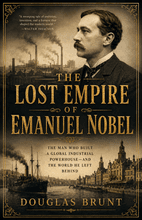
5 Main Takeaways from The Lost Empire of Emanuel Nobel
Business empires crumble when power shifts to extremists.
Emanuel Nobel's oil empire in Russia was built on innovation and royal favor, but the rise of revolutionary extremism—from the Black Hundreds to Stalin's gangs—made his position untenable. The book shows that even the most prosperous enterprises are vulnerable when political violence replaces the rule of law.
Reform without stability breeds the seeds of revolution.
Alexander II's reforms inadvertently united Marxist intellectuals with a disgruntled working class, and his assassination attempt triggered a cycle of repression that radicalized opponents. The lesson: piecemeal reform can create expectations that, if unmet, fuel more dangerous movements.
Vertical integration wins markets but attracts state seizure.
Ludvig Nobel's strategy of owning every link from well to customer gave Nobel Brothers dominance in Russian oil, but it also made the company a prime target for nationalization. When the Bolsheviks took over, they seized the entire infrastructure—proving that too much control can become a liability.
Personal alliances with autocrats are a double-edged sword.
Emanuel Nobel secured Tsar Alexander III's favor and Russian citizenship, which protected his firm for decades. Yet when the monarchy fell, his ties to the regime made him a target. The insight: aligning with a single power source can be fatal if that power collapses.
Historical erasure is a tool of totalitarian control.
The Soviet regime deliberately deleted the Nobel family's contributions from Russian history, even as their workers revered them. This book recovers that lost legacy, reminding us that who controls the narrative controls the past—and the present.
Executive Analysis
These five takeaways form a single tragic arc: the Nobel empire rose through innovation and political favor, but the failure of reform, the rise of extremism, and the fragility of autocratic alliances doomed it. The book’s central argument is that capitalism and revolution are not opposing forces—they are co-dependent in a cycle of creation and destruction. Emanuel’s story illustrates how even the most rational business strategies cannot survive when the state itself unravels.
This book matters because it reframes the Russian Revolution not as an abstract ideological event, but as a concrete business disaster with human faces. It belongs to the genre of narrative history that blends biography, business strategy, and political analysis. For readers, it offers a cautionary tale about investing in unstable regimes, the limits of corporate diplomacy, and the long shadow of historical amnesia. It is both a riveting story and a practical lesson in risk management.
Chapter-by-Chapter Key Takeaways
Prologue (Prologue)
Emanuel Nobel is trapped between the old world and the new, his family’s fortune and his own freedom hanging by a thread.
The “Nobel Notes” episode shows his ability to create order from chaos—a trait that will define his legacy.
The prologue sets a tone of imminent danger, contrasting the quiet civility of Kislovodsk with the brutal violence that has already claimed the Tsar and his family.
The choice Emanuel faces is not merely personal; it will shape the fate of the Nobel business empire in Russia.
Try this: Recognize when you are trapped between old and new systems; use your ability to create order from chaos as a strategic advantage, but never ignore the violence that may be coming.
Prison or Russia (Chapter 1)
Immanuel Nobel's fortune was built on a wartime boom, but it was financed with borrowed capital and tied directly to the Tsar's favor.
Nicholas I's brutal philosophy was forged by family assassinations and an attempted coup, leading to a regime of secret police and rigid control.
Alexander II inherited a failed war and a traumatized empire. His desire for reform signaled a new era—one that would bring both opportunities and existential threats to the Nobel business.
Try this: Avoid building a fortune solely on wartime booms and borrowed capital tied to a single ruler’s favor—diversify your political and financial dependencies.
Reform, Repress, Repeat (Chapter 2)
Alexander II’s reforms inadvertently united Marxist intellectuals with a disgruntled working class, creating a potent anti-tsarist movement.
Darwin’s theory of evolution directly undermined the Tsar’s divine-right legitimacy, especially in a monarchy fused with the Orthodox Church.
Karakozov’s 1866 assassination attempt shattered the aura of invulnerability around the Tsar, shifting the threat from palace coups to populist terror.
Dostoevsky’s reaction captured the psychological turning point: the Tsar was now killable.
Alexander’s response—repression instead of continued reform—only deepened the conflict, pushing revolutionaries toward dynamite and terrorism.
Try this: Understand that any reform you initiate will create unintended coalitions; be prepared to manage the backlash rather than simply repress it.
“Everyone Rushed for Everything at Once” (Chapter 3)
Russia’s industrial and technological successes under Alexander II came at a steep cost: political turmoil and rising opposition to the Tsar.
Joseph Stalin was born in Gori in December 1878, during a period of rapid change and unrest in the Russian Empire.
The Nobels’ expansion into the Caucasus oil fields coincided with Stalin’s early years, setting the stage for a future collision between the capitalist dynasty and the revolutionary who would challenge their world.
Try this: When expanding into politically volatile regions, deliberately time your entry to coincide with stability—or plan your exit before the unrest reaches your doorstep.
From Well to Wick (Chapter 4)
Ludvig Nobel’s strategy of vertical integration—owning everything from oil wells to railcars to customer-facing depots—was the key to dominating Russia’s unpatented petroleum market.
His innovations in continuous distillation and massive storage infrastructure gave Nobel Brothers a decisive cost and supply advantage over competitors.
The assassination of Alexander II and the reactionary rule of Alexander III created both opportunities and obstacles: state credit saved the firm, but a ban on dynamite manufacturing blocked expansion and fueled simmering resentment that would later explode.
Try this: Implement vertical integration to dominate a market, but also build redundancy in key assets and plan for the risk of state seizure through legal or offshore structures.
Emanuel Leads a Russian Deluge (Chapter 6)
Ludvig’s death thrust Emanuel into leadership at twenty-eight, facing skepticism from Alfred, Edla, and the board.
Emanuel’s patient, diplomatic handling of internal power struggles earned him respect and proved his maturity.
Hosting Tsar Alexander III was a masterstroke of diplomacy, securing royal favor and a Russian citizenship that gave the firm legal and political advantages.
The false obituary of Alfred Nobel likely inspired the creation of the Nobel Prizes.
Despite record profits, Emanuel worried about Russian civil unrest and Standard Oil’s aggressive tactics—foreshadowing future conflicts.
Try this: When thrust into leadership at a young age, use patient diplomacy and strategic hospitality to earn respect and secure legal advantages that protect your firm.
The Danger is from Within (Chapter 8)
Internal decay, not foreign threat: Emanuel Nobel saw Russia’s greatest danger was self-destruction. The 1905 revolution confirmed his fear—the empire was tearing itself apart from within.
Violence as a political tool: The Black Hundreds and Stalin’s militant gangs both used ethnic murder and terror to advance their goals. The absence of a moderate center allowed extremism to flourish.
Emanuel’s fragile position: Despite his best efforts to treat workers fairly, Nobel couldn’t isolate his company from the revolutionary tide. His connections with the Tsar’s government and the Octobrists put him directly in the crosshairs of radicals like Stalin.
1905 as a dress rehearsal: The revolution failed to topple the monarchy, but it taught Lenin and Trotsky the value of centralized planning and decisive action. Stalin learned to lead men in armed struggle—a skill he would refine.
Baku as the crucible: The oil city was ground zero for both industrial capitalism and revolutionary violence. The clash between Nobel and Stalin was not just personal—it symbolized the larger war between order and destruction that would define Russia’s future.
Try this: Monitor internal decay within your organization and nation as closely as external threats; treat signs of social unrest as early warnings to shift your risk posture.
The Second Baptism of Fire (Chapter 9)
Edmond de Rothschild’s attempt to sell to Nobel Brothers failed, beginning the Rothschild exit from Russian oil.
Stalin’s first meeting with Lenin in 1905 deepened his commitment to revolutionary violence over reform.
The death of Stalin’s wife, Kato, hardened him emotionally and drove him into more extreme criminal operations.
The Tiflis bank heist (1907) was Stalin’s most notorious act, cementing his reputation as a thug but earning Lenin’s approval.
Stalin was arrested in 1908 and exiled to Siberia, but the light exile system under the tsars only fueled his later brutality.
Emanuel Nobel’s philanthropic workers’ suburbs and government role stood in stark contrast to Stalin’s campaign of sabotage.
Try this: Refuse to engage in sabotage or criminal operations even when they promise short-term gains—they will harden your character and attract the wrong allies.
Rasputin (Chapter 10)
Rasputin’s rise was a perfect storm: the Tsar’s personal vulnerability (his son’s hemophilia), a superstitious aristocracy, and a ruler desperate for reassurance.
Despite his crude appearance and behavior, Rasputin wielded immense political influence by playing on Nicholas II’s insecurities.
His presence deepened the instability of the Russian monarchy, alienating nearly every faction—conservatives, liberals, and revolutionaries alike.
Both Kerensky and Lenin later argued that Rasputin’s role was decisive in making the Russian Revolution possible, by discrediting and paralyzing the autocracy from within.
Try this: Beware of relying on a single, vulnerable figurehead for political influence; diversify your advocacy across multiple factions to survive a regime’s collapse.
The Best Customer of Fabergé (Chapter 11)
Fabergé’s Imperial eggs were intimately tied to family moments—Nicholas II presented one on Easter morning 1913.
Designer Alma Pihl (a woman) created that 1913 egg, quietly notable in a male-dominated craft.
Emanuel Nobel’s apparent celibacy leads to historical speculation about his sexuality, humanizing a behind-the-scenes figure.
A messy political truth emerges: the Russian Empire was never a unified nation-state, a tension that outlasted the Tsar and persists today.
Try this: Invest in craftsmanship and family traditions (like Fabergé eggs) to create lasting cultural capital, but remember that political borders are arbitrary and can vanish overnight.
World on Fire (Chapter 12)
The global scramble for oil before WWI turned petroleum into a strategic resource, with Winston Churchill nationalizing Anglo-Persian Oil (later BP) to secure fuel for the Royal Navy.
Emanuel Nobel’s failed hostile takeover by the British backfired, leaving him in control of over half of Russia’s oil industry at the moment war erupted.
Germany’s preemptive war strategy against Russia was driven partly by the desire to seize Baku’s oil fields.
Emanuel’s businesses boomed during the war, producing fuel, TNT, and Diesel engines for the military, but the suffering of the Russian population fueled revolutionary agitation.
The war deepened ethnic hatred between Germans and Russians, ensnaring the German-born Empress and even forcing Emanuel to remove German managers from his companies.
Stalin’s miserable exile in Siberia during the early war years left him a nonfactor, but he survived, waiting for the revolution.
Try this: When war turns a resource into a strategic weapon, secure your supply chain through multiple geographies and prepare for hostile takeovers from both competitors and governments.
The Tsar Cannot Be in Two Places at Once (Chapter 13)
Nicholas II’s decision to personally command the army removed any buffer between the throne and military disaster, while leaving the capital in the destructive hands of Alexandra and Rasputin.
The murder of Rasputin by Prince Yusupov and co-conspirators (possibly including British intelligence) failed to stabilize the regime and instead added to the chaos.
Despite the war and political turmoil, Emanuel Nobel’s industrial empire achieved record output in 1916—but logistical failures and the collapse of public trust made economic gains irrelevant.
Stalin, exiled in Siberia, read Machiavelli and waited with grim certainty for the revolution he believed would come.
Try this: Do not let the illusion of record profits blind you to logistical failures and collapsing public trust—those are the real indicators of future disaster.
February (Chapter 14)
Emanuel Nobel’s calculated optimism in the summer of 1917—trusting in business continuity amid political fire—was a gamble that history would soon undermine.
The Finnish civil war and independence show how quickly imperial collapse reshaped borders and loyalties.
Colonel Hurban’s testimony underscores the international dimensions of the Bolshevik revolution: Germany deliberately funneled support to Lenin and his allies to weaken Russia militarily.
The chapter leaves us with the uneasy sense that plausible normalcy can be a delusion; revolutions don’t wait for convenient moments.
Try this: Resist the temptation of optimistic normalcy during political firestorms; build contingency plans that assume revolutions will not wait for convenient moments.
October (Chapter 15)
The October Revolution succeeded largely because Kerensky's own actions armed his enemies—the forty thousand rifles distributed to factory workers became the Red Guard's arsenal.
International powers, particularly American industrialists, rushed to curry favor with whichever regime controlled Baku's oil, creating an "unholy alliance" between monopoly capitalism and revolutionary socialism.
Stalin emerged as Lenin's most aggressive strategist, recognizing early that controlling the Caucasus petroleum meant controlling Russia's future.
Emanuel Nobel represented the single largest obstacle to Bolshevik control of Baku's oil—too valuable to ignore, too dangerous to approach directly.
The revolution's speed stunned even its victors: Lenin went from hiding in Finland to ruling Russia in a matter of weeks, sleeping on newspaper piles in a cramped office.
Try this: Arm your opponents only if you can control the outcome; distributing weapons to workers can backfire when they become the arsenal of revolution.
Campaign Promise Delivered (Chapter 16)
Lenin and Stalin never intended to honor the Treaty of Brest-Litovsk's oil concessions; they viewed Baku as theirs and kept treating Germany as an enemy.
The Bolsheviks needed Emanuel Nobel's expertise to extract and deliver oil, forcing a reluctant partnership that Stalin might have preferred to end with imprisonment.
Shaumian's Baku Commune faced a looming Ottoman invasion, with a military force half the size of the advancing Turkish army.
Emanuel Nobel saw through the Soviet summons as a trap and refused to cooperate, betting on the collapse of the Bolshevik regime.
Try this: When the state collapses, do not trust summons from a new regime that needs your expertise—they may be traps, not partnerships.
Burn Down the Mast (Chapter 17)
Emanuel Nobel’s decision to remain in the Caucasus was based on a strategic calculation that the White Army’s control of the region would hold.
The nationalization of the oil industry removed everything the Nobels had built, and the new board was a farce—former owners forced to arrange their own funeral.
The Romanov executions were the pivotal moment that turned the West against the Bolsheviks, sealing the regime’s isolation.
Emanuel’s decision to stay in Kislovodsk was strategically sound; Baku’s control shifted rapidly and violently.
Lenin’s August 1918 deal with Germany bought military aid at enormous cost in territory, money, and oil, and deepened domestic opposition.
The assassination attempt on Lenin by Fanya Kaplan reflected growing disillusionment with Bolshevik authoritarianism.
British strategists recognized the importance of southern Russia for postwar stability but lacked the troop strength to secure it.
Dunsterforce’s withdrawal led directly to the massacre of nearly ten thousand Armenians in Baku.
The Russian Civil War, then intensifying, would prove far deadlier than the Great War had been for Russia.
Try this: Never stay in a conflict zone based on a single strategic assumption; always prepare multiple escape routes because control can shift violently within days.
Run for Your Life (Chapter 18)
The end of World War I brought little relief to Russia, where the Civil War raged on and Allied soldiers continued fighting despite the armistice.
Emanuel's escape succeeded through meticulous planning, bribery, and the critical luck of being recognized and then released—a near miss that would have meant certain death under Stalin.
The brothers' survival hinged on a technicality: Stalin assumed they were Russian citizens, but Swedish citizenship gave their government leverage to secure their release.
Political borders, as Gosta observed, are arbitrary lines that can mean the difference between life and death in times of conflict.
The Nobel family's reunion in Sweden was bittersweet—they had escaped with their lives, but their vast industrial empire was now lost to the Bolsheviks.
Try this: Bribe, plan, and use every legal technicality (like dual citizenship) to escape chaos—borders are arbitrary lines that mean life or death in times of war.
Civil Is the Worst Kind of War (Chapter 19)
Oil was the critical resource that drove both Lenin’s civil war strategy and Allied hesitation. Without it, the Bolshevik transport system would collapse; with it, they could consolidate power.
Emanuel Nobel acted as a reluctant broker between the Bolsheviks and the Allies, using his warning about an attack on Baku to pressure Britain and America into a decision they ultimately fumbled.
The White Army’s internal divisions and antisemitic violence made Allied support politically unsustainable, handing the disciplined, well-propagandized Bolsheviks a decisive advantage.
Baku’s seven changes of control in under three years illustrate the chaos of the post-imperial Caucasus, where local nationalists, foreign powers, and the Red Army all fought for the same oil.
Nobel’s final business move—selling his claim while it still had value—was a realistic acknowledgment that the old world was gone, and that only governments with military backing could enforce ownership in Russia.
Try this: Sell your claim while it still has value rather than holding out for the old world to return; only governments with military backing can enforce ownership in revolutions.
Woe to the Vanquished (Chapter 20)
Stalin systematically erased the Nobel family’s legacy, even as their workers revered them as “Nobelites” and risked their lives for Emanuel.
Allied withdrawals from Archangel and Vladivostok left local supporters to face certain Soviet reprisals.
Standard Oil acquired Nobel’s Russian assets for roughly $2 billion in present-day value—a fraction of their true worth.
Trotsky’s globe-trotting opposition ended with an ice pick to the skull, courtesy of Stalin’s hit squad.
Under Bolshevik management, the same factories that once churned out over a million rifles produced fewer than half that number; shell production collapsed to less than 1% of Nobel’s output.
Try this: Prepare for systematic erasure of your legacy by documenting your contributions independently; archives outside the regime’s control are your best defense.
At Last (Epilogue)
Historical erasure: The Soviet regime deliberately deleted the Russian Nobels from history, and this book aims to restore them.
The Nobel name today is contested: The Nobel Foundation, the Nobel Family Society, and the Nobel Sustainability Trust are in active conflict over the use of the family name, with the Sustainability Trust awarding prizes that align with contemporary Russian political interests.
The Russian Revolution casts a long shadow: Understanding the Nobels’ story is essential to grasping the full, tragic arc of modern history, from the failure of reform to the rise of totalitarianism.
Try this: Actively restore lost histories and challenge official narratives, because who controls the past shapes the present—and your own legacy may depend on it.
Continue Exploring
- Read the full chapter-by-chapter summary →
- Best quotes from The Lost Empire of Emanuel Nobel → (coming soon)
- Explore more book summaries →