The Invisible Coup Quotes
by Peter Schweizer
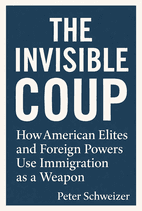
These quotes pull no punches. You will find statements that openly describe migration as a weapon, borders as obstacles, and cultural change as a deliberate strategy. What makes this book quotable is its willingness to let people speak for themselves, often in ways that sound extreme until you see the source. The lines range from defiant declarations to cold calculations. Each one offers a glimpse into a worldview that sees the United States not as a refuge but as a target. Expect sharp, confrontational language from political leaders, activists, and insiders. These are the kind of quotes that stick with you.
Readers will also find quotes that expose the mechanics behind mass migration and naturalization. The book reveals how movements and foreign governments openly discuss using people flows to reshape societies. It’s a collection that challenges comfortable assumptions and lays bare intentions that are rarely stated so plainly.
Top Quotes from The Invisible Coup
“The beauty of migration as a weapon was that it twisted the reputation of America as a champion of human rights around the country's neck, and America would not see the noose until it was too late.”
The author describes the strategic advantage of Castro's weaponized migration.
This line uses the vivid metaphor of a noose to illustrate how America's own values were used against it, and it highlights the blindness of the US to the attack until it was too late.
“Mexico does not end at its borders ... Where there is a Mexican, there is Mexico.”
Mexican president Felipe Calderón in his September 2007 state-of-the-nation address.
This succinctly encapsulates a nationalist doctrine that expands sovereignty beyond territory, justifying political interference in the US as a matter of principle.
“This is civilizational warfare: first, arrive surreptitiously; second, cultivate allegiance to hostile foreign entities; and third, sabotage the cultural norms of your host country.”
The author's summary of the strategy employed by foreign governments and activists described in the chapter.
It frames mass migration and resistance to assimilation as an intentional, three-step campaign, giving readers a provocative and memorable framework for the chapter's argument.
“The refrain ends: We are more American than all of the gringos.”
The song 'Somos Mas Americanos' by Los Tigres del Norte, embraced by Mexican president Claudia Sheinbaum at official events.
This brazen lyric directly claims superiority over white Americans and is used as an anthem by activists, making it a powerful symbol of the 'Reconquista' sentiment described.
“Because of US birth tourism, perhaps more than a million Chinese nationals have become US citizens by virtue of being born here, but have no memories or allegiance to our country.”
The author describes the potential impact of Chinese birth tourism on American society.
It highlights the deeply unsettling idea that millions of people with US citizenship may have no loyalty or connection to the country, posing a long-term national security risk.
“Their work in America is a kind of grand Jihad in eliminating and destroying the Western civilization from within and ‘sabotaging’ its miserable house by their hands and the hands of the believers so that it is eliminated, and God's religion is made victorious over all other religions.”
This excerpt comes from a Muslim Brotherhood internal memo discovered in the US, outlining their strategy to destroy Western civilization through immigration and subversion.
This quote provides direct evidence of a foreign organization's intent to subvert and destroy American civilization from within. Its blunt language shocks readers and underscores the perceived threat of ideological infiltration via immigration.
Themes Behind the Quotes
One central theme is the deliberate use of migration as a strategic weapon. The quotes show how nations and movements view uncontrolled borders as opportunities to weaken adversaries and shift political power. Another theme is the idea of civilizational conflict, where cultural and ideological battles are fought through population movements and identity politics.
The book also highlights the role of institutions, from the Catholic Church to labor unions, in facilitating or opposing these changes. Finally, there is a recurring motif of betrayal and subversion, with actors on American soil openly declaring loyalty to foreign powers. These themes combine to paint a picture of a world where borders are battlefields.
Quotes by Chapter
Chapter 1: Proof of Concept
“Castro reveled in the inability of the United States to control its border.”
A US Department of Defense study concluded this about Castro's reaction after the Mariel Boatlift.
This quote succinctly captures Castro's strategic satisfaction and the humiliation of the US, emphasizing the border vulnerability.
“Weaponization of mass migration would become a mainstay of the SPF, leading to its declaration, “A world without borders and with universal citizenship is what guides our struggle for emancipation.””
The author describes the Sao Paulo Forum's adoption of migration as a weapon and its stated goal.
This quote reveals the contradictory ideal of open borders masking the weaponized reality, and it shows the ideological basis of the strategy.
Chapter 2: Mexico’s Reconquista of the US Is Real
“This is more than an outreach program,” she said approvingly. “This is part of a concerted program to educate Hispanic children in the United States, and to help the United States make the transition into a bicultural society this century.”
Raquel Romero, director of Mesoamerica Foundation, explaining the Mexican government's textbook distribution in the US.
It candidly reveals a stated goal of transforming American society through education, making it a potent and controversial line that challenges assimilationist ideals.
Chapter 3: Mexico: Organizing Militancy in the US
“It’s a classic case, an example of I'll f*ck around and find out.”
Ramiro Luna, a Texas political operative and DACA recipient, warns Republicans about Latino political mobilization during a meeting at the Mexican consulate in Oklahoma City.
The raw, colloquial threat captures the confrontational tone of the cross-border activism and serves as a memorable slogan for political retaliation.
“Read that again: The ruling party of Mexico, through its consulates, was on the “front line” of “civil resistance” in the United States. This is the very definition of subversion.”
The author sums up the implications of Alejandro Robles' activities as a Morena operative organizing militancy inside the US.
This direct, accusatory statement crystallizes the chapter's central argument about foreign interference, forcing readers to confront the seriousness of the actions described.
“We will be on American soil fighting for our people.”
Alejandro Robles, a former Mexican deputy and Morena official, declares the party's intent to operate politically inside the United States.
The simple, declarative sentence openly asserts a foreign government's plan to conduct political warfare on US soil, making it a stark and quotable line.
“We change places, not flags; I have green, white, red in my veins.”
The Migrant Anthem echoed by Mexican President Claudia Sheinbaum to migrants in the United States.
This line starkly encapsulates the Mexican government's effort to maintain national loyalty and political influence over its diaspora, directly challenging the concept of integration into the United States.
Chapter 4: Voter Mills
“The administration may be blowing a great chance to create a whole lot of pro-Clinton Voters.”
A column in the Los Angeles Times, cited in a letter from Father Vega to Vice President Al Gore, regarding the naturalization backlog.
This line bluntly exposes the raw political calculus behind immigration policy, reducing citizenship to a tool for electoral gain. Its cynical honesty shocks readers into recognizing the transactional nature of the scheme.
“Faster naturalization means more potential Democratic voters in the next election.”
A memo from aide Stephen Warnath to White House fixer Harold Ickes, conveying the Hispanic Caucus's sentiment.
This sentence strips away any pretense of civic idealism, revealing the core motivation driving the Clinton administration's citizenship push. It resonates because it captures the cold, partisan logic that governed the entire operation.
“Migrants, it appears, could be useful political tools.”
The author's summary of the Democratic leadership's evolving view of immigration policy after the 1996 naturalization surge.
This line crystallizes the dehumanizing transformation of people into electoral assets, a theme that echoes through modern political debates. Its starkness forces readers to confront the ethical cost of treating human beings as instruments of power.
“I am dealing with some of these managers.”
Mayorkas complained at a conference about managers who resisted his push to approve every applicant, hinting at retaliation.
The ominous tone exposes a leadership willing to purge dissenters to enforce a partisan agenda, underscoring the coercion behind immigration policy.
Chapter 5: China: The Manchurian Generation
“We might call them the Manchurian Generation, but it's a story stranger and more lethal than fiction.”
The author coins the term 'Manchurian Generation' to describe these children.
The phrase is evocative and ominous, drawing on Cold War paranoia to suggest an orchestrated infiltration, and the claim that reality is 'stranger and more lethal than fiction' grabs attention.
“The Chinese Communist Party views itself not simply as a competing power, but as a superior civilization that must vanquish the decrepit, corrupt, and evil West.”
The author summarizes the CCP's self-perception as a rival civilization.
It reveals the ideological basis for China's aggressive birth tourism strategy, framing it as a civilizational struggle rather than mere immigration, which is a powerful and provocative idea.
“Anyway, I'm already home,” the father later said. “US can’t do anything to me.”
The father of a Chinese birth tourist child speaks after fleeing without paying the full hospital bill.
This quote perfectly encapsulates the arrogance and sense of impunity among some Chinese birth tourists, showing their belief that US laws cannot reach them, which is both revealing and infuriating.
Chapter 7: Progressives and Drug Cartels
“The movement vetted prospective refugees for their ideological pedigree through the Catholic networks in Mexico and Central America, before they even reached the border.”
According to a Capital Research Center study, the sanctuary movement vetted refugees for ideological alignment through Catholic networks before they reached the US.
This reveals that the sanctuary movement's humanitarian façade masked a deliberate political vetting process, prioritizing ideology over need. It highlights how immigration was used as a tool for radical political change.
“Illegal immigrants not only swelled the ranks of unions and revived them but also became the most radical vanguard.”
The author describes how illegal immigrants revitalized American labor unions and became their most radical leaders.
It succinctly captures how illegal immigration revitalized declining unions by providing a collectivist-minded workforce. This line underscores the transformation of labor unions into vehicles for radical political activism.
“Mass migration presents an opportunity to reshape the country.”
The author summarizes the progressive view that mass migration offers a chance to fundamentally change the United States.
This concise statement encapsulates the progressive ambition to alter American society through mass migration. It resonates because it openly admits that migration is a tool for reshaping the country's foundations.
Chapter 8: Transforming America
“If you continue talking like this,” Raul said he told Francis, “sooner or later I will begin to pray again, and I will return to the Catholic Church. . . I may convert again to Catholicism, even though I am a Communist.”
Raul Castro recounting his conversation with Pope Francis after their meeting at the Vatican.
This quote starkly illustrates how Francis's leftward shift made the Church palatable to a communist dictator. It shows that the Church moved toward Castro, not the other way around, revealing the ideological realignment.
“No one can accept the precepts of neoliberalism [free market capitalism] and consider themselves Christian.”
Pope Francis writing as archbishop in Buenos Aires in 1998, condemning free market capitalism.
This uncompromising statement links Christian faith with rejection of capitalism, revealing Francis's long-held ideological立场. It shows his belief that economic systems are a matter of religious doctrine, not just policy.
“President Trump was the candidate of disruption ... Well now, we must all become disrupters.”
Bishop Robert McElroy gave a speech at the World Meeting of Popular Movements in Modesto, California, urging religious leaders to obstruct immigration enforcement.
The call to 'become disrupters' encapsulates the radical activism endorsed by church leaders, directly opposing federal law.
“Leo is no Francis, but perhaps their ultimate desire is that the machinery they have established within the Catholic Church can withstand any changes Leo might make.”
The author reflects on the ambitions of factions within the Catholic Church regarding Pope Leo and the legacy of Pope Francis.
This line sharply contrasts two popes and reveals a strategic fear that institutional machinery could outlast reform, making it a resonant comment on power and resilience within religious hierarchies.
Chapter 9: The Surge
“It's a great business for Ortega,” observed Eduardo Enriquez, exiled editor of Nicaragua's La Prensa. “You cause problems for the US and at the same time you cash in on those troubles.”
An exiled Nicaraguan editor describes how President Ortega profits from facilitating mass migration to the United States.
This cynical and concise observation highlights the transactional exploitation of the crisis, resonating with readers who see policy failures as deliberate profit-making.
“Who comes into this country?” one asked. “They don’t know. OK, I'm good, but how if they're not good? How if they're killers, psychopaths, else? No guarantee of that. Like, no security checks, no background check.”
A migrant crossing the border expresses personal concern about the lack of vetting for others making the same journey.
This raw, firsthand doubt underscores the dangers of unchecked migration, making the abstract issue feel urgent and human through the speaker's own fear.
“They make MS-13 look like school kids.”
Palm Beach County sheriff Ric Bradshaw on the danger of Tren de Aragua gang members in Miami.
This vivid comparison underscores the severity of the gang threat, making it memorable and alarming.