The Invisible Coup Key Takeaways
by Peter Schweizer
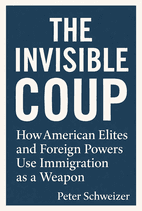
5 Main Takeaways from The Invisible Coup
Foreign governments exploit migration as a strategic weapon against the United States.
The book details how Cuba's Mariel Boatlift served as a proof of concept for using migration to export instability, and how Mexico and China actively organize political activism and military training within the U.S. to advance their interests, evading conventional military responses.
Progressive political alliances enable hostile actors to influence U.S. policy.
Schweizer documents functional alliances between segments of the American left and Islamist groups, drug cartels, and foreign leaders like Mexico's AMLO, who share goals like open borders that benefit adversarial agendas while transforming American society.
U.S. immigration systems are deliberately weakened for political gain.
Examples include the politicized streamlining of naturalization under Democratic administrations to create new voters, as seen with Alejandro Mayorkas at USCIS, and the exploitation of asylum fraud facilitated by nonprofits coaching migrants on qualifying narratives.
Religious and ideological institutions play a key role in promoting mass migration.
Under Pope Francis, the Catholic Church formed alliances with progressive donors and activists to view migration as a tool against Western capitalism, directly intervening in U.S. politics and aligning with radical groups opposing border enforcement.
A multi-pronged defense is needed to counter weaponized migration.
The book proposes legislative reforms like the Laken Riley Act, enhanced legal scrutiny using FARA, and cutting funding to NGOs that facilitate unchecked migration, while countering revolutionary ideologies imported through migrant networks.
Executive Analysis
"The Invisible Coup" posits that the United States is under a sustained, covert assault using mass migration as a primary weapon. Schweizer connects dots from Castro's Mariel Boatlift to Mexican consular activism, Chinese military infiltration, progressive-cartel alliances, and Vatican policy shifts, arguing that these disparate forces are collectively undermining American sovereignty and social cohesion. The five key takeaways reveal a pattern where foreign interference, domestic political manipulation, and ideological subversion converge to exploit weak immigration systems for transformative ends.
This book matters because it reframes immigration from a policy debate to a national security crisis, urging readers to recognize the strategic motivations behind migration flows. As a work of investigative journalism, it challenges mainstream narratives and provides a controversial yet meticulously documented perspective that demands scrutiny from policymakers and citizens alike. Its practical impact lies in empowering readers to question the origins and beneficiaries of immigration policies and to support defensive measures outlined in the final chapter.
Chapter-by-Chapter Key Takeaways
Proof of Concept (Chapter 1)
The 1980 Mariel Boatlift was not a humanitarian crisis but a deliberate, state-sponsored attack by Cuba, designed to export crime, disease, and instability to the United States.
The operation succeeded because U.S. authorities, committed to a narrative of humanitarian rescue, willfully ignored early warnings and evidence of hostile intent.
Castro proved migration could be a devastatingly effective asymmetric weapon, inflicting damage comparable to Pearl Harbor or 9/11 but evading a conventional military response.
This "proof of concept" created a lasting strategic template, inspiring and enabling a network of state and non-state actors—coordinated through groups like the São Paulo Forum—to adopt mass migration as a primary weapon against American sovereignty and social cohesion.
Try this: Analyze migration crises for signs of state-sponsored hostility, not just humanitarian need.
Mexico’s Reconquista of the US Is Real (Chapter 2)
The Mexican government formally enlisted major U.S. activist and labor organizations to lobby for its interests, creating a vast political network.
Mexican diplomats conducted this political organizing covertly, denying it to the U.S. public while promoting it within Mexican-American communities.
This model of extraterritorial political influence was copied by other Latin American nations, amplifying foreign intervention in U.S. domestic affairs.
The organized network demonstrated its power by mobilizing millions in 2007 to successfully shift U.S. policy, with some participants openly celebrating a reconquest of lost territory.
Try this: Scrutinize foreign government lobbying and political organizing within the U.S. as potential interference.
Mexico: Organizing Militancy in the US (Chapter 3)
The Mexican government, through its consulates, foreign ministry, and state-funded organizations, plays a direct and active role in organizing, funding, and supporting political activism within the United States.
Key protest leaders in the U.S. often hold formal advisory or legislative roles within the Mexican government, creating a direct channel for foreign political influence.
Activism is driven by a powerful cultural narrative that rejects assimilation, frames the U.S. Southwest as occupied land, and positions migrant identity in opposition to Anglo-America.
The movement contains a radical faction that explicitly advocates for Reconquista—the liberation and reunification of Mexican territory—a view that finds sympathetic voices within the Mexican political elite.
Mexican officials have moved from supporting protests to appearing to endorse and glorify violent resistance and lawlessness on U.S. soil, framing it as a legitimate defense of the migrant community.
Try this: Investigate the ties between U.S. activist leaders and foreign governments to uncover influence channels.
Voter Mills (Chapter 4)
The naturalization process under Democratic administrations has been deliberately streamlined and politicized to create new voters aligned with progressive policies.
Figures like Alejandro Mayorkas actively corrupted USCIS procedures, prioritizing high approval rates over legal integrity and fraud prevention.
Taxpayer funds have been used to support campaign-style initiatives to naturalize immigrants ahead of elections.
The stated goal, as admitted by officials, is to alter the demographic and political makeup of the United States, with conscious disregard for security risks.
Try this: Audit naturalization processes for political bias and fraud to ensure electoral integrity.
China: The Manchurian Generation (Chapter 5)
China employs a multi-pronged strategy of political interference within the U.S., utilizing United Front groups, alleged voter fraud schemes, and mobile consulates to influence elections and policy.
Beijing-aligned radical groups actively work to create domestic unrest and political instability, coordinating with other anti-American movements.
China systematically exploits U.S. immigration and educational openness to train thousands of pilot cadets on American soil, directly bolstering its military aviation capabilities through its Military-Civil Fusion doctrine.
Critical decisions by U.S. institutions—from the FBI to Congress—have at times inadvertently facilitated or concealed these activities, highlighting a dangerous gap between perceived threats and operational reality.
Try this: Monitor foreign military and political training programs on U.S. soil as national security threats.
Progressives and Drug Cartels (Chapter 6)
A functional political alliance exists between segments of the American progressive left and Islamist actors, who provide organized voting blocs in exchange for support on immigration and foreign policy.
Islamist ideology views mass migration (hijrah) as a strategic tool for civilizational expansion and eventual domination, a goal often obscured or ignored by their progressive allies.
Organizations like Progressive International formalize cross-border leftist collaboration, but have been compromised by the inclusion of individuals tied to narcotics cartels, aligning the group's "open borders" agenda with the financial interests of criminal empires.
The chapter argues that both radical Islamists and drug cartels view progressive movements as useful instruments for achieving their own objectives, which ultimately involve the fundamental transformation or subversion of Western societies.
The election of AMLO in Mexico represented a pivotal victory for cartel interests, as he formally ended prosecution of the drug war, hobbled the DEA, and is alleged to have received cartel campaign financing.
U.S. progressive politicians and organizations like Progressive International actively cultivate relationships with, and parrot the policy goals of, Latin American leaders accused of deep ties to drug cartels.
Core progressive policy goals—open borders and ending the "war on drugs"—functionally enable the business models of drug cartels and human trafficking networks.
A serious question is raised about whether this alliance stems from political naivete or a deliberate, cynical prioritization of ideological transformation over national security and public health.
Try this: Examine the alliances between progressive movements and criminal or extremist groups for hidden agendas.
Transforming America (Chapter 7)
Pope Francis's theology consciously de-emphasized Western Christian traditions in favor of indigenous and liberationist perspectives, viewing mass migration as a tool to combat Western individualism and capitalism.
His policies sparked significant internal Church opposition, led by figures like Archbishop Vigano, who warned of cultural dissolution and conflict of interest.
Strategic alliances were formed with secular progressive donors and organizations, like those funded by George Soros, to influence U.S. politics and immigration policy.
Francis directly intervened in the 2016 U.S. election and used platforms like the World Meeting of Popular Movements to align the Church with radical activist groups opposing border enforcement.
The institutionalization of his migration agenda within the Vatican bureaucracy and the optimistic reaction of liberation theologians to his successor suggest this transformative project may endure.
The narrative reflects on the enduring influence of the Catholic Church amidst internal uncertainties. Whether the strategic shifts within the institution are ultimately prudent or merely aspirational remains to be seen. While the current leadership under Leo may not embody the transformative vision of his predecessor Francis, there is an underlying confidence that the foundational structures and machinery established within the Church are resilient enough to withstand any potential reforms he might introduce. Most significantly, this portion of the chapter underscores the profound and deliberate role the Catholic Church has played, through alliances with foreign governments and various movements, in precipitating what is described as the greatest subversive act in American history. This highlights how religious institutions can wield substantial political and social power beyond their spiritual domains.
The effectiveness of recent changes within the Catholic Church is still uncertain, pending future outcomes.
Leadership transitions, such as from Francis to Leo, emphasize a balance between change and institutional durability.
The Catholic Church's collaborations with external forces have been pivotal in orchestrating significant subversive events in American history.
Try this: Assess religious institutions' political activism on migration for its transformative societal impact.
The Surge (Chapter 8)
Mexico and Nicaragua quietly restructured their laws and visa policies in anticipation of a more permissive US administration, creating a coordinated corridor that funneled migrants from around the world to the US border.
The Biden administration’s policies, language shifts, and pre-election planning signaled an openness that produced record-breaking migration numbers and a dramatic change in the origin and composition of border crossers.
Cartels, smugglers, and hostile foreign regimes exploited these conditions for profit and strategic gain, while nonprofits, international organizations, and local US governments built an extensive support infrastructure that further normalized and accelerated the flow.
Venezuelan criminal gangs have established operations in the U.S., contributing to violence while Venezuela's domestic crime rates decline.
Elaborate fraud schemes, including false abuse claims under the Violence Against Women Act, are exploited to gain legal residency.
Document fraud and identity manipulation are common, strategic practices among migrants.
Some progressive voices justify migrant fraud as a form of resistance against systemic barriers.
Nonprofits coach migrants on asylum claims, using psychological methods to craft qualifying narratives, which may compromise the asylum system's legitimacy.
The migration surge is viewed as a politically motivated demographic shift, aimed at permanently changing American society and voter demographics.
Try this: Verify migrant claims and documentation rigorously to combat fraud and maintain asylum system legitimacy.
Fighting Back (Chapter 9)
Training Exploitation: Western civilian aviation resources are targeted by foreign militaries, particularly China, for strategic knowledge gain, creating a national security blind spot.
Immigration as a Platform: Activist networks involved in immigration advocacy are portrayed as being ideologically aligned with, and sometimes directed by, adversarial foreign political movements.
Ideological Merging: A tactical alliance exists between Islamist organizations pursuing "civilization jihad" and segments of the progressive left, united by opposition to traditional American power structures.
Direct Political Access: Adversarial states, including Iran, are alleged to successfully cultivate influence and lobbying power within the U.S. Congress through supportive political figures and affiliated advocacy groups.
Controversies Surrounding US Politicians
This section details allegations and criticisms against several progressive U.S. representatives. Congresswoman Rashida Tlaib is scrutinized for her membership in a secret Facebook group accused of "glamorizing" Hamas, and she has publicly called to defund U.S. immigration agencies. Ilhan Omar has condemned the vetting of immigrants' social media as "fascism in action" and is cited for promoting a "Somalia first" agenda. Reports also suggest potential ties between Representative André Carson and the Muslim Brotherhood, while Congresswoman Debbie Dingell is noted for maintaining connections with a Michigan imam, Mohammad Ali Elahi, described in MEMRI reports as extremist and antisemitic. The narrative extends to New York mayoral candidate Zohran Mamdani, whose support from Islamist figures and celebration by Hezbollah-linked outlets raises questions about his affiliations.
Immigration and Border Policy Debates
Aligned with their progressive stance, these politicians advocate for looser immigration controls. Tlaib and Omar have repeatedly criticized border security measures, with Tlaib urging the defunding of agencies like ICE. This perspective is bolstered by academic works and activist narratives that frame refugees as agents who "transform and enhance our societies," arguing for open borders as a moral imperative. The section contrasts this with warnings from figures like Czech President Miloš Zeman, who alleged the Muslim Brotherhood uses migration as an "invasion force" to seize control in Europe.
European Incidents and Responses
A significant portion of the text focuses on the mass sexual assaults in Cologne, Germany, on New Year's Eve 2016, where hundreds of women were attacked by groups described as predominantly migrant men. Similar incidents are reported in Helsinki, Zurich, and other European cities. The reaction was polarized: some Muslim clerics, like those in Vienna, preached against sexual harassment, while others controversially blamed victims for wearing perfume. A German Muslim group suggested banning alcohol to aid integration and prevent further attacks. Feminist voices, such as Alice Schwarzer, decried the events as "sexual terrorism," highlighting a clash between progressive multicultural policies and women's safety concerns.
Progressive International and Latin American Ties
The narrative shifts to the global network of the Progressive International, highlighting its inclusion of Latin American leaders with controversial backgrounds. Ecuador's former president Rafael Correa, whose father was a drug smuggler, faces U.S. sanctions for corruption, yet the Progressive International frames this as persecution. Colombian President Gustavo Petro, who advocates for cocaine legalization, is embattled by scandals including his son's admission that drug money financed Petro's campaign. U.S. progressive lawmakers, notably Alexandria Ocasio-Cortez, have forged strong ties with these figures, leading congressional delegations to Chile, Brazil, and Colombia—a trip funded by Soros-linked organizations. They promote dismantling the Monroe Doctrine in favor of a "New Good Neighbor" policy, aligning with the Progressive International's vision of "economic liberation" for the Global South, despite the alleged entanglement of some allied governments with narcotics trafficking and organized crime.
A multi-pronged defensive strategy is emerging, combining proposed legislation (e.g., the Laken Riley Act, birthright citizenship reform), enhanced legal scrutiny (using FARA), and stricter oversight of visa categories (EB-5, student visas, R-1 religious worker visas).
Countering weaponized migration requires directly confronting the foreign interference apparatus, including the political operations of consulates, the exploitation of investment visa programs for political gain, and security risks in sectors like pilot training.
The battle extends into the financial and ideological spheres, aiming to cut funding to NGOs that facilitate unchecked migration and to robustly counter the revolutionary ideologies—from Marxism to Islamism—that are actively imported and promoted through migrant networks.
This final section weaves together a diverse array of figures, movements, and concepts that encapsulate the chapter's core theme of resistance. References to Siraj Wahhaj and Ayman al-Zawahiri anchor discussions on terrorism, connecting to the backdrop of the World Trade Center attacks, while the 2017 Women's March and mentions of white supremacy illustrate the spectrum of social and ideological conflicts. Economic dimensions emerge through entities like the Wanxiang Group and individuals such as Wang Wenliang, highlighting how global business interests intersect with broader geopolitical struggles.
Technology's pervasive influence is noted through platforms like WeChat, WhatsApp, and YouTube, which serve as tools for communication and mobilization in these battles. Institutional responses are represented by the War on Drugs, figures like FBI Director Christopher Wray, and legal advocates such as Stephen Warnath, emphasizing governmental and judicial avenues for fighting back. The World Meeting of Popular Movements underscores organized civil society efforts, contrasting with cultural debates over Western values and Yankee fundamentalism.
Media and popular culture, from The Wall Street Journal to The West Wing, are presented as shaping public understanding of these issues. The section closes by introducing author Peter Schweizer, contextualizing the investigative lens through which the narrative is framed.
Terrorism and ideological extremism remain pivotal concerns, driving responses from both security apparatuses and grassroots movements.
Economic leverage and digital platforms are integral to modern strategies of resistance, influence, and control.
Social mobilization and policy frameworks, such as the War on Drugs, represent complementary approaches to addressing systemic threats.
Cultural narratives and media portrayals significantly impact how societies perceive and engage in conflicts.
Try this: Advocate for legislative and legal reforms to counter weaponized migration and foreign influence.
Continue Exploring
- Read the full chapter-by-chapter summary →
- Best quotes from The Invisible Coup → (coming soon)
- Explore more book summaries →