The Gap and The Gain Quotes
by Benjamin Hardy
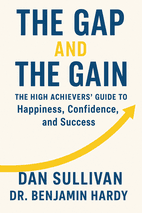
Here you'll find a collection of the most powerful lines from The Gap and The Gain. Each quote distills a simple but profound idea about how we measure success and happiness. The book is endlessly quotable because it reframes familiar struggles into clear, actionable truths. These lines stick with you, offering a new way to see your own progress. Whether you need a quick reminder or a deeper insight, these words will help you shift from comparing yourself to others to celebrating how far you've come.
Top Quotes from The Gap and The Gain
“You, and you alone, are the person who should take the measure of your own success. 1 do not try to be better than anyone else. I only try to be better than myself.”
Dan Jansen, champion speed skater, opens the chapter with this personal motto.
It encapsulates the core message of measuring success against yourself rather than others, which is central to the GAIN mindset.
“Happiness is not something you pursue. Happiness is not somewhere in the future. Decades of scientific research is clear on this point: happiness is where you start, not where you finish.”
The author summarizes decades of research on happiness and its role in performance.
It reframes the common misconception that happiness is a distant goal, emphasizing it as a starting point for growth and high performance.
“There's a quiet confidence that comes from running your own race, from no longer measuring or comparing yourself to others.”
This appears near the end of the chapter, referencing the philosopher Seneca's concept of euthymia.
It evokes a peaceful, assured state of being that readers aspire to, contrasting sharply with the anxiety of constant comparison.
“The only way to measure the distance you've traveled is by measuring from where you are back to the point where you started.”
Quoting Dan Sullivan, founder of Strategic Coach, presented as the core lesson of the chapter.
It provides a clear, actionable definition of backward measurement, the central technique of the chapter.
“There is nothing noble in being superior to your fellow man; true nobility is being superior to your former self.”
Opening epigraph attributed to Ernest Hemingway, setting the theme of measuring against oneself rather than others.
This line reframes nobility as personal growth rather than competition, making it a timeless and aspirational call to focus on self-improvement.
“Every day you measure the GAIN, you're happier than you were yesterday. You're further than you were yesterday. You're freer than you were yesterday. You're more yourself than you were yesterday.”
A summary of the benefits of adopting a 'GAIN' mindset, measuring progress backward daily.
The rhythmic repetition drives home the compounding effect of this practice, making happiness feel both immediate and cumulative.
Themes Behind the Quotes
A central theme is the distinction between measuring backward versus measuring forward. Measuring backward means looking at where you started and appreciating your progress, while measuring forward means comparing yourself to an ideal that always keeps you feeling behind. The quotes emphasize that happiness is an internal choice, not something you chase after achieving external goals. Another key idea is self determination. You decide what success means for you, and you run your own race without needing approval from others. This mindset builds quiet confidence and resilience. The book also explores how perception shapes reality, and that every experience can be interpreted in a way that fuels growth rather than frustration. Ultimately, the message is to focus on your own journey, celebrate small gains, and trust that consistent effort leads to lasting change.
Quotes by Chapter
Chapter 1: Embrace the Freedom of “Wants”: Avoid the Attachment of “Needs”
“Training yourself to be happy is completely internal. There is no external progress, no external validation. You're competing against yourself—it is a single-player game.”
Naval Ravikant, entrepreneur and investor, is quoted on the nature of happiness.
It reinforces the internal nature of happiness and success, aligning with the chapter's theme of avoiding external needs and attachments.
“In the wanting world, there is an abundance of resources as a result of the creativity and innovation that comes from wanting.”
From the section 'Wanting Creates Abundance' in the chapter.
It redefines wanting as a creative, abundant force rather than a scarcity-driven need, empowering readers to embrace desires without desperation.
Chapter 2: Be Self-Determined: Define Your Own Success Criteria
“Being self-determined means that you've decided what success means to you, and you don’t need anyone else's permission for what you want for yourself.”
This passage explains the concept of self-determination within the chapter.
It powerfully asserts personal autonomy over one's definition of success, freeing readers from seeking external validation.
“Your happiness as a person is dependent on what you measure yourself against.”
This appears in a discussion about the GAP versus the GAIN and the role of reference points.
It distills a profound psychological truth into a simple, memorable line that can shift how readers evaluate their own contentment.
“Success is measured by you. No one else can set your happy meter.”
Sandi McCoy, who lost over 240 pounds, shares this on her Instagram account.
It is a direct, empowering call to own one's own standards of success, reinforced by a real-life transformation story.
Chapter 3: The Compound Effect of the GAP or GAIN: Train Your Brain to See GAINS
“The way you interpret an experience literally affects how your body metabolizes that experience. Perception shapes biology.”
The author states this while explaining the field of epigenetics and how perception shapes biological responses, citing studies on exercise and milkshakes.
It empowers readers by showing that their mindset has a direct physiological impact, giving them agency over their health. The simple, declarative sentences make the concept memorable and actionable.
“Being in the GAIN doesn’t just make you happier. It makes you more resilient to challenges. It increases your health and longevity.”
The author summarizes the benefits of the GAIN mindset after sharing the story of his friend Jeff's divorce.
It offers a hopeful and practical takeaway that the GAIN mindset not only improves happiness but also builds resilience and longevity. The three parallel statements reinforce the comprehensive benefits.
“The GAP robs you of enjoying your life. It robs you of appreciating what you already have. It completely kills the reward of any positive experience you have or progress you make.”
The author describes the negative effects of the GAP mindset using examples of his children with spoons and cookies.
It vividly captures how the GAP mindset destroys appreciation and satisfaction. The repetition of 'robs you' drives home the sense of loss, making readers reflect on their own tendencies.
“Research shows that optimistic people often live 10+ years longer than pessimistic people.”
The author references a longitudinal study of Catholic nuns to illustrate the compound effect of positivity on lifespan.
This statistic is startling and memorable, providing a concrete incentive to adopt a GAIN mindset. It underscores that happiness is not just a feeling but a health factor.
Chapter 4: Always Measure Backward: Increase Your Hope and Resilience
“You can’t connect the dots looking forward; you can only connect them looking backwards.”
Opening epigraph attributed to Steve Jobs (with a typo in the text).
This quote elegantly summarizes the principle of backward measurement, reminding readers that understanding and appreciating progress requires looking back.
“You are always growing, and you continually measure yourself in terms of growth.”
Said by Jill Bishop, a physical therapist, about her philosophy for working with special needs children.
It reinforces the idea that constant growth is the metric, not a fixed endpoint, which is empowering and hopeful for anyone facing challenges.
“A mind that is stretched by a new experience can never go back to its old dimensions.”
Quoting Oliver Wendell Holmes, Jr., used to explain how past experiences permanently change our perspective.
This phrase vividly captures the transformative power of growth and why we cannot simply revert to old ways of thinking.
Chapter 6: Transform EVERY Experience into a GAIN: Take Ownership of Your Past
“No system works all the time, but there is always something that’s working.”
Howard Getson's epiphany during the 2008 financial crisis after losing over $2 million in a single day.
This line reframes failure as a signal to look for what is still effective, empowering readers to shift focus from loss to opportunity.
“Meaning and value aren't given to us. We create our own meaning and value for every experience.”
A key insight following Howard Getson's story about transforming a devastating loss into a strategic breakthrough.
It encapsulates the chapter's core message of ownership, reminding readers that they have the power to define their own experiences.
“Life is simple. Everything happens for you, not to you. Everything happens at exactly the right moment, neither too soon nor too late. You don’t have to like it. . . . It’s just easier if you do.”
A quote from Byron Katie that appears in the chapter on taking ownership of your past.
This profound perspective shift challenges readers to see adversity as purposeful and to embrace acceptance for greater ease.
“When people stop spending their energies on justifying what they want, they free themselves up to focus on creativity and innovation.”
From the section 'FREE YOURSELF FROM JUSTIFICATION' in the chapter.
It highlights how letting go of defensiveness opens mental space for growth and new possibilities, a liberating insight for personal development.
Conclusion
“Rather than measuring yourself against an ideal, as Jefferson subscribed, there is a much better formula for happiness, confidence, and success: always measure backward.”
The authors contrast Jefferson's 'pursuit of happiness' with their own method of measuring progress from where you started.
It provides a clear, actionable alternative to the common but flawed ideal-chasing approach, empowering readers to feel accomplished by tracking their own growth.
“Trust me when I say that one day it’s going to hit you—that you woke up happy, that you're smiling for no reason, that your hands aren't shaking anymore. One day, you're going to remember what it was like to be you a year ago, or three years ago, or even a week ago, and you're going to be so glad that you fought. You're going to be so glad that you kept going.”
A quote from popular blogger Bianca Sparacino, included as a motivational reminder of the payoff of perseverance.
This vivid, emotional promise resonates deeply with anyone who has struggled, offering hope that the fight will be worth it and that happiness is attainable.