The Gap and The Gain Key Takeaways
by Benjamin Hardy
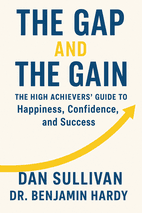
5 Main Takeaways from The Gap and The Gain
Shift from external needs to internal wants for freedom and performance.
The book teaches that attachment to external 'needs' traps you in the GAP, focusing on an elusive future, while embracing internal 'wants' fosters harmonious passion and high performance. For example, by viewing goals as desires rather than compulsions, you can operate from a place of freedom and full commitment in the present.
Define success by your own standards, not by comparing to others.
Using external reference points like societal benchmarks keeps you in the GAP, but self-determination allows you to create personal success criteria. This internal measurement leads to autonomy and happiness, as you filter decisions through your values and accelerate toward self-defined goals.
Train your brain to recognize and compound positive gains daily.
The compound effect of the GAP versus GAIN impacts well-being and longevity, with GAIN-focused habits fostering happiness. Practices like mental subtraction—imagining life without a positive event—and implementation intentions, such as the 5-minute rule, help reframe setbacks and build new behaviors that amplify gains.
Measure progress backward to build hope and resilience.
Regular reflection on past achievements, through journaling or annual reviews, helps you see how far you've come from your former self. This backward measurement counters the tendency to forget gains, boosts hope, and motivates future action without falling into comparison traps.
Transform every experience into a gain by owning your narrative.
The GAIN mindset empowers you to control the meaning of your past, using tools like the Experience Transformer to turn setbacks into growth opportunities. By practicing proactive gratitude and deliberate rumination, you become antifragile, better equipped to handle challenges and clarify values.
Executive Analysis
The five key takeaways collectively articulate the book's central thesis: that sustained well-being and high performance come from shifting from a 'GAP' mindset—constantly measuring oneself against an ideal future—to a 'GAIN' mindset—measuring progress from a past starting point. This shift requires internalizing success criteria, training the brain to recognize gains, and proactively reframing all experiences as growth opportunities, cultivating freedom, resilience, and intrinsic motivation.
'The Gap and The Gain' matters because it provides a practical, evidence-based framework for overcoming the comparison trap and achieving personal fulfillment. In the crowded self-help genre, it distinguishes itself by emphasizing backward measurement and psychological flexibility, offering tools like the Experience Transformer™ that enable readers to build antifragility and maintain momentum regardless of circumstances.
Chapter-by-Chapter Key Takeaways
Embrace the Freedom of “Wants”: Avoid the Attachment of “Needs” (Chapter 1)
The GAP stems from unhealthy needs or external attachments, keeping you focused on escaping "here" to reach an elusive "there."
The GAIN is rooted in harmonious passion and intrinsic motivation, allowing you to be content and free in the present moment.
"Freedom from" addresses external constraints, while "freedom to" empowers internal choice and self-direction.
Ideals should inspire rather than measure progress, helping you shift from compulsion to conscious living.
Embracing the GAIN enables full commitment and high performance, as you operate from a place of want, not need.
Try this: Audit your motivations by distinguishing one 'need' you can reframe as a 'want,' freeing yourself from external attachment and operating from conscious choice.
Be Self-Determined: Define Your Own Success Criteria (Chapter 2)
External reference points, such as societal standards or social media comparisons, keep you in the GAP by making success unattainable and shifting.
Shifting to internal reference points through self-determination allows you to define and achieve success on your own terms, fostering happiness in the present.
Living in the GAIN means measuring your progress against yourself, not others, leading to autonomy and intrinsic motivation.
Creating and applying personal success criteria as decision filters empowers you to stay aligned with your values and accelerate toward your goals.
Try this: Define three personal success criteria based on your values and use them to evaluate your decisions this week, ensuring alignment with your internal standards.
The Compound Effect of the GAP or GAIN: Train Your Brain to See GAINS (Chapter 3)
Being in the GAP creates a negative compound effect, while being in the GAIN fosters a positive one, with happy people often living 10+ years longer.
How you frame experiences influences how your body processes them, and having language for the GAP and GAIN helps you perceive and use these concepts.
Call yourself out when in the GAP and encourage loved ones to do the same, fostering accountability.
Practice mental subtraction to appreciate GAINS by imagining life without positive elements.
Use implementation intentions and Tiny Habits, like the 5-minute rule, to pre-plan responses to setbacks and build new, GAIN-focused behaviors.
Try this: When faced with a setback, immediately call yourself out for GAP-thinking and apply a pre-planned 5-minute action to redirect your focus to a GAIN.
Always Measure Backward: Increase Your Hope and Resilience (Chapter 4)
Regular reflection on past beliefs and achievements helps you recognize growth, boosting hope and resilience.
Journaling or annual reviews provide context to see how far you’ve come, counteracting the tendency to forget GAINS.
Embracing the “joy of being wrong” fosters continuous learning and personal evolution.
Measuring GAINS across different time frames (e.g., 90 days) reinforces progress and motivates future action.
Sharing GAINS in a supportive environment enhances motivation without falling into comparison traps.
Always measure backward to anchor your growth and build a foundation for moving forward.
Try this: Set a recurring reminder to journal three accomplishments from the past week, comparing them to where you were 90 days ago to visualize your growth.
Next chapter: “Transform EVERY Experience into a GAIN: Take Ownership of Your Past” is locked
Keep learning from The Gap and The Gain — and unlock all 600+ book summaries with audio, mindmaps and AI Q&A.
$0.00 due today · 7 days free, then $89.99/year ($7.49/mo) · Cancel anytime before day 7
plus sales tax where applicable