The Freedom-Based Business Method Quotes
by Natalie Ellis
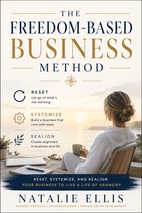
These quotes capture the essence of building a business that gives you life instead of draining it. You will find unfiltered truths about burnout, the trap of doing too much, and what freedom really means. The book earns its shareability because it reframes familiar struggles in a way that feels both honest and hopeful.
Natalie Ellis writes with a direct, conversational style that makes deep ideas feel accessible. Her words are not just inspirational but practical, offering a new lens on work and worth. That combination makes them easy to remember and pass along.
Top Quotes from The Freedom-Based Business Method
“Your upper limit is a subconscious ceiling on how good you're allowed to feel.”
The author introduces Gay Hendricks's concept of the upper limit problem.
This succinct phrase powerfully explains why people self-sabotage when things start going well, resonating with anyone who has felt stuck after success.
“Freedom isn't about having fewer obligations—it's about choosing your obligations consciously.”
The author concludes the chapter by defining freedom in terms of conscious choice.
This line reframes freedom from a negative (fewer obligations) to a positive (conscious choice), empowering readers to take control of their decisions.
“Your value is not defined by your productivity. It’s about how you experience and interact with your life and the people around you.”
The author encourages readers to prioritize inner state over external accomplishments.
This quote challenges the hustle culture mindset and validates that self-worth comes from presence and connection, not output.
“FREEDOM DOESN'T COME FROM DOING MORE. It comes from doing less—on purpose.”
Opening of chapter, author states her core philosophy.
It reframes productivity as purposeful reduction, a counterintuitive insight that resonates with overwhelmed entrepreneurs.
“More is not better. Mastery is better.”
After discussing Basecamp's pivot to focus on one product.
Simple, rhythmic, and profound—easily quotable as a mantra for business simplification.
“Most successful people aren't doing anything revolutionary. They're certainly not doing anything you can’t do. They're just consistent in what they do, day after day, and they know what they're working toward.”
The author reflects on entrepreneur Justin Welsh’s insight about the secret to success.
It demystifies success and replaces the myth of a secret formula with the relatable, achievable power of daily consistency and clear goals.
“I believe you can have it all if you don’t do it all.”
The author counters the false belief that success requires doing everything yourself.
This pithy, memorable line encapsulates the entire philosophy of the chapter—that letting go leads to having more.
Themes Behind the Quotes
The central theme is redefining freedom. It is not about having an empty calendar but about deliberately choosing your obligations and feeling safe enough to enjoy them. The book challenges the belief that more effort equals more success, instead advocating for purposeful reduction and mastery over a single thing.
Another key thread is the inner work required to break the burnout cycle. Your own subconscious limits and fear of success can hold you back. The book emphasizes that your worth is separate from your output, and that sustainable success comes from consistent rhythms, smart delegation, and trusting your best self to make things happen.
Quotes by Chapter
CHAPTER 1 Free from Burnout
“You start your business and, over time, opportunities turn into tasks that pile up, and you become overwhelmed and stretched a little thin.”
The author describes the typical progression of an entrepreneur into burnout.
This line captures the subtle, creeping nature of burnout that many entrepreneurs experience, making it highly relatable.
“Here is the deepest reason that you repeat the burnout cycle over and over again: You are subconsciously trying to protect yourself.”
The author reveals the core insight behind repeated burnout patterns.
It reframes burnout as a protective mechanism rather than a personal failing, offering a compassionate and eye-opening perspective.
“That's what I think freedom really is: not just having less on your calendar, but feeling safe enough to enjoy it.”
The author defines freedom in the opening of the chapter.
This reframes freedom from mere scheduling to an internal sense of safety, which is a profound and relatable insight for overwhelmed entrepreneurs.
CHAPTER 2 Free from Expectation
“Everything I'd worked for was right there—the financial freedom, the recognition, the impact—but I was miserable.”
The author describes her emotional state shortly after having her baby, despite achieving external success.
This line powerfully captures the dissonance between outer achievement and inner emptiness, resonating with anyone who has ever felt unfulfilled despite reaching their goals.
“I was living a life based on what I thought I should be doing— not what I truly wanted.”
The author reflects on her realization after asking herself why she kept pushing for more.
It articulates a universal struggle: the gap between societal expectations and personal desire, making readers question their own motivations.
“This kind of self-discovery work isn't nearly as much about becoming something new as it is about remembering who you always were.”
The author explains the deeper purpose of shedding expectations and 'shoulds.'
This reframes personal growth as a return to authenticity, offering hope that we don't need to become someone else but simply reconnect with our true selves.
“Beware of the sunk-cost fallacy. This is when you keep doing something that you might hate or know you need to let go of, but you've already spent so much time doing it, you feel like you have to keep doing it.”
The author warns readers about a common psychological trap during the Alignment Audit exercise.
It names a painful pattern many entrepreneurs experience, giving them language to recognize and break free from it.
CHAPTER 3 Free from Obligation
“Your best self achieves results. Your best self makes it happen. Trust your best self.”
The author emphasizes trusting oneself after completing the exercises.
The repetition and imperative tone inspire confidence and self-reliance, reinforcing that the reader's best self is capable.
“You're not just trying to get things done. You're trying to become someone.”
The author explains the deeper purpose of productivity systems in the To-Be List section.
It shifts the focus from task completion to personal transformation, making productivity meaningful and identity-driven.
CHAPTER 4 Free from Distraction
“Almost anything will work if you're willing to give it all of your attention, put your blinders on, keep your head down, and ignore distractions.”
Author explaining the power of focus after sharing her own journey.
It's a bold, actionable statement that challenges the 'more is better' mindset and emphasizes commitment over complexity.
“Free yourself from distractions and obsess over making one product or service great. That's the secret.”
Author summarizing her key advice after the example of a $29 product leading to seven figures.
Direct and memorable, it encapsulates the chapter's core message with a clear call to action.
CHAPTER 5 Free from FOMO
“My job isn’t to use social media. My job is to do work that other people want to talk about.”
Seth Godin said this during a podcast interview when asked about platform guilt.
It redefines the entrepreneur's focus from chasing algorithms to creating remarkable work that naturally spreads, freeing them from the pressure to be everywhere.
“You don’t need to be everywhere. You just need to be so deeply helpful in one place that the right people can’t help but talk about you.”
The author summarizes the lesson from Seth Godin's story about focusing on one platform.
This line powerfully reframes success as deep value rather than broad presence, giving readers permission to let go of FOMO and commit to mastery.
“If it's working for you, it is the best thing.”
The author dispels the myth that entrepreneurs must chase every new platform.
A simple yet liberating reminder that consistency and results matter more than trend-hopping, reducing anxiety about missing out.
“Algorithms are not your enemy. They are meant to work for you, and you can use them that way.”
The author explains how to treat social media as a tool rather than a trap.
This shifts the reader's mindset from fear to empowerment, encouraging strategic use of algorithms instead of feeling victimized by them.
CHAPTER 6 Free from Uncertainty
“Data is the North Star that has always shown me whether we're on track or falling behind.”
The author reflects on how relying on data has guided her business decisions.
This metaphor powerfully conveys that data provides clear, reliable direction amid entrepreneurial uncertainty.
“Data isn't about being good at math. It’s about being good at business.”
The author challenges the common excuse that tracking numbers is only for 'math people.'
It reframes data as a core business skill, making it accessible and essential for all entrepreneurs.
“Numbers, even when they're “bad,” aren't scary. Try not to see them as markers of success or failure but as helpful tools that aid in decision-making.”
The author encourages a healthy mindset shift around analyzing business metrics.
This destigmatizes negative data and empowers readers to use numbers for growth rather than fear.
“If you're not measuring it, you’re not managing it. You're just spending energy.”
The author summarizes a key principle at the end of the chapter's weekly review section.
It's a punchy, memorable reminder that effort without measurement is wasted, motivating readers to track their actions.
CHAPTER 7 Free from Chaos
“Natalie, I don’t think you need to quit. What you need is a rhythm.”
Brendon Burchard says this to Natalie after she breaks down feeling overwhelmed as a new mother and entrepreneur.
This line reframes burnout not as a need to abandon your dreams, but as a need for structure—simple, yet profoundly empowering.
“Think of business rhythms like your heartbeat. Your heart doesn't beat randomly—it follows a predictable pattern that keeps you alive.”
The author introduces the concept of business rhythms using a biological metaphor.
The heartbeat analogy makes the necessity of predictability visceral and memorable, grounding a business principle in a universal human experience.
“A rhythm isn’t a rigid schedule. It's a flexible framework that adapts to life’s chaos while keeping you moving toward your goals.”
The author clarifies the nature of business rhythms.
This distinction removes the fear of being locked into a strict routine and instead offers a compassionate, adaptable approach to productivity.
CHAPTER 8 Free from Overwhelm
“If you really want to have a freedom-based business, you need to learn the art of delegation.”
The author states this early in the chapter as the foundational premise.
It directly links the core goal of a freedom-based business to the essential skill of delegation, making it a clear and actionable takeaway.