The Freedom-Based Business Method Key Takeaways
by Natalie Ellis
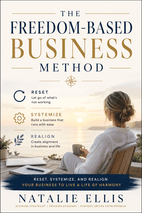
5 Main Takeaways from The Freedom-Based Business Method
Burnout stems from a dysregulated nervous system, not overwork.
The book reveals that burnout is a recurring cycle driven by a narrow window of tolerance. By regulating your nervous system and interrupting the trigger-story-reaction pattern at the first sensation of discomfort, you can break free from the chaos and choose differently.
Every yes is a no — choose your obligations consciously.
Freedom isn't about having fewer obligations; it's about selecting them deliberately. Use the Four D's framework (Do, Defer, Delegate, Delete) and let your 'To-Be' list—who you want to become—filter what you do, ensuring each trade-off serves your true priorities.
Simplify your funnel: one core offer and consistent rhythms.
Start with a single offer focused on transformation, not features. Build simple, repeatable sales and marketing rhythms that you follow even imperfectly. Simplicity beats complexity—track attendance and conversion rates, but don't overcomplicate early on.
Measure what matters: track the Big 3 metrics for certainty.
Data replaces uncertainty. Identify three metrics that directly impact your revenue and goals, then track them consistently. If you're not measuring, you're not managing—just spending energy. Start simple, expand gradually as you grow.
Harmony over balance: prioritize seasons and be fully present.
Replace rigid 50/50 balance with seasonal harmony. Identify your current season (sprint, growth, maintenance, recovery) and rank your Being and Doing Pillars. Give yourself permission to deprioritize business when needed, and commit fully to where your feet are—guilt fades when you honor the moment.
Executive Analysis
These five takeaways form a coherent framework for building a business that supports your life rather than consuming it. The book argues that true freedom starts internally—by regulating your nervous system to break the burnout cycle—and extends outward through conscious choice-making (obligations, offers), simplified systems (rhythms, data), and seasonal alignment. Together, they shift the entrepreneur from reactive chaos to intentional leadership, where work fits into a life you've designed.
This book matters because it integrates nervous system science with practical business systems, offering a rare permission slip for ambitious founders to prioritize themselves. Unlike typical productivity or hustle manuals, it directly addresses the emotional and physiological roots of burnout, overwhelm, and resentment. Its impact is deeply actionable: readers learn to trust their systems enough to step away, return from alignment more powerful than before, and build a business that truly frees them—not one that demands constant sacrifice.
Chapter-by-Chapter Key Takeaways
CHAPTER 1 Free from Burnout (Chapter 1)
Burnout is a recurring cycle, not a one-time event. The real driver is a dysregulated nervous system that feels safer in chaos than in calm.
Common self-stories (“I’m a perfectionist,” “Everything is a priority”) are surface symptoms. The root is a narrow window of tolerance.
The cycle follows: Trigger → Story → Reaction → Burnout → Temporary Relief → Repeat.
You can break the cycle at the initial sensation of discomfort—before you react. Choose differently, even if it feels unfamiliar.
Expanding your window of tolerance requires nervous system regulation, not just mindset work.
Try this: Pause at the first sensation of discomfort and ask what story you're telling yourself before reacting — this interrupts the burnout cycle at its root.
CHAPTER 3 Free from Obligation (Chapter 3)
Every yes is a no to something else—make this trade-off consciously, not by default
Use the Four D's Framework deliberately for every task: Do, Defer, Delegate, or Delete
Let your "To-Be" list guide your "To-Do" list—who you want to become filters what you choose to do
Freedom isn't about having fewer obligations; it's about choosing your obligations consciously
Try this: Apply the Four D's to every new task (Do, Defer, Delegate, Delete) and let your 'To-Be' list — the person you want to become — filter your daily choices.
CHAPTER 4 Free from Distraction (Chapter 4)
A conversion event needs storytelling, interactivity, and a thoughtful follow-up to actually convert.
Start with one core offer; add compact and chief offers only after your funnel runs smoothly.
Position offers around transformation and outcomes, not features.
Simplicity wins: a functional, focused funnel beats a complex, half-broken one every time.
Track attendance and conversion rates to refine your funnel, but don't overcomplicate early on.
Try this: Simplify your sales funnel to one core offer that promises a clear transformation, then track attendance and conversion rates before adding any extras.
CHAPTER 6 Free from Uncertainty (Chapter 6)
Data creates certainty. Numbers tell you what’s working so you can do more of it.
Start simple, expand gradually. Track the Big 3 metrics first, then add others as you grow.
Measure what matters. Focus on metrics that directly impact your revenue and goals.
If you’re not measuring it, you’re not managing it. You’re just spending energy.
Try this: Track your Big 3 metrics — the numbers that directly drive revenue — and review them weekly to replace uncertainty with data-driven decisions.
Next chapter: “CHAPTER 7 Free from Chaos” is locked
Keep learning from The Freedom-Based Business Method — and unlock all 600+ book summaries with audio, mindmaps and AI Q&A.
$0.00 due today · 7 days free, then $89.99/year ($7.49/mo) · Cancel anytime before day 7
plus sales tax where applicable