The Detective's Wife Quotes
by Mary Stone
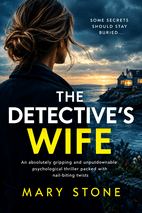
On this page you'll find lines drawn from dialogue, first person narration, and the kind of inner monologue that turns a thriller into something you underline. Some are sharp exchanges between characters, some are quiet observations about marriage and fear, and some sit right inside the narrator's head as she tries to read the people around her.
What makes the novel so quotable is the way it mixes domestic detail with psychological unease. The lines are short, tense, and often uncomfortably recognizable, whether they are about grief, control, attraction, or the stories people tell themselves to keep going.
Top Quotes from The Detective's Wife
“But the question isn’t whether I believe Conor Slater killed his first wife. It's why I married him anyway.”
— Jo
At the end of the ballroom scene, after Conor asks Jo if she knows he didn’t kill Hannah.
It turns the central mystery inward, making Jo’s marriage the real question. The line is a chilling, compact hook.
“That's what grief does eventually, or what humans need it to do. It sands down the edges so you can pick it up without bleeding.”
— Jo
Listening to Conor describe Hannah’s disappearance, Jo notices how smooth his account has become.
It turns grief into a physical object handled carefully enough to survive.
“When a woman reaches that place, it isn't usually Paris she moves toward. It's silence. The permanent kind. The one that doesn’t require a passport.”
— Jo
While weighing Esme’s article and Hannah’s late-night text, Jo considers what a woman might do after reaching a breaking point.
It reframes Hannah’s disappearance as possible self-erasure rather than escape, deepening the mystery.
“For seven days, I stop looking for danger. Maybe that’s the real honeymoon. The absence of vigilance. Even if I'm sleeping with a murderer.”
— Jo
During the first week after the wedding, Jo lets herself stop cataloging danger.
It captures the seductive relief of lowering her guard while naming the threat she is trying not to see. The line makes intimacy and suspicion feel inseparable.
“The mind is adorable like that. Show it one unlocked door and it starts planning escape routes as if the entire building isn’t still on fire.”
Hannah experiences college as her first taste of freedom from her mother’s control.
It captures how freedom can feel total even while old damage still surrounds and threatens her.
“You've been managing me and calling it love. I know you believe it's the same thing.”
— Anna
At the cemetery, Anna confronts Hannah over a lifetime of sisterly control.
It names the central wound between them: care that feels like domination and cannot be trusted.
“Because I miss having thoughts that belong to me. Because I'm disappearing in this house one invisible sacrifice at a time.”
— Hannah
Hannah holds the check from her first paid decorating job as Conor dismisses her need to work.
It captures the quiet erasure of identity beneath domestic comfort, making her desire for work feel like survival rather than indulgence.
Themes Behind the Quotes
The quotes circle around marriage as both shelter and trap. Trust is never simple here, especially when love is tangled up with control, jealousy, and the sense that someone is always managing someone else. Fear and intimacy sit side by side, and the reader keeps wondering which version of a person is the real one.
Another major thread is grief and self-erasure. Characters carry old wounds into present relationships, and the domestic world becomes a place where small compromises can turn into disappearing. There is also a strong interest in perception: how people read danger, how they justify what they want to believe, and how much of another person remains hidden even in the closest rooms.
Quotes by Chapter
Chapters 1-3
“Not I didn’t kill her. You know I didn’t. A request for alignment. For intimacy. For trust.”
— Jo
Jo analyzes Conor’s careful phrasing after he asks whether she knows he didn’t kill Hannah.
It exposes how charm and intimacy can be used as manipulation. The forensic reading of a spouse’s words is sharp and unsettling.
“He'd be furious in that carefully restrained, condescending way, where the warmth of his voice is worse than shouting.”
— Jo
Jo imagines replacing a wedding photograph with Conor’s new plaque and anticipates his reaction.
It captures coercive control in a single image: calm warmth as a threat. The line is memorable because it makes quiet menace feel physical.
“Strong factual orientation. Clear adversarial understanding. Purposeful, organized answers across the board. Terrible performance.”
— Dr. Adair
Dr. Adair assesses Martin Moore’s competency answers during their interview.
It distills clinical observation into a devastating verdict. The final two words land like a diagnosis and a warning.
Chapters 4-7
“Phone calls flatten people. Details disappear. You miss the pauses, the body language, the tiny fractures that matter more than words ever do. Especially with violent men. Especially with detectives.”
— Jo
Driving to Sweetwater, Jo explains to herself why she needs to update Conor in person.
It captures how much dangerous communication lives in pauses and bodies rather than words.
“Most psychiatrists go into the profession to solve themselves. We pretend otherwise. We use cleaner language. Intellectual curiosity. Passion for vulnerable populations. Fascination with trauma systems. Most of us are lying.”
— Jo
On the drive, Jo reflects on why people enter her profession.
It exposes the self-deception behind helping others and quietly indicts the narrator’s own buried wounds.
“You're the first reason I've had to think about moving on.”
— Conor
At dinner, after explaining his plans to file for divorce, Conor admits what Jo has begun to mean to him.
It is a quiet romantic confession weighted by grief, timing, and Jo’s hidden calculations.
Chapters 8-10
“The smartest predators understand anticipation. Two can play that game.”
— Dr. Adair
At the drive-in, after Conor steps close and then retreats, Dr. Adair wonders whether his chivalry is calculated.
It captures the charged mutual suspicion beneath the romance and frames desire as a strategic contest.
“A man who loves his children isn't automatically innocent of other things. Attachment and darkness aren't mutually exclusive.”
— Dr. Adair
While watching Conor mask his anger over texts about Romy, Dr. Adair weighs what his devotion to his children does and does not prove.
It resists easy moral judgments and keeps the reader alert to the possibility that tenderness and danger can coexist.
“Some feelings are so old they live in the body instead of the memory.”
— Dr. Adair
As Conor describes Romy's refusal to leave her room, Dr. Adair recalls the helplessness of being twelve when family life shifts.
It names how early pain persists physically and intuitively, even when memory cannot fully account for it.
“The truly dangerous patients aren't always the loudest ones. Sometimes they're the ones mourning lives no one else believes ever existed.”
— Dr. Adair
After Cathy's unsettling account of her children and Mark Holloway, Dr. Adair reflects on which patients are most dangerous.
It complicates the usual image of danger and gives Cathy's grief a haunting, credible weight.
Chapters 11-15
“The words settle between us. My heart pounds so hard I feel it everywhere. I've been waiting for this moment for months. Planning for it. Dreaming of it. It's exactly what I wanted. Yet, I hesitate.”
— Jo
Conor has just told Jo to tell him to go.
It captures the split between desire and the moral hesitation that defines their affair.
“Strange how the end of a marriage can look so administrative. A missing woman reduced to tiny print beside a used tractor listing.”
— Jo
After the divorce publication notice runs, Jo lies awake beside Conor and reflects on the legal notice.
It turns a human disappearance into bureaucratic small print, sharpening the novel’s contrast between procedure and loss.
“Whatever problems we had...I loved her.”
— Conor
Conor defends himself to Jo after Esme Kincaid’s article implies he may have harmed Hannah.
The past tense is quietly damning and exposes how much about the marriage remains unresolved.
Chapters 16-19
“This is the version of Conor Slater that either makes him the most dangerous man I know or the most human one. I still don't know which.”
— Jo
Jo watches Conor in the cabin kitchen before the day has fully started.
It captures her uncertainty about whether his unguarded self is a warning or a relief.
“I need you beside me. In my bed. At my table. I need to wake up next to you instead of counting hours until I can see you again.”
— Conor
Conor asks Jo to marry him in the car outside her apartment complex.
The confession is raw and specific, turning longing into a vision of ordinary domestic life.
“You're not even close to being as pretty as my mom.”
— Romy
At the bowling alley, Romy compares Jo to Hannah during their first meeting.
It exposes Romy’s grief and loyalty as sharp adolescent cruelty.
“Romy isn’t cruel. She's drowning. And I'm standing too close to the water.”
— Jo
Jo absorbs Romy’s insult at the bowling alley and recognizes the pain underneath.
The line reframes cruelty as grief and shows Jo’s hard-won empathy.
Chapters 20-24
“Fear detonates through me so completely that the room sharpens into something hyper-real—the texture of the rug beneath me, the pressure of his hands and the fact that I can't move and he isn't moving and I'm afraid to breathe.”
— Jo
Conor pins Jo to the office floor with his hands at her throat.
The sentence renders terror as sensory overload rather than abstraction. Its long rush mirrors how fear freezes and sharpens everything at once.
“I believe he means it. That might be the scariest part.”
— Jo
After Conor apologizes following the office-floor episode.
It shows how sincere remorse can make a frightening moment harder to dismiss. The line captures the trap of loving someone whose regret does not make him safe.
“His first wife's clothes live in the primary closet. Mine live in cardboard.”
— Jo
Jo compares Hannah’s preserved wardrobe with her own unpacked boxes.
In one image, Jo is both wife and replacement: Hannah’s life remains curated while Jo’s is still provisional. It is a compact, cutting picture of a house that has not made room for her.
Chapters 25-29
“Strange things grew inside children who watched love being measured out and realized they were losing before they understood the game.”
After Anna leaves the crown behind, Hannah reflects on how her sister became watchful and strange.
It reframes Anna’s unsettling behavior as a wound from conditional love, not an innate defect.
“I need to learn how to unfuck myself after growing up in that house.”
— Anna
At their parents’ funeral, Anna explains why she chose to study psychiatry.
The blunt confession turns a respectable career choice into a survival strategy and indicts their upbringing.
Chapters 30-34
“You comment on what I wear. What I feed the kids. What I spend. How organized the house is. How much wine I drink. How often I work out. How often I leave the house.”
— Hannah
Hannah confronts Conor during an argument about her decorating work and spending.
The list rhythm makes control feel suffocating and ordinary, exposing how scrutiny hides inside care.