The Calamity Club Themes
by Kathryn Stockett
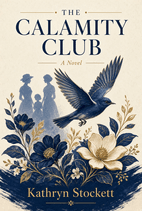
Underneath the plot, the novel is really wrestling with how institutions talk about virtue while practicing neglect, how women survive when money and respectability are tight, and whether a mother who leaves can ever come back. It keeps asking who gets protected, who gets shamed, and who has to lie to stay safe.
This page traces six themes with concrete moments: orphanage and Anti-Vice League hypocrisy, Meg's waiting and maternal longing, doorway and contraceptive secrecy, overdue taxes and class/racial hierarchy, coached lies, and women's limited control over work, sex, and fertility. It also follows recurring symbols: the ironic HOME IS WHERE THE HEART IS pillow, the blue-painted office and boarded-up window, ledgers, and Life magazine.
Major Themes in The Calamity Club
Institutional hypocrisy and moral policing
The novel repeatedly contrasts charitable and moral language with neglect, self-interest, and control. The orphanage and Anti-Vice League claim to protect girls while Garnett punishes Meg, diverts the girls' pay, and uses eugenic rhetoric; moral campaigns threaten the women at Idlewilde while the institution protects its own reputation.
- The Orphan's sign excludes many people and the Ladies' Lounge is plush while the girls eat gray lumpy meals and Miss Garnett is said to like rules more than people.
- Miss Garnett lets the inspector praise the blue paint and straightened books as her own work while Birdie learns the girls' pay goes to housing and board until they are sixteen.
- Garnett's award speech warns about feebleminded mothers and a moral deficit while Birdie remembers Meg locked in a moldy office and twelve-year-olds sent to a cannery.
- Anti-Vice League signs read 'Keep Mississippi straight' and Garnett confers with Sheriff Porter while Birdie thinks, 'Hypocrites adjourned.'
Abandonment, maternal longing, and reunion
Meg's story is organized around waiting for a mother who left, and the novel keeps returning to whether mothers return, why they leave, and who is allowed to claim a child. Charlie's search for Meg and Mama's final reappearance complicate the orphanage's story that Meg was simply abandoned.
- Meg's pretend play has her mother returning to take her home, and she begs the ladies to tell her where her mother went.
- Ava pins Meg down and makes her repeat 'Mamas do not come back,' and Meg eventually stops her pretend play.
- Charlie Lefleur arrives at the Orphan insisting she never meant to abandon Meg and asking Birdie to help find her daughter.
- Mama arrives in a motorcar, hugs Meg, whispers that she did not leave on purpose, and drives her away toward Memphis.
Respectability, shame, and secrecy
Characters constantly manage appearances: who may be seen at the front door, who may buy contraceptives, what a family can admit about money, sex, or adoption. The novel shows respectability as both a survival strategy and a source of cruelty, especially for women and children.
- Birdie, an unmarried churchgoing woman, must buy contraceptives secretly, and the counter lady worries about selling them to an unmarried lady.
- Frances sends Birdie around back because important ladies are inside, then begs her not to embarrass her and says the Tartts make the Calhouns look poor.
- Lucille scripts Meg's adoption story about Mrs. Georgia Tann and threatens to return her to the orphanage if she does not recite it.
- Birdie moves Mrs. Tartt and Frances into the attic and tells Charlie to put away the rubbers and book hotel rooms so the brothel stays hidden.
Economic hardship, class, and racial hierarchy
Money trouble drives nearly every plot turn, from overdue taxes and foreclosed houses to the brothel scheme. The notes also tie economic vulnerability to class and racial hierarchy: white families cling to status, Black workers are underpaid or invisible, and institutions decide who is adoptable or respectable.
- The Tates lose their home for back taxes, Birdie's family is down to about thirty-five dollars, and the bank demands $2,754 from Mrs. Tartt by September 15 or foreclosure.
- Rory has not paid Picador and Polly for three weeks while Frances charges $62.55 in new clothes, and Mrs. Tartt later dismisses the maids because she cannot keep them on.
- The grocery in Freedmen Town has no segregation signs and cheaper prices, while Buffaloe's Cafe has a handwritten Whites Only sign and Birdie feels conspicuous as a white lady there.
- Charlie says she is running a whorehouse so she can be Meg's mother again, and Birdie calculates that each partner has made just over $100 in two nights.
Deception and survival lies
Lying is taught, practiced, and institutionalized: children are coached to hide their pasts, adults withhold truths to protect or use each other, and the brothel depends on a legitimate front. The novel does not treat deception as simple villainy; it is often the tool of people with few options.
- Mama teaches Meg how to tell a lie and how to spot a liar, then instructs her to say her daddy died in the war if asked.
- Birdie sends her mother a watered-down letter and tears up the truthful one, then lies to Pripp that Frances and Rory are fine.
- Charlie insists the brothel will be a dance club because they will run a dance club as a front.
- Meg lies to Mrs. Heidelberg that there is no drinking in the house, practices her lying faces in the mirror, and keeps the spying arrangement secret from Tom and Lucille.
Women's precarious survival and bodily autonomy
The women in the novel repeatedly face limited choices about work, sex, fertility, and safety. The brothel passages expose both exploitation and solidarity, while Garnett's sterilization of Charlie and Virginia's medical work make control over women's bodies a central concern.
- Flossy says sometimes prostitution chooses you and describes her uncle Roy sending her to work at twelve.
- Charlie says Garnett had her declared feebleminded and sterilized after she had a child out of wedlock.
- Virginia sets up a makeshift STD testing lab in the cellar and tells Birdie that the hymen has been used as a patriarchal symbol of a woman's worth.
- Birdie writes Jack that she cannot have children because she is tired of feeling like she wasn't enough, and Jack later says he would rather be with her without children than without her.
Symbols and Motifs
HOME IS WHERE THE HEART IS pillow
A piece of domestic needlework that becomes ironic: it stands for family duty, guilt, chores, and the obligation to look after Mama and Meemaw rather than simple sentimental home feeling.
- Birdie is given a stitched pillow at the Footely train stop to give to Frances.
- Birdie thinks the pillow also stands for guilt, chores, and looking after her mama and meemaw, yet she goes to Oxford because her family asks.
The blue-painted orphanage office and boarded-up window
Cosmetic improvement over institutional rot. The blue paint and opened window make the office feel better, but the notes stress that the window only looks boarded up and that paint cannot fix what is rotten down deep.
- Birdie paints the office walls baby-blue without Garnett's approval and teaches Meg to paint the trim.
- Birdie removes window boards, finds a missing triangle of glass, stuffs steel wool in it, and light and breeze enter.
- Birdie tells Meg that paint cannot fix what is rotten down deep while looking at the upstairs water stains.
Ledgers and account books
Records of money and secrets: who is owed, who is paid, what is hidden, and how respectability is balanced against profit. The ledger appears at the orphanage, in the drugstore, and in Charlie's brothel planning.
- Birdie signs a false name in the Gathright-Reed drugstore ledger when buying ninety-nine prophylactics.
- Birdie questions Miss Garnett about the account books and learns the big girls' money goes to the work program and that the girls will not be paid until they are sixteen.
- Charlie shows Birdie the ledger with projected brothel earnings, and later Birdie records the night's take in the ledger.
Life magazine
A forbidden window to the wider world and to a sense of personhood. For Meg, reading it is an escape from institutional confinement and a hunger for words, California, and a life beyond the orphanage.
- Meg steals a Life magazine and a letter addressed to Dorella Pratt when the coat closet is left open.
- Meg reads the Life magazine and feels like a real person again until Miss Garnett catches her and takes her to the belt closet.
- While being whipped, Meg thinks of the Life pictures of California.