The Black Book of Influence Quotes
by Sagar Sharma
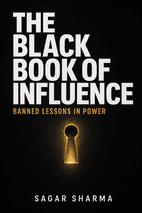
These lines from The Black Book of Influence are the kind you underline and then send to a friend. They cover knowing when to stop talking, using silence well, guarding your energy, and seeing how framing shapes a conversation. Some are blunt reminders. Some are clever one-liners that make you pause.
What makes the book quotable is the way it turns social dynamics into simple, usable observations. You get short statements about power, attention, identity, and self-control. They rarely waste a word, which fits the subject perfectly. Read one and you may start noticing the same patterns in your next meeting or group chat.
Top Quotes from The Black Book of Influence
“I think the rule underneath all of this is that every extra sentence is either strengthening your position or weakening it. Most extra sentences, when you're uncomfortable, weaken it.”
The author sums up the danger of over-explaining when setting boundaries, prices, or refusals.
It gives readers a simple test for every sentence they are tempted to add. The second sentence lands because it names the discomfort behind most over-explanation.
“She had the most power at the table, and she showed it by using almost none of the air.”
After a long dinner story, the woman who runs a large business asks one quiet question and then stops.
It captures the paradox that real influence can come from restraint rather than volume. The image is memorable and immediately actionable.
“If you've said what you needed to say, stop. Let it sit there. If someone wants more, they'll ask.”
The author offers advice for interviews and conversations where silence feels uncomfortable.
It gives a simple rule that prevents overexplaining and weakening a strong point. The rhythm makes it easy to remember.
“The simplest rule is to treat information about you the way you'd treat money in your wallet. You don't hand it over just because someone asks nicely.”
The author gives a rule for dealing with people who collect personal information.
It converts a vague sense of caution into a concrete boundary. The wallet metaphor makes privacy feel like something valuable to protect.
“You don't try to win the argument. You try to decide what the argument is about. You choose the starting point, the options on the table, the words used, and the questions that get asked.”
The chapter contrasts direct argument-winning with controlling the terms of a discussion.
It captures the book’s core insight: influence often comes from setting the terms of debate rather than winning it. It is direct, memorable, and immediately practical.
“Many a decision has been made not by the vote, but by the summary that followed the debate.”
In the business section on meetings, the narrator describes how a closing summary can shape decisions.
It is a compact warning that the person who summarizes controls the official story and often the outcome. It is short, sharp, and highly memorable.
“People often defend their identity more fiercely than their interests.”
The author reflects on why an argument about phones became personal.
It captures the chapter's core insight in one line: identity defense is stronger and more personal than ordinary self-interest.
Themes Behind the Quotes
The book keeps returning to restraint. It treats attention, words, and access as resources that lose value when scattered carelessly. Silence is not empty here. It is a way to let your point land, keep mystery, and avoid giving away leverage. The same logic shows up in relationships, where approval seeking weakens you and selective closeness protects your time.
Another major theme is control of the frame. Before an argument begins, someone has already shaped the options, the starting point, and the summary that follows. Identity matters too, because people defend who they are more readily than what they want. Underneath all of it sits self-control, especially over energy, money, and impulses. The quotes suggest influence is less about pushing people and more about arranging conditions, staying steady, and knowing what not to hand over.
Quotes by Chapter
Part 2 - Chapters 2 to 11
“You can learn every technique about framing, leverage, and access in the later chapters, and still undo all of it by talking too much at the wrong moment.”
The narrator explains that mastering speech comes before every other influence skill.
It captures the chapter's core warning: technique cannot compensate for undisciplined speech. Readers remember it because it turns over-talking into a single point of failure.
“When a person talks all the time, their words become background noise. You stop weighing each sentence. You nod along while thinking about lunch.”
The author describes how constant talkers train others to tune them out.
The concrete image of nodding while thinking about lunch makes the cost of over-talking instantly recognizable. It shows that visibility is not the same as attention.
“People give their attention to what's scarce, and your words become scarcer when you stop scattering them everywhere.”
The author compares words to money to explain why restraint increases impact.
It reframes silence and brevity as strategic scarcity rather than passivity. The line is memorable because it explains why quiet people can command a room.
Part 3 - Chapters 12 to 23
“Sometimes knowing when to stop is part of knowing what to say.”
The chapter explains the mature skill of recognizing when you have said enough.
It reframes communication as discipline, not just expression. Readers can apply it to conversations, interviews, and arguments.
“It's about being able to tell the difference between words that do something and words that only fill space.”
The chapter cautions that speaking less does not mean using silence as a weapon or withholding carelessly.
It distinguishes purposeful restraint from coldness or manipulation. The test is practical for everyday speech.
Part 4 - Chapters 24 to 35
“But the noise is not a sign that solitude is bad for you. It's what was already there, hidden under the distractions. It was shaping your mood the whole time. Being alone just lets you hear it.”
The author explains what happens when outside distractions disappear and a person first spends time alone.
It reframes inner noise as something already present rather than a sign that solitude is harmful.
“A person who needs constant company, attention, or approval is easy to move. If you know that someone dreads being excluded, you know how to pressure them.”
The author connects solitude to influence by explaining how dependence makes people easy to move.
It reveals that needing approval hands leverage to others.
“Fear doesn't only make you feel bad. It makes your life smaller. Every place you avoid, every conversation you skip, every situation you decline because it feels unfamiliar, removes a whole set of possible experiences from your life.”
The author warns that fear and staying inside a comfort zone shrink a person's experience.
It makes the cost of avoidance concrete and cumulative.
“The one who's chasing approval gets less of it, and the one who stands comfortably apart tends to get more.”
The author observes how people respond to those who do not need approval.
It captures the irony that neediness repels the approval it seeks.
Part 5 - Chapters 36 to 45
“When you aren't alone, whoever you're with is writing into the same notebook. So, it's worth knowing who gets a pen.”
The author discusses how our social environment silently shapes what we consider normal.
It turns a common warning about influence into a vivid, practical question: who is shaping you? It makes deliberate relationship choice feel necessary.
“The problem is not having connections. it's constantly trying to convince everyone that you have them.”
The author contrasts genuine connections with people who constantly sell their importance.
It exposes performative networking as insecurity rather than influence. The wording is blunt and easy to remember.
“The best version of this is genuine. You're curious about their work, you care about the problem, and you help because it's the sort of thing you'd do anyway. The relationship that results has a real base under it, so it lasts.”
The author explains how to build professional relationships through genuine value rather than transactions.
It captures the balance between strategy and sincerity. It reminds readers that lasting relationships need a real base.
Part 6 - Chapters 46 to 56
“One type says yes easily and delivers rarely. The other type says yes rarely and delivers reliably.”
The author contrasts performers with quiet, capable people by how they handle promises and access.
It captures a simple test of character in a memorable parallel structure. Reliability is framed as rarer and more valuable than easy agreement.
“Don't be impressed by someone who keeps telling you how important they are. Pay more attention to what they actually do.”
The author states the core lesson after describing people who perform importance instead of proving it.
It redirects admiration from self-presentation to observable behavior. The line is direct, practical, and easy to remember.
“Who gets close to you is a choice, even though most people never treat it as one.”
The author closes the section by urging readers to decide carefully who gets their time, plans, and influence.
It turns social access into an active decision rather than a default. The phrasing is compact and quietly empowering.
“He looked like a man who had everything in order, and he was quietly drowning.”
The author describes River, who appeared remarkably fit and composed at the reunion but was struggling financially.
The contrast between outward order and private struggle is vivid and haunting. It shows how easily appearances hide distress.
Part 7 - Chapters 57 to 66
“Influence starts with control over yourself, and your body and your finances are the two biggest places where control gets lost.”
The author explains why health and finances belong in a book about influence.
It reframes self-control as the foundation of influence rather than a separate personal topic. The line is memorable because it connects physical and financial stability directly to power.
“The difference between living with both wheels and living with one is large. It's the difference between making choices and having choices made for you.”
The author summarizes the book's bicycle metaphor for health and wealth.
It turns a practical balance into a stark contrast between agency and passivity. The image is simple and easy to remember.
“A person who's exhausted all the time is easy to push around. They don't have the energy to argue, so they give in.”
The author describes what happens when the body wheel is neglected.
It shows how depletion becomes a vulnerability that others can exploit. The line is blunt and persuasive about why health matters for influence.
“The subject takes up the room, and the unspoken subjects fade out.”
The author explains how limited attention shapes what a group can discuss.
It vividly captures how an agenda can crowd out alternatives without anyone noticing. This makes agenda-setting feel concrete and powerful.
Part 8 - Chapters 67 to 76
“If you control the frame, you can influence the conversation before the argument even begins. That's the real power of it. You haven't made a single claim yet. You haven't tried to persuade. You've just set up the situation in a way that makes some conclusions feel natural and others feel strange.”
After explaining framing through examples, the text states its pre-argument power.
It makes the invisible power of framing concrete by showing how conclusions are shaped before persuasion begins. The cadence and repetition make it especially quote-worthy.
“Notice that none of this requires lying. You're not claiming anything untrue. You're simply choosing which true thing to start with.”
In the negotiation section, the narrator distinguishes framing from dishonesty.
It gives a simple ethical boundary between honest emphasis and manipulation. It reassures readers that influence can be truthful while still strategic.
Part 9 - Chapters 77 to 86
“When a topic touches identity, people stop acting like judges and start acting like defense lawyers.”
The author explains what happens once identity becomes involved in a discussion.
The legal metaphor makes defensive reasoning vivid and easy to recognize in everyday arguments.