The American Way of Killing Quotes
by Malcolm Gladwell
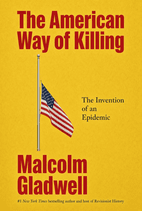
This page collects lines from Malcolm Gladwell's The American Way of Killing. You will find observations about gun deaths, trauma care, slavery, policing, prison, and the stories people tell themselves about crime and punishment. Some lines are blunt statistics. Some are vivid comparisons. Some sound like a challenge you cannot ignore.
The book is quotable because Gladwell keeps turning complicated arguments into sharp, human-sized moments. He asks why American violence looks so different, then answers with history, medicine, and everyday consequences. The result is writing that is easy to remember and hard to shake.
Top Quotes from The American Way of Killing
“Take out your phone. Make a list of fifteen people you have texted with on a regular basis over the past few years of your life. Now imagine that every one of them was shot dead, and that you attended every one of their funerals.”
Abdullah Pratt challenges Gladwell and readers to grasp the scale of his losses.
It turns an abstract statistic into an intimate exercise, forcing readers to imagine their own circle erased by gun violence.
“An American ER doctor who has lost fifteen close friends and his older brother to gun violence is going out to local elementary schools on his afternoon off and teaching fourth-graders how to stabilize a gunshot wound.”
Gladwell summarizes Pratt's volunteer work after describing his lesson for children.
The sentence captures both the heroism and the absurdity of a society where emergency-room doctors must teach children battlefield medicine.
“Giving a mass shooter access to an assault rifle makes as much sense as giving a drunk the keys to a Ferrari.”
Gladwell's assessment after describing the AR-15 as a highly configurable killing machine.
The analogy is blunt and unforgettable, capturing the absurdity of enabling someone intent on mass murder. It frames the gun-control debate in moral rather than technical terms.
“Both places, we spent hours with hundreds of family members who were broken and whose lives will never be the same. And they had one message for all of us: Do something. Just do something. For God's sake, do something.”
President Joe Biden after visiting families in Buffalo and Uvalde following two mass shootings.
The repetition turns grief into an urgent moral demand. It captures the frustration of a president confronting a seemingly intractable political failure.
“The culprit in this case is—paradoxically—the American medical profession, whose extraordinary expertise has made it easier for Americans to live with their gun violence.”
The author contrasts Memphis's falling homicide rate with its rising aggravated assault rate.
It indicts medical progress as a form of national anesthesia, making the country more comfortable with an ongoing crisis.
“The United States has more prisoners serving life without parole than the rest of the world combined.”
The chapter describes America’s emphasis on severity over certainty in deterrence.
It is a startling, concrete measure of how extreme American sentencing has become. The number makes abstract policy debate vivid.
“A neighborhood where children cannot safely learn to control their emotions is unforgiving. A city where there aren't enough police to break up arguments before they turn lethal is unforgiving. A country with so many guns that disputes end with a gunshot as opposed to a broken nose is unforgiving.”
The author echoes Jens Ludwig's book title 'Unforgiving Places' to diagnose American violence.
It names the environmental conditions—emotional insecurity, under-policing, and gun saturation—that make American violence uniquely unforgiving.
Themes Behind the Quotes
The through line is that American gun violence is not a natural fact. It grows from history, especially slavery and racial terror, and from a culture that has learned to live with carnage. The book also looks at medicine, showing how better trauma care can mask the scale of the problem by saving more victims while leaving the underlying danger untouched.
Another theme is how ordinary conflicts become deadly. Arguments over small things, learned scripts, easy access to guns, weak police presence, and extreme punishments all shape outcomes. Gladwell contrasts the United States with other rich countries and asks why one place produces so much lethal violence. The quotes keep returning to responsibility, denial, and the need to act.
Quotes by Chapter
INTRODUCTION: Fifteen Funerals
“This does not happen anywhere else in the developed world. I want to figure out why.”
Gladwell reacts to Pratt's gunshot-wound training for fourth-graders.
It distills the book's central question with blunt moral clarity.
“And yet in one of those places, a young boy like me can grow up without any firsthand experience of lethal violence at all, and in another a young man can bury more than a dozen of his closest friends by his thirtieth birthday. Why?”
Gladwell contrasts his Canadian childhood with the life of someone like Pratt in the United States.
It makes the cross-border mystery vivid by setting two ordinary lives side by side.
CHAPTER ONE: A Shooting Lesson
“With a rifle, that piece will be gone. There'll be nothing there. You'll be looking at the edge of a cliff, with the edge of it... If you could just imagine a cliff, just bleeding like a waterfall.”
Trauma surgeon Babak Sarani describing to Gladwell what an assault-rifle bullet does to a body.
The visceral imagery makes abstract lethality physical and immediate. It shows why assault rifles provoke such horror even beyond statistics.
“This is not gun control. This is gun control theater.”
Gladwell's conclusion after describing how an assault-rifle ban lists cosmetic features while exempting ninety-six pages of equivalent rifles.
The line is a compact, damning verdict on symbolic legislation. It sticks because it names the gap between political performance and real-world effect.
CHAPTER TWO: The Slave Owner’s Lament
“The profits from rice cultivation in that part of South Carolina were so large that it was often cheaper for plantation owners to work their slaves to death and buy replacements than try to keep their existing slaves alive.”
The chapter explains the economics of slavery in the South Carolina Lowcountry before the Stono Rebellion.
It captures the brutal logic of slavery, reducing human lives to disposable labor. The line makes the system's violence feel ordinary and calculated.
“Thomas Jefferson would famously describe the practice of slavery as grabbing a wolf by the ears: it was too dangerous to continue but too dangerous to stop.”
The chapter discusses the fear that haunted white planters, citing Jefferson's famous metaphor.
It distills the impossible trap of a society built on slavery. The image of a wolf by the ears conveys danger on both sides.
“And then comes the Stono Rebellion and that pit in your stomach becomes a molten mass.”
The chapter describes the dread slave owners felt after the Stono Rebellion.
The metaphor turns abstract fear into visceral dread. It shows how rebellion haunted the slaveholding South.
“His grandfather was allegedly poisoned to death by three slaves on the family plantation. James Madison knew all about the Stono Rebellion. He was as petrified as any other white planter, and for the petrified planter, the militias were of special importance.”
The chapter turns to James Madison's background to explain the Second Amendment's origins.
It ties the future architect of the Second Amendment to the terror of slave rebellion. The line grounds the amendment in racial fear and militia control.
CHAPTER THREE: The Cornwell Effect
“Is this because between 1935 and 1985, the residents of Memphis became inexpert with handguns and clumsy with their fists? Please. It’s because their doctors got better.”
The author contrasts Memphis's falling homicide rate with its rising aggravated assault rate.
It crystallizes the Cornwell Effect: better trauma care can mask a worsening underlying violence problem.
“And I showed a table where we have five consecutive days on our trauma service where every single day a twenty-year-old died: gunshot to the chest, dead on arrival; gunshot to the chest, dead on arrival; stab wound to the chest, ER thoracotomy.”
Cornwell describes a weekly mortality and morbidity meeting at Johns Hopkins.
It makes the daily toll of lethal violence concrete and relentless, turning young death into a grim routine.
“And when I walk into a waiting room with all these families—by the way, no father in the waiting room. Father's there at weddings and at graduation—no father in the waiting room in urban trauma center[s] during my thirty-five-year experience.”
Cornwell recounts speaking to families in the waiting room after treating gunshot victims.
It exposes the social absence and grief behind each trauma case, with the repeated detail of no father in the waiting room.
CHAPTER FOUR: The Quarrel Was about a Very Trivial Thing
“The quarrel was about a very trivial thing.”
The author quotes the opening sentence of an 1887 Chicago newspaper story about a murder.
It distills the chapter’s argument that lethal violence often begins with trivial quarrels rather than calculated motives.
“There is no motive behind a murder that begins with a quarrel over a trivial thing. That's expressive violence.”
After citing the 1887 story, the author explains what such a motiveless killing represents.
It draws the line between instrumental crime and expressive violence, the chapter’s central distinction.
“These are just run-of-the-mill arguments that go sideways and, you know, they feel very in-the-moment, not super well-thought-through. They're not over money or whatever.”
Jens Ludwig describes what Harold Pollack found in the Chicago homicide files.
It punctures the media-driven image of gun violence as calculated and reveals it as ordinary arguments gone wrong.
“Long prison sentences and no-nonsense judges are of little consequence to a would-be criminal who doesn’t realize he's a would-be criminal.”
The author explains why harsh punishments fail against expressive violence.
It captures the mismatch between deterrence-based policy and crimes committed in the heat of the moment.
CHAPTER FIVE: “Zero. Zero. It’s Not Gonna Happen.”
“Oates: Zero. Zero. It's not gonna happen.”
Gladwell asks Daniel Oates whether a town council would agree to double its police force.
It is the chapter’s title quote and bluntly captures why expanding American policing is politically unthinkable.
“The Germans look at America and say, You are far too soft on crime. You have no police. Americans look at Germany and say, You are far too soft on crime. You don’t lock anybody up and your prisons are country clubs.”
The chapter contrasts European and American attitudes toward crime and punishment.
It captures the paradox that each side sees the other as soft on crime. It sharply frames the book’s central comparison.
“If you kill someone in a place like the South Side of Chicago, you are likely not to get caught.”
Gladwell contrasts low homicide clearance rates in disadvantaged US neighborhoods with high certainty in Europe.
It links small police departments to impunity for lethal violence. The line is blunt and haunting.
CHAPTER SIX: Becoming a Man
“There is a sense in which conduct regarded as criminal is often quite the opposite. Far from being an intentional violation of a prohibition, much crime is moralistic and involves the pursuit of justice.”
Donald Black argues in his essay 'Crime as Social Control' that much crime is moralistic rather than simply predatory.
It overturns the usual picture of violent criminals as predators and recasts them as people pursuing justice, however misguided.
“What they all have in common, though, is an extreme emotional overreaction: at a crucial moment the protagonist escalates from simple and in some cases even justifiable anger to extreme and unjustifiable violence.”
The author distills the pattern he sees across the book's expressive-homicide stories.
It captures the terrifying escalation at the heart of expressive violence: catastrophic outcomes from trivial beginnings.
“These youth are acting out pre-written scripts. They aren't thinking. No amount of rational persuasion or economic intervention is going to disrupt that pattern. You need to rewrite that pre-written script.”
After Abdullah Pratt describes cycles of retaliation, the author argues that these youths are following pre-written scripts.
It suggests that violence is learned and rehearsed, not merely chosen, and that prevention must intervene at the script level.
CHAPTER SEVEN: Nobody Appears to Have Liked Sir John Knight
“The murder of David Graham Phillips was one of the most sensational crimes of the early 1900s. It was the O. J. Simpson case of its era.”
The narrator describes the public sensation caused by David Graham Phillips's murder.
It immediately frames the killing as a media spectacle that shaped law and culture. The comparison makes a forgotten crime feel disturbingly familiar.
“But when it comes to gun violence, the United States is not an ordinary country.”
The narrator contrasts the Sullivan Act's promise with the American response to gun violence.
It is a blunt thesis for the chapter and the book. The sentence indicts American exceptionalism as a deadly distortion rather than a point of pride.