The American Way of Killing Key Takeaways
by Malcolm Gladwell
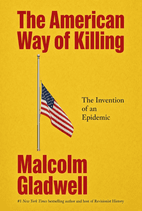
5 Main Takeaways from The American Way of Killing
American Gun Violence Is Exceptional Because Guns Meet Ordinary Rage
Gladwell shows U.S. homicide runs three to six times Western Europe's while robbery does not, so the problem is not crime in general but lethal violence. Most killings are expressive: young men in drunken arguments reaching for a nearby weapon. The American exception is the gun's proximity to ordinary rage.
Regulate Firearm Capability and Access, Not Cosmetic Features
Assault-weapon bans regulate silhouette rather than capability, and the Senate bill's own appendix of legal rifles undercuts it. Handguns are often the more lethal mass-shooting instrument, magazine limits save only seconds, and removing all assault weapons would barely dent a toll driven by firearms as a whole. Policy should target handgun access and the capability that makes shootings deadly.
The Individual-Right Second Amendment Is a Historical Distortion
Madison's Second Amendment joined an outdated being clause about militias to a right to bear arms, and the historical context included slave patrols, not just minutemen. Heller treated the militia clause as mere preface, and Bruen selected history to void long-standing laws. This distorted reading blocks handgun permitting and public-carry restrictions that once saved lives.
Deaths Understate Gun Violence and Distort Who Gets Counted
Nonfatal shootings vastly outnumber gun homicides, and surviving or dying often depends on how fast a victim reaches a level 1 trauma center. Better surgeons can make a falling murder rate look like safety, while unequal transport and treatment inflate Black homicide counts and prison populations. Counting only deaths hides the real scale and racial geography of American gun violence.
Effective Gun Policy Combines Carry Limits, Policing, and Certainty
Dodge City checked guns at gates, fined carrying, and kept six officers for a thousand residents, after which killings nearly stopped. The U.S. under-polices and over-sentences, and its prisons should approximate ordinary life rather than maximize suffering; certainty, not severity, deters. Boston's 15 percent police cut and Australia's swift post-Port Arthur reform show that choices, not fate, determine outcomes.
Executive Analysis
Gladwell's argument is that American gun violence is a self-inflicted, homegrown crisis, not an unavoidable feature of modern life or ordinary crime. The country's homicide rate stands apart while robbery does not, because ordinary expressive quarrels meet extraordinary firearm access. The policy response misfires when it bans cosmetic rifle features, ignores handguns, or relies on mass incarceration. The Second Amendment's individual-right reading, rooted in a misread militia clause, blocks the public-carry restrictions that once worked in Dodge City and Australia. Meanwhile, trauma care and unequal survival hide the true scale of shootings, distorting data and punishment.
The book matters because it reframes gun violence as a solvable systems problem: regulate access and capability, police with certainty and legitimacy, and stop treating severity as deterrence. For readers, it offers a diagnostic checklist: count nonfatal shootings and trauma access, demand honest constitutional history, and judge policies by whether they alter the gun's proximity to rage. In the gun-policy genre, it is a bracing synthesis of history, criminology, medicine, and data, arguing that American paralysis is chosen rather than inevitable.
Chapter-by-Chapter Key Takeaways
Fifteen Funerals (Introduction)
A country that shares its cars, music, food, and religion with its neighbor can still be many times more lethal. American violence is a homegrown problem, not a permanent fact of modern life.
Any explanation built on a single statistic describes only one part of the problem. The country will keep failing at prevention until the parts are assembled into a whole.
The failures come in three mutually reinforcing kinds: dishonest public language about guns, a misdiagnosis of what drives street violence, and a path the country has chosen that is morally reckless.
Teaching fourth-graders to save a classmate's life shows how much has been lost, not a solution, since no other developed country requires it of its children.
Gladwell puts the American homicide rate at three to six times Western Europe's, back near its 1960 level after a peak in the 1980s and 1990s. The country is living with a lasting problem, not a temporary crisis.
Try this: Stop treating American gun violence as a single-statistic crisis or an inevitable fact; treat it as a homegrown, multi-part failure of public language, violence diagnosis, and moral choice, and demand prevention that addresses all three.
A Shooting Lesson (Chapter 1)
America's gun problem is a violence problem rather than a crime problem: homicide separates this country from its peers while robbery and other offenses do not, so policies aimed at crime in general will not reach it.
The Senate bill regulates silhouette rather than capability, and its own lengthy appendix of rifles that match the banned models in price, weight and operation undercuts the case for it more effectively than any opponent could.
In a mass shooting the handgun is the more lethal instrument, since it can be carried in close and fired over and over from a range where nearly every round lands.
Magazine restrictions promise very little: shooters stretch their attacks across minutes or hours and fire at a measured pace, giving up only a couple of seconds to reload.
Removing every assault weapon from the country would leave the toll largely where it is, since the University of Colorado count of 1,342 mass-shooting deaths across fifty-seven years sits beside roughly two million gun deaths in the same period; firearms as a whole are the target.
Try this: Target firearms as a whole, especially handguns, rather than assault-weapon silhouettes or magazine limits; ask whether any policy would meaningfully reduce gun capability and access.
The Slave Owner’s Lament (Chapter 2)
The Stono Rebellion of 1739 terrified white planters in South Carolina, where enslaved people outnumbered them by as much as ten to one, and it shaped how they thought about armed militias.
Mexico's Article 10 shows how a right to bear arms can be written clearly; the U.S. Second Amendment is confusing because it joins two clauses with different subjects.
The linguist Kari Sullivan found that Madison's "being clause" construction was already outdated when he wrote it, and her analysis shows the amendment is about militias, not an individual right.
Madison wrote the amendment to reassure slaveholding states like Virginia that the new Constitution would not let the North undermine slavery.
The Supreme Court's Heller decision ignored this history and grammar, treating the militia clause as mere preface, when the real image behind the amendment is the slave patroller, not the minuteman.
Try this: Interrogate constitutional claims by reading the Second Amendment through its militia and slave-patrol history, not as an untethered individual right; ask what Madison's outdated grammar and Southern fears were actually protecting.
The Cornwell Effect (Chapter 3)
A falling homicide rate is not proof that a city has become safer; it can be proof that its surgeons have grown better at keeping gunshot victims alive.
Counting only deaths understates gun violence, because surviving a shooting and dying from one are the same event separated by luck, and Indianapolis recorded roughly three nonfatal shootings for every fatal one.
Testosterone makes hemorrhagic shock harder to survive, so Cornwell's finding that girls outlive boys after puberty points toward androgen blockers as a treatment for young men bleeding out.
The expertise needed to spot such a treatment can only be produced where gunshot trauma is routine, which makes the country with the most gun violence the only one positioned to generate its medical advances.
Try this: Track nonfatal shootings and trauma-center access alongside homicide counts, and support survival research such as androgen blockers; a falling murder rate may reflect better surgeons rather than real safety.
The Quarrel Was about a Very Trivial Thing (Chapter 4)
Punitive policy can only reach offenders who weighed the risk; the bulk of killings come from people who never considered themselves criminals, and prison threats do nothing to them.
Intimate-partner killings and fatal child abuse belong inside the expressive column rather than beside it, since neither pursues a material advantage, and counting them together pushes impulsive homicide past half of the total.
Lethal quarrels over small provocations are a permanent feature of human societies, visible in medieval English coroner's rolls, nineteenth-century newsprint and modern Chicago alike, so each generation's rediscovery of the pattern is confirmation rather than revelation.
Women's danger sits mostly at home: men are killed by strangers far more often than women are, and, as Ludwig's figures show, most women are killed by someone they already know.
The American exception lies in the weapon, not the temper; arguments and insults arise everywhere, but only here does a gun sit close enough to end one fatally.
Try this: Recognize that most killings are expressive quarrels, not calculating crimes; direct prevention toward intimate-partner violence, child abuse, and keeping guns out of moments of rage.
“Zero. Zero. It’s Not Gonna Happen.” (Chapter 5)
The United States does not out-police Europe. It under-polices, then makes up for it with extreme sentences. The evidence favors certainty over severity: systems that solve crimes at high rates and impose prompt, probable, fair consequences can keep penalties mild and still deter.
Christopher Lewis and Adaner Usmani found that the lower a country's ratio of officers to murders, the more civilians its law enforcement kills. That pattern places the United States alongside Pakistan, Iran, and Brazil.
The reform wave after 2020 missed this trade-off. Cutting officer numbers removes the preventive, neighborhood-embedded work that keeps minor disputes from escalating, while leaving the detached, enforcement-only patrol that alienates residents.
Prison systems should be judged by whether they approximate ordinary life, as Berlin's Tegel does, rather than by how much suffering they inflict. By that measure the United States has joined the company of authoritarian states.
Try this: Shift from severe sentencing to certain, fair, prompt policing; fund neighborhood-embedded prevention, measure officer-to-murder ratios, and avoid cuts that leave only alienating enforcement patrols, while judging prisons by how closely they approximate ordinary life.
Nobody Appears to Have Liked Sir John Knight (Chapter 7)
Heller's removal of the militia clause from the Second Amendment, a clause written to shield Southern slave patrols, is what allowed a 1911 handgun permit law to be argued through six centuries of English and colonial precedent.
Bruen did not uncover history so much as select it, favoring whichever reading of the Knight acquittal suited the Second Amendment and voiding 111 years of New York law along with dozens of similar statutes.
The American failure with guns is a defect of national character rather than of legislative technique. Australia rewrote its laws after Port Arthur and dismissed an almost identical challenge in twenty-four minutes, which shows the paralysis is chosen.
Briggs Depew and Isaac Swensen's century-long study found that the Sullivan Act cut gun suicides by 32 to 48 percent with no compensating rise in other methods. That makes handgun access the deciding factor in whether many people die, a word the Court's opinion never uses.
Try this: Use the Sullivan Act evidence to defend handgun permitting and public-carry restrictions; recognize that Bruen cherry-picked history, and compare U.S. paralysis with Australia's swift post-Port Arthur reform.
The Footnote (Chapter 8)
How fast a shooting victim reaches a level 1 trauma center often decides whether the case is an assault or a homicide.
The neighborhoods with the most gunfire often have the fewest trauma centers nearby.
Hanke and Gundlach found that unequal transport and treatment inflated Alabama's Black homicide count and helped fill its prisons.
Brandon Young died on a short ambulance ride because the crew assumed a shooting in a Black area did not involve a white victim.
A dense city can make getting shot more likely while making survival more likely. A rural county can do the opposite.
Try this: Map trauma-center deserts and transport inequities alongside shooting rates, because survival often depends on distance, race, and ambulance assumptions; invest in equitable access to level 1 trauma care.
Getting Outta Dodge (Epilogue)
American homicide is mostly expressive: young men in drunken arguments reaching for a weapon, not schemers executing a plan, which is why a framework built on calculation and intent keeps missing.
The country is not overpoliced; Boston's decision to shrink its force by 15 percent after a historic drop in homicides, and the shootings that followed, show how quickly hard-won gains reverse when officers are pulled off the street.
The constitutional right to carry a gun in public as Americans now understand it would have been unrecognizable in the nineteenth century, when states and towns taxed dealers, banned sales to minors, and barred weapons from polling places and circuses, with Texas law in 1890 stricter than Texas law today.
Robert Dykstra's count of Dodge City's cattle-era killings, nearly half of which began as disputes over women, confirms that the town was dealing with the same impulsive violence that dominates American homicide now.
Dodge City itself supplies the proof of what works: guns checked at the gates, a hundred-dollar fine or jail for carrying, and six officers for a thousand residents, after which the killing stopped almost entirely.
The phrase "get out of Dodge" has buried that lesson for a century and a half, teaching Americans that flight is the only answer to violence rather than the measures a frontier town actually adopted.
Try this: Apply Dodge City's actual lesson—check guns at public gates, fine or jail carrying, and keep enough officers—and reject the 'get out of Dodge' myth that flight is the only answer to violence.