The 7 Habits on the Go Quotes
by Sean Covey
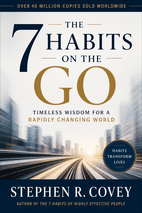
These quotes are the kind that stop you mid page. Each one packs a life principle into a single line you can carry with you. They come from a book designed for busy people, a portable version of timeless wisdom that fits in your pocket.
What makes this book so quotable is how it distills complex ideas into sharp, memorable statements. Covey has a gift for saying something profound in a way that sticks with you long after you close the cover. These lines aren't just nice to read. They are tools you can actually use to change your perspective and your habits.
Top Quotes from The 7 Habits on the Go
“Between what happens to us and our response is a space, and the key to our growth and happiness is how we use that space.”
Stephen R. Covey, in a quote about the space between stimulus and response.
This line powerfully captures the essence of proactivity—the freedom to choose our response. It offers a simple yet profound insight into personal growth and happiness.
“Tam not the product of my circumstances. I am a product of my decisions.”
Stephen R. Covey, in a quote about proactive language and self-identity.
The typo 'Tam' underscores the raw, unedited power of the original statement. It reminds readers that personal responsibility and choice define who we are.
“It’s incredibly easy to work harder and harder at climbing the ladder of success, only to discover that it’s leaning against the wrong wall.”
Stephen R. Covey offers this as a warning about the danger of acting without a clear end in mind.
This metaphor powerfully illustrates how misdirected effort can lead to wasted energy and regret, urging readers to first define what truly matters.
“The key is not to prioritize what’s on your schedule, but to schedule your priorities.”
Stephen R. Covey in the chapter on Habit 3: Put First Things First.
This line reframes time management from mere scheduling to intentional alignment with what truly matters, empowering readers to take control of their choices.
“The main thing is to keep the main thing the main thing.”
Stephen R. Covey in the section 'Live in Quadrant 2'.
Its simple repetition reinforces the core message of focus and prioritization, making it instantly memorable and applicable to daily decisions.
“When you really listen to another person from their point of view, and reflect back to them that understanding, it’s like giving them emotional oxygen.”
Stephen R. Covey illustrates the impact of empathic listening with a vivid metaphor.
The metaphor of emotional oxygen makes the abstract concept of empathy tangible and memorable, showing how deep listening can revive and sustain relationships.
“The key to valuing differences is to realize that all people see the world, not as it is, but as they are.”
Stephen R. Covey on the perception of reality.
This quote fosters empathy and humility by reminding us that our own perspective is limited, encouraging openness to others' unique ways of seeing the world.
Themes Behind the Quotes
One major theme is the power of personal agency. These quotes emphasize that we are not victims of our circumstances, but have the freedom to choose our responses. They urge us to define our own mission and focus on what truly matters, rather than getting lost in busyness.
Another central thread is the importance of connection with others. True effectiveness comes from mutual respect and understanding. By listening deeply and valuing different perspectives, we create results far greater than what we can achieve alone. This theme also includes the shift from a scarcity mindset to one of abundance, where there is enough for everyone.
Quotes by Chapter
HABIT 1: Be Proactive
“You are influenced by your genes, by your upbringing, and by your environment, but you are not determined by them.”
Stephen R. Covey, speaking about the limits of determinism.
It affirms that while external factors shape us, they do not dictate our destiny. This message liberates readers to take ownership of their lives.
“Every human being has four endowments—self-awareness, conscience, independent will, and creative imagination. These give us the ultimate human freedom: the power to choose.”
Stephen R. Covey, summarizing the human gifts that enable proactivity.
This quote encapsulates the foundation of proactive living, listing the innate tools everyone possesses. It inspires readers to recognize and leverage their inner strengths.
HABIT 2: Begin With the Endin Mind
“All things are created twice: a mental creation and a physical creation.”
This appears in the section 'Define Outcomes Before You Act' as a foundational principle of Habit 2.
It concisely captures the core idea that every achievement begins with a clear vision, reminding readers that thoughtful planning precedes successful action.
“Deep within each one of us is an inner longing to live a life of greatness and contribution—to really matter, to really make a difference.”
This quote appears under 'Celebrate Your 80th Birthday' to inspire reflection on legacy.
It taps into a universal human desire for purpose and significance, encouraging readers to align their actions with a meaningful vision.
“The mission statement gives you a changeless sense of who you are.”
Stephen R. Covey says this in the section 'Refine Your Mission Statement' to emphasize the stabilizing power of a personal mission.
It highlights how a well-defined mission provides clarity and consistency amid life's changes, making it a timeless anchor for decisions.
HABIT 3: Put First Things First
“You have to decide what your highest priorities are and have the courage—pleasantly, unapologetically —to say ‘no’ to other things. And the way you do that is by having a bigger ‘yes’ burning inside.”
Stephen R. Covey in the section 'Eliminate the Unimportant'.
This quote captures the emotional and practical challenge of prioritization, offering a powerful mindset shift from resistance to purpose-driven action.
“Make a little promise to yourself and keep it; then a little bigger one, then a bigger one. Eventually, your sense of honor will become greater than your moods.”
Stephen R. Covey in the section 'Keep Your Commitments'.
It provides a practical, incremental path to building self-trust and discipline, resonating with anyone struggling with procrastination or consistency.
HABIT 4: Think Win-Win
“Win-win is not a technique; it’s a total philosophy of human interaction. It is a frame of mind and heart that seeks mutual benefit in all interactions. Win-win sees life as a cooperative, not a competitive, arena.”
Stephen R. Covey explains the core idea of Habit 4.
This redefines win-win from a simple tactic to a profound worldview, challenging readers to shift from competition to cooperation.
“Most people are deeply scripted in the Scarcity Mentality. They see life as having only so much, as though there were only one pie out there. And if someone else gets a big piece of pie, it means less for everybody else.”
Stephen R. Covey describes the scarcity mindset that hinders win-win thinking.
The vivid pie metaphor makes the limiting belief instantly relatable, helping readers recognize and question their own competitive assumptions.
“The Abundance Mentality flows out of a deep inner sense of personal worth and security. It is the paradigm that there is plenty out there and enough for everybody.”
Stephen R. Covey contrasts the abundance mentality with scarcity thinking.
This quote ties confidence and self-worth to generosity, inspiring readers to see others' success as additive rather than threatening.
“If people can express their feelings and convictions with courage balanced with consideration for the feelings and convictions of others, they are mature, particularly if the issue is very important to both parties.”
Stephen R. Covey defines maturity in the context of balancing courage and consideration.
It offers a clear, actionable definition of emotional maturity that emphasizes both speaking up and listening respectfully.
HABIT 5: Seek First to Understand, Then to Be Understood
“Next to human survival, the greatest need of a human being is psychological survival—to be understood, to be affirmed, to be validated, to be appreciated.”
Stephen R. Covey, author of The 7 Habits, describes the fundamental human needs beyond physical survival.
This line powerfully elevates the importance of emotional validation, reminding readers that understanding others is not just polite but essential to their well-being.
“Listen, or your tongue will make you deaf.”
A Native American Proverb cited in the chapter to warn against talking instead of listening.
This short, striking proverb captures the self-defeating nature of not listening, and its vivid imagery sticks in the reader's mind long after reading.
“When you present your own ideas clearly in the context of a deep understanding of the other person’s paradigms and concerns, you increase the credibility of your ideas.”
Stephen R. Covey explains the second half of Habit 5—seeking to be understood after understanding others.
This quote reframes persuasion as a respectful, empathetic process, showing that true credibility comes from first valuing the other person's perspective.
HABIT 6: Synergize
“Insecure people have a need to mold them into their own thinking. They don’t realize that the very strength of the relationship is in having another point of view. Sameness is uncreative—and boring.”
Stephen R. Covey on the value of differing perspectives.
This line challenges the instinct to conform others to our thinking and highlights that true strength comes from embracing different viewpoints, making it a powerful reminder for collaborative relationships.
“Alone we can do so little; together we can do so much.”
Helen Keller on the power of collaboration.
A timeless and succinct statement that captures the core of synergy—the exponential potential of working together—and resonates across all areas of life.
“The essence of synergy is to value differences—to respect them, to build on strengths, to compensate for weaknesses.”
Stephen R. Covey defining the essence of synergy.
It clarifies that synergy is not just about cooperation but about actively leveraging differences, providing a clear and actionable principle for effective teamwork.