The 7 Habits on the Go — Interactive Mindmaps

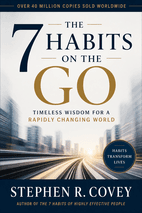
The 7 Habits on the Go by Sean Covey Book Cover

by Sean Covey

Sean Covey's The 7 Habits on the Go distills Stephen R. Covey's timeless principles into a portable guide for today's fast-paced world, helping overwhelmed readers align daily actions with deep values through practical prompts and reflective steps.

On Insta.page you also get an Apply This Book tool that lets you combine insights from up to 3 books to solve your specific situation.

Chapter mindmaps

Free preview: chapters 1–4 are fully interactive. Click any node to expand or collapse. Subscribe to unlock the rest.

Chapter 1: HABIT 1: Be Proactive

Key concepts: HABIT 1: Be Proactive

1. HABIT 1: Be Proactive

The Pause Between Stimulus and Response

  • Proactivity is choosing your response, not reacting
  • The pause is where your freedom lies
  • Ask: What response aligns with my principles?

Becoming a Transition Person

  • Break unhealthy patterns from your past
  • The cycle of negativity stops with you
  • You are not determined by your upbringing

Language: Mirror of Your Mindset

  • Reactive language: 'I can't,' 'He makes me'
  • Proactive language: 'I choose,' 'I will'
  • Words shift ownership and drive solutions

Focus on Your Circle of Influence

  • Circle of Concern: things you can't control
  • Circle of Influence: things you can affect
  • Reactive people drain energy on concern
  • Proactive focus expands your influence

Proactivity as a Daily Practice

  • Start each morning by anticipating triggers
  • Prepare a proactive response in advance
  • The pause becomes automatic over time

Chapter 2: HABIT 2: Begin With the Endin Mind

Key concepts: HABIT 2: Begin With the Endin Mind

2. HABIT 2:  Begin With the Endin Mind

Define Outcomes Before You Act

  • All things are created twice: mentally then physically
  • Ask what outcome you want before any action
  • Focus on effectiveness, not just efficiency
  • Align physical efforts with deepest intentions

Visualize Your Legacy

  • Imagine your 80th birthday celebration
  • What do you want people to say about you?
  • Daily decisions build your legacy
  • Live a life of greatness and contribution

Create a Personal Mission Statement

  • It's your life's constitution and compass
  • Detect your mission through reflection, not invention
  • Use it as a filter for every decision
  • Write it from within, not from external expectations

Nurture Key Relationships

  • Don't treat people as to-do list items
  • True effectiveness is measured by impact on others
  • Tend to relationships with presence and care
  • Build trust, love, and understanding

Balance Your Life Roles

  • Write a mission for each key role
  • Avoid over-investing in a single role
  • Check daily actions for balance across roles
  • Give each role the attention it truly deserves

Chapter 3: HABIT 3: Put First Things First

Key concepts: HABIT 3: Put First Things First

3. HABIT 3: Put First Things First

The Time Matrix

  • Quadrant I: Urgent and important (crises, deadlines)
  • Quadrant II: Not urgent but important (planning, renewal)
  • Quadrant III: Urgent but not important (interruptions)
  • Quadrant IV: Not urgent and not important (time wasters)

Living in Quadrant II

  • Focus on proactive work and long-term payoff
  • Prevent crises through preparation
  • Schedule your priorities, not your schedule
  • Keep the main thing the main thing

Weekly Planning with Big Rocks

  • Plan your week before it begins
  • Schedule Big Rocks first (roles and goals)
  • Less important tasks fit around the rocks
  • This is the most productive habit you can adopt

Staying True in Moments of Choice

  • Character revealed when choosing priorities over urgency
  • Use independent will and integrity
  • Say no to time robbers with a bigger yes
  • Keep commitments to yourself to build self-trust

Emotional Bank Accounts

  • Trust in relationships is built through deposits
  • Deposits include kindness, promises, and listening
  • Apologize sincerely to restore overdrawn accounts
  • Forgive others to free yourself from resentment

Chapter 4: HABIT 4: Think Win-Win

Key concepts: HABIT 4: Think Win-Win

4. HABIT 4: Think Win-Win

Core Philosophy of Win-Win

  • Refuse to see life as zero-sum
  • Seek outcomes where everyone benefits
  • It's a frame of mind and heart
  • Stop treating relationships as transactions

Overcoming Scarcity Mentality

  • Life seen as a fixed pie
  • Fuels comparison, jealousy, and competition
  • Threatened by others' success
  • Miss out on collaborative wins

Cultivating Abundance Mentality

  • Conviction there's enough for everyone
  • Celebrate others' victories
  • Flows from personal worth and security
  • Opens you up to receiving more

Balancing Courage and Consideration

  • Courage to speak your truth
  • Consideration to listen and respect
  • Maturity holds both at once
  • Essential for effective interaction

Practical Win-Win Actions

  • Check intent before any agreement
  • Invest in relationship before contract
  • Share credit generously
  • Acknowledge those who help you

Continue exploring The 7 Habits on the Go