The 7 Habits on the Go Key Takeaways
by Sean Covey
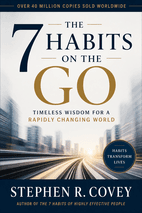
5 Main Takeaways from The 7 Habits on the Go
Choose your response; focus on what you can influence.
Proactivity is a deliberate choice, not a fixed trait. By shifting your language from 'I can't' to 'I choose' and concentrating on your Circle of Influence, you reclaim power over your reactions and avoid wasting energy on uncontrollable factors.
Define your end goal before starting anything.
All things are created twice—mentally then physically. Visualizing your 80th birthday or writing a personal mission statement clarifies your legacy and aligns daily choices with what truly matters, making every action intentional.
Prioritize important, not urgent tasks to achieve effectiveness.
Most time should be spent in Quadrant II (important but not urgent). Schedule your 'Big Rocks'—key roles and top priorities—first each week, and learn to say no to trivial activities by committing to a compelling yes.
Seek mutual benefit through understanding and synergy.
Win-Win thinking shifts from competition to cooperation, requiring courage balanced with consideration. Empathic listening (reflecting feelings and words) builds trust, and combining diverse perspectives creates a 3rd Alternative that outperforms any individual solution.
Renew yourself regularly across all four dimensions.
Habit 7, 'Sharpen the Saw,' emphasizes continuous renewal of body, mind, heart, and spirit. This includes seeking feedback, engaging with your audience, and scheduling time for rest and growth—ensuring long-term effectiveness and preventing burnout.
Executive Analysis
These five takeaways form the core of Sean Covey's framework, which moves from personal independence (Habits 1-3) to public interdependence (Habits 4-6) and finally to renewal (Habit 7). The central argument is that true effectiveness requires aligning your actions with principle-centered values: first master yourself, then build collaborative relationships, and sustain both through ongoing renewal. Together, the habits create a cycle where proactive self-discipline, a clear vision, and disciplined prioritization enable empathic cooperation and synergistic breakthroughs, all powered by regular self-care.
This book matters because it distills a proven, timeless philosophy into a portable, actionable guide for modern life. In a crowded self-help field, "The 7 Habits on the Go" stands out for its clarity and practicality—each insight can be applied immediately to work, family, or personal growth. Readers gain not just concepts but daily tools to break negative patterns, strengthen relationships, and achieve lasting success without sacrificing well-being.
Chapter-by-Chapter Key Takeaways
HABIT 1: Be Proactive (Chapter 1)
Proactivity is a choice, not a personality trait. Anyone can learn to pause and respond deliberately.
Your language either empowers you or traps you. Listen for “I can’t” and replace it with “I choose.”
Focus on your Circle of Influence. Energy spent on what you can’t control only depletes you.
Become a transition person. Break negative patterns; pass on what builds people up.
The four human endowments—self-awareness, conscience, independent will, creative imagination—give you the ultimate freedom: the power to choose.
Try this: Pause before reacting; replace 'I can't' with 'I choose' and invest all your energy only in what you can influence, while becoming a transition person who breaks negative cycles.
HABIT 2: Begin With the Endin Mind (Chapter 2)
All things are created twice: mentally first, then physically. Define your desired outcome before you act.
Your legacy is built daily. Visualize your 80th birthday to clarify what matters most.
A personal mission statement is your life's constitution. Detect it through reflection, then write it down.
Tend to relationships with the same intentionality you give to tasks—they are the true measure of effectiveness.
Share your mission statement with loved ones to create alignment and accountability.
Balance your roles by assigning a mission to each and reviewing your actions regularly. Don't let one role dominate at the expense of others.
Try this: Write a personal mission statement based on your envisioned legacy, assign a mission to each life role, and share it with loved ones to create alignment and regular accountability.
HABIT 3: Put First Things First (Chapter 3)
Spend most of your time in Quadrant II (important, not urgent).
Plan your week by scheduling your Big Rocks first—your roles and top priorities.
Learn to say no to unimportant activities by having a compelling yes.
Build self-trust by keeping small promises to yourself.
Nurture relationships through consistent deposits in the Emotional Bank Account.
Apologize sincerely when you’re wrong, and forgive others to free yourself from resentment.
Try this: Plan your week by scheduling your Big Rocks—your roles and top priorities—first, then say no to unimportant activities by keeping a compelling yes in mind.
HABIT 4: Think Win-Win (Chapter 4)
Win-Win is a complete philosophy, not a tactic—it requires a shift from competition to cooperation.
Scarcity thinking compares and threatens; abundance thinking trusts there’s enough for all.
True effectiveness balances courage (speaking up) with consideration (listening deeply).
Before any agreement, check your intent: are you genuinely aiming for mutual benefit?
Sharing credit freely builds trust and frees you to accomplish more than you ever could alone.
Try this: In every agreement, check your intent for genuine mutual benefit, balance courage with consideration, and freely share credit to build abundant trust.
Next chapter: “HABIT 5: Seek First to Understand, Then to Be Understood” is locked
Keep learning from The 7 Habits on the Go — and unlock all 500+ book summaries with audio, mindmaps and AI Q&A.
$0.00 due today · 7 days free, then $89.99/year ($7.49/mo) · Cancel anytime before day 7