Talk Like TED Quotes
by Carmine Gallo
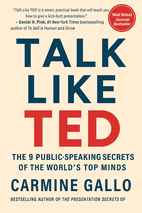
Welcome to a collection of the most memorable lines from Carmine Gallo's Talk Like TED. These quotes capture the essence of what makes a great speaker and a powerful idea stick. You will find insights on storytelling, emotion, authenticity, and the science of attention, all drawn from the world's most celebrated talks.
What makes this book so quotable is how it boils down complex communication principles into sharp, unforgettable phrases. Each line stands alone as a piece of wisdom you can apply immediately. Whether you are preparing a presentation or simply want to share ideas more effectively, these quotes offer a quick dose of inspiration and practical truth.
Top Quotes from Talk Like TED
“IDEAS ARE THE CURRENCY OF the twenty-first century.”
The opening line of the introduction.
It succinctly captures the central thesis of the book—that ideas hold immense value and power in modern society.
“There’s nothing more inspiring than a bold idea delivered by a great speaker.”
Early in the introduction, the author states a core belief about the impact of effective communication.
This line emphasizes the transformative potential of combining a compelling idea with skilled delivery, inspiring readers to master both.
“Your work is going to fill a large part of your life, and the only way to be truly satisfied is to do what you believe is great work. And the only way to do great work is to love what you do.”
Steve Jobs said this in his 2005 Stanford commencement speech, quoted in the chapter to emphasize following your passion.
This iconic advice cuts to the heart of purpose-driven work, resonating with anyone seeking fulfillment and courage to pursue what they truly care about.
“Maybe stories are just data with a soul. And maybe I'm just a storyteller.”
Brené Brown, a research professor, says this after an event planner suggests calling her a storyteller rather than a researcher.
It perfectly captures the idea that stories transform dry information into something emotionally resonant, and it empowers anyone to embrace the role of storyteller.
“Don’t fake it till you make it. Fake it till you become it.”
Opening of the chapter, a quote from Amy Cuddy, professor at Harvard Business School.
This reframes the common cliché into a more profound journey of genuine transformation. It resonates because it encourages internalizing confidence rather than merely pretending.
“Combine humor and novelty and you've got presentation gold.”
Author explaining why Sir Ken Robinson's talk went viral.
This concise phrase captures the core secret of the chapter and is easily remembered for any presentation.
“Humor lowers defenses, making your audience more receptive to your message. It also makes you seem more likable, and people are more willing to do business with or support someone they like.”
From the 'Why it works' section of the chapter.
It clearly articulates the psychological and practical benefits of humor, making a strong case for its use in any setting.
Themes Behind the Quotes
One central theme is the primacy of emotion and story over pure logic. Many quotes emphasize that people are moved by feelings, not just facts, and that authentic vulnerability creates powerful connections. Another theme is the importance of passion and purpose in work and communication, with a strong call to love what you do and let that enthusiasm shine through.
A second major thread is the role of novelty and surprise in capturing attention. The brain craves new, emotionally charged experiences, and humor lowers defenses to make messages more memorable. The underlying idea is that communication is not about delivering information but about creating a shared human experience that inspires action.
Quotes by Chapter
Introduction: Ideas Are the Currency of the Twenty-first Century
“TED is where brilliant people go to hear other brilliant people share their ideas.”
Oprah Winfrey's quote about the TED conference, as referenced by the author.
It perfectly encapsulates the unique prestige and appeal of TED in a memorable, quotable way that resonates with aspirational audiences.
“Ideas are only as good as the actions that follow the communication of those ideas.”
Near the end of the introduction, the author stresses the need to move from ideas to action.
It serves as a powerful reminder that communication must inspire tangible results, motivating readers to apply what they learn.
Part I: Emotional
“PART I The key part of the TED format is that we have humans connecting to humans in a direct and almost vulnerable way.”
Chris Anderson, curator of TED, explaining the core philosophy behind TED talks.
This line captures the essence of what makes a presentation truly impactful—the raw, vulnerable connection between speaker and audience, reminding us that authenticity beats polish.
“The talks that work best are the ones where people can really sense that humanity.”
Chris Anderson continuing his description of successful TED talks.
It distills the secret to memorable talks: audiences crave genuine human emotion, not just information, making this a powerful reminder for any speaker.
1. Unleash the Master Within
“It is no longer a conversation about overcoming deficiency. It’s a conversation about potential.”
Aimee Mullins, a double amputee and former Paralympian, says this in her TED talk about redefining disability through prosthetic limbs.
This line reframes a perceived limitation as an opportunity, empowering readers to see challenges as springboards for possibility rather than obstacles.
“Image is powerful, but also image is superficial. I just totally transformed what you thought of me in six seconds.”
Fashion model Cameron Russell says this during her TEDx talk after changing her outfit on stage to challenge perceptions of beauty.
It succinctly exposes the constructed nature of appearance and instantly grabs attention by demonstrating the gap between superficial image and reality.
“Authentic happiness can only come from the long-term cultivation of wisdom, altruism, and compassion, and from the complete eradication of mental toxins, such as hatred, grasping, and ignorance.”
Matthieu Ricard, dubbed 'the happiest man in the world,' shares this in his TED talk 'The Habits of Happiness.'
It provides a profound, actionable definition of happiness rooted in inner work rather than external circumstances, inspiring readers to take responsibility for their own well-being.
2. Master the Art of Storytelling
“There is power in identity. When we create the right kind of identity, we can say things to the world around us that they don’t actually believe makes sense. We can get them to do things that they don’t think they can do.”
Bryan Stevenson explains why he never drank alcohol after his grandmother told him he was special, revealing the deeper lesson about identity.
This insight shows how a strong sense of identity can influence behavior and persuasion, making it a foundational principle for effective communication.
“I came into this courtroom to tell this young man, keep your eyes on the prize, hold on.”
A janitor in Bryan Stevenson’s story enters a tense courtroom to offer him encouragement during a difficult moment.
This simple, emotionally charged line becomes the climax of Stevenson’s talk, illustrating how a few words can inspire perseverance and connect deeply with an audience.
“You simply cannot persuade through logic alone.”
The author reflects on Bryan Stevenson’s TED talk, which was 65% emotional appeal (pathos) and still considered highly persuasive.
It challenges the common belief that facts and data are enough, reminding speakers that emotional storytelling is essential to truly influence people.
3. Have a Conversation
“Authenticity doesn’t happen naturally.”
After Thomas Dolby advises Amanda Palmer to be authentic, the author explains the paradox.
It challenges the misconception that being authentic requires no effort, highlighting that true authenticity demands deliberate practice and self-discovery. This line sticks because it reverses a common assumption.
“Don’t deliver a presentation. Have a conversation instead.”
A TED note in the chapter summarizing the core advice for public speaking.
It encapsulates the chapter’s central theme in a simple, memorable directive. Readers remember it because it shifts the mindset from performance to genuine connection.
“Put in the time. Your ideas are worth the effort.”
The author’s concluding encouragement after discussing the necessity of practice.
This direct, motivational call to action validates the reader’s effort and reinforces that great presentations require hard work. It resonates because it honors the value of one’s ideas.
Part II: Novel
“Novelty recognition is a hard-wired survival tool all humans share.”
Dr. A. K. Pradeep, author of The Buying Brain, explains the evolutionary basis for seeking novelty.
This line reframes the search for the new as a fundamental survival instinct, making the pursuit of novelty feel both primal and essential.
“Our brains are trained to look for something brilliant and new, something that stands out, something that looks delicious.”
Dr. A. K. Pradeep further describes what our brains actively seek.
The rhythmic, almost poetic listing of what the brain craves creates a vivid and memorable image that resonates with anyone trying to capture attention.
4. Teach Me Something New
“Imagination is a force that can actually manifest a reality.”
Director James Cameron tells a TED audience in 2010, explaining how his curiosity led to diving the Titanic wreck.
It captures the transformative power of imagination, encouraging audiences to believe that ideas can become tangible realities.
“I like to refer to dopamine as the ‘save button’ in the brain.”
Neuroscientist Martha Burns explains how dopamine helps retain new information.
The metaphor makes a complex neurological concept instantly understandable and memorable, reinforcing the value of novelty in learning.
“Introverts, the world needs you and it needs the things you carry. So I wish you the best of all possible journeys and the courage to speak softly.”
Author Susan Cain addresses introverts in her TED talk on the power of solitude.
This uplifting and validating message empowers introverts to embrace their strengths and offers a counterpoint to extrovert-centric culture.
“The brain is just “a lazy piece of meat,” according to neuroscientist Gregory Berns.”
The author cites neuroscientist Gregory Berns to explain why the brain resists new information.
This vivid, memorable metaphor instantly communicates the brain's tendency to conserve energy, making the case for why novelty is essential in presentations.
5. Deliver Jaw-Dropping Moments
“The brain does not pay attention to boring things.”
The author explains why Bill Gates used a shocking moment in his TED talk.
This succinctly captures a core principle of effective communication: to engage an audience, you must first capture their attention.
“Emotionally charged events persist longer in our memories and are recalled with greater accuracy than neutral memories.”
Molecular scientist John Medina explains the neuroscience behind memorable presentations.
It provides scientific backing for the technique of creating jaw-dropping moments, showing that emotional arousal directly enhances memory retention.
“If you connect to an audience’s emotional responses then they will perceive the information more vividly, be less distracted, and will be more likely to remember it.”
Rebecca Todd, psychology professor, advises on how to make presentations memorable.
This offers actionable advice for presenters, linking emotional engagement to vivid perception and recall, which is the ultimate goal of any talk.
“The brain remembers the emotional components of an experience better than any other aspect.”
Molecular biologist John Medina states a key finding from his book Brain Rules.
It reinforces the central theme of the chapter—that emotion is the most powerful driver of memory—making it a concise and memorable takeaway.