Take Me to Your Leader Quotes
by Neil deGrasse Tyson
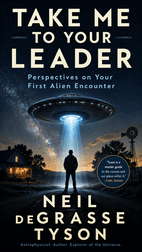
These quotes are the kind you want to read out loud at a dinner party. They mix sharp observations about human nature with a cosmic perspective that deflates our ego. You will find lines on alien encounters, the fragility of knowledge, and the absurdity of thinking we are the center of everything.
What makes this book so quotable is how Tyson turns complex science into punchlines. He uses aliens as a mirror, forcing us to see our biases and blind spots. Every line lands with a blend of humility and humor that sticks with you long after you close the cover.
Top Quotes from Take Me to Your Leader
“But if a space Alien arrives from across the Galaxy and has no genes in common with humans—or no genes at all—then we might expect it to look at least as different from all life on Earth as humans and bananas look from each other.”
The author discusses the genetic disparity between humans and potential extraterrestrial life.
By comparing aliens to bananas, this sentence vividly underscores how radically different alien biology could be, challenging our human-centered imagination.
“How else could any of us believe that the creator of the universe cares about when and where you worship, who you mate with, or what foods you eat or don’t eat and what time of day you eat them?”
The narrator reflects on human egocentrism, particularly in religious and daily practices.
This line starkly challenges anthropocentric religious assumptions, forcing readers to question the idea that a cosmic creator would micromanage trivial human behaviors.
“Imagine a pair of Aliens, perched halfway across the Milky Way, staring at a dense star field, and one says to the other, “See that distant star? The one that’s indistinguishable from a billion other stars just like it? On its third rock in orbit, there's a species that’s certain the whole universe was made just for them.””
The narrator imagines aliens observing Earth from afar.
This vivid alien perspective brilliantly inverts human self-importance, making our cosmic hubris feel absurd and laughable.
“The question remains: Who declared that humans are intelligent? Answer: Humans did.”
The author after discussing human self-assessment of intelligence relative to other species.
Strikingly exposes human arrogance in declaring ourselves intelligent, prompting self-reflection. The blunt, call-and-response format makes the point unforgettable.
“By direct analogy, we're left with the inescapable conclusion that the simplest thoughts of an Alien species, a mere 2 percent smarter, would be incomprehensible to us.”
The author after comparing the human-chimp intelligence gap to a potential alien-human gap.
Challenges our perspective on intelligence and warns that we may be too primitive for alien communication. It reframes the search for extraterrestrial life as a potentially futile endeavor.
“Sooo, where are the Aliens? That is the essence of Fermi’s argument, which has come to be known as Fermi's Paradox.”
After a calculation showing aliens should have colonized the galaxy, the author poses the famous question.
It captures the core puzzle of Fermi's Paradox in a direct, conversational tone that invites readers to ponder the mystery.
“We've seen the enemy, and it's ourselves.”
Early in the chapter, after discussing human behaviors.
This succinctly captures a universal truth about human self-destruction and introspection, making it instantly memorable.
Themes Behind the Quotes
A central theme is cosmic humility. Again and again, these quotes remind us that humanity is not the pinnacle of intelligence or importance. We are a tiny species on a tiny planet, often mistaking our own limited perspective for universal truth. This humility extends to our science and technology, which may be as primitive to an advanced alien as a stone tool is to us.
Another major thread is the critique of anthropocentrism, especially in religion and self-perception. The quotes challenge the assumption that the universe cares about human affairs or that our beliefs are special. They also celebrate the power of curiosity and the joy of asking questions, even when answers are not forthcoming. The book encourages us to embrace uncertainty and remain open to the vast unknown.
Quotes by Chapter
Chapter 1: Alien to Us
“You don’t know anything about your new friend's customs, so on a first encounter, it’s probably a good idea to leave all your habits at home, until you learn a thing or two about theirs.”
The author advises readers on how to behave during a first meeting with an alien.
This line uses a lighthearted scenario to deliver a universal lesson in humility and cultural awareness, making it both memorable and broadly applicable.
“The laws of physics greatly restrict the likelihood of Earth being visited by, much less invaded by, tiny Aliens.”
The author explains why scaling laws make insect-sized aliens impractical for space travel.
This concise statement uses real physics to debunk a common sci-fi trope, grounding the discussion in scientific reality.
“By invoking Aliens to explain all of history's mysteries, we deny our ancestors the power of imagination, which today we cherish and celebrate in our fantasy-fueled storytelling across genres.”
The author critiques the tendency to attribute ancient achievements to extraterrestrials.
This line reframes the debate by crediting human creativity, reminding readers that imagination is a timeless and powerful human trait.
Chapter 2: Alien to Them
“At this speech, our two voyagers nearly fell over... with laughter. Their shoulders and their stomachs heaved up and down, and in these the Sirian... spoke to them with great kindness, although in the depths of his heart he was a little angry that the infinitely small had an almost infinitely great pride.”
From Voltaire's story Micromegas, after an Earthling claims the universe was made for mankind.
The Sirian's mixed reaction of laughter and anger perfectly encapsulates the absurdity of human pride when viewed from an interstellar scale.
“For all we know, out there on a neutron star there's a scientist who is the size of a pinhead describing something which is even more bizarre. He may be trying to show that there could be life “out there” in those places, the ordinary stars, which are very high vacuums to him. It just could be that it is not they who are preposterous, it is we.”
Frank Drake imagines nucleonic aliens on a neutron star speculating about life on ordinary stars.
This passage flips the perspective entirely, suggesting that what we consider normal might be bizarre to other forms of life, humbling human exceptionalism.
Chapter 3: Alien Intelligence
“I do not know what I may appear to the world, but to myself I seem to have been only like a boy playing on the sea-shore, and diverting myself in now and then finding a smoother pebble or a prettier shell than ordinary, whilst the great ocean of truth lay all undiscovered before me.”
Isaac Newton, as quoted by the author at the start of the chapter.
It humbles human intelligence by comparing our knowledge to a child's play, reminding us of the vast unknown. This timeless expression of intellectual humility grounds the chapter's exploration of alien intelligence.
“The moral to that story? There are many. Top of my list would be “Trust your scientists.””
The author after summarizing the novel 'The Black Cloud' in which humans attack a superintelligent alien cloud against scientists' advice.
A concise and memorable lesson about valuing scientific expertise over political fear. It echoes real-world tensions between science and governance.
Chapter 4: Alien Science & Technology
“No science achieves maturity without a system of measurement. —LOGAN CLENDENING!”
An epigraph at the start of a section on measurement.
It succinctly declares that measurement is foundational to any mature science, setting a universal standard that resonates across disciplines.
“Anything truly universal should apply on Earth as in the heavens.”
The author criticizes Earth-centric uses of the word 'universal' and defines true universality.
This line challenges human ego and reframes universality as a property that must hold everywhere, not just on our planet.
“All this leaves me saddened to report that smooth, rotating flying saucers are not a thing.”
The author explains conservation of angular momentum and debunks a classic UFO trope.
Humorously combines scientific fact with pop culture, making physics memorable and accessible while deflating a common sci-fi image.
Chapter 5: Alien Powers
“And those who were seen dancing were thought to be Insane by those who could not hear the music.”
Attributed to Friedrich Nietzsche while discussing how lacking a sense makes others' behavior seem peculiar.
A powerful metaphor for empathy and understanding across different perspectives; it resonates deeply in discussions of perception and prejudice.
“So the next time someone at your dinner party boasts of a “sixth sense,” you no longer need to be impressed.”
After listing the many scientifically detectable senses (like radio waves, infrared) that humans have invented.
Witty and empowering, it deflates pseudoscience by demonstrating that real science already provides multiple 'senses' far beyond the paranormal.
“In summary, Aliens that disappear from view—no problem. Aliens that step back and forth across wormholes—no problem. Aliens that disappear without a trace within our three dimensions? Now you're violating universal laws of physics.”
Closing the section on invisibility and higher dimensions, contrasting plausible sci-fi with physically impossible feats.
A clear, forceful, and humorous summary that reinforces the book's grounding in real physics while still embracing imaginative possibilities.
Chapter 6: Alien Evidence
“When I trace at my pleasure the windings to and fro of the heavenly bodies, I no longer touch earth with my feet, I stand in the presence of Zeus himself and take my fill of ambrosia.”
Claudius Ptolemy, the ancient astronomer, wrote this in the margins of his work Almagest while marveling at planetary motions he did not fully understand.
This quote captures the profound wonder and humility of early science, where mystery was met with poetic reverence. It illustrates how humans have long filled gaps in knowledge with divine explanation, a theme central to the chapter.
“Blind Fate could never make all the Planets move one and the same way in Orbs concentrick, some inconsiderable Irregularities excepted which may have risen from the mutual Actions of Comets and Planets upon one another, and which will be apt to increase, till this System wants a Reformation.”
Isaac Newton wrote this in the second edition of Opticks (1717–1718), invoking divine intervention to explain solar system stability he could not yet mathematically prove.
The quote shows even the greatest scientific mind falling back on the 'God of the gaps' when faced with unknowns. It powerfully underscores the human tendency to invoke supernatural causes at the frontiers of knowledge.
“Sir, I had no need for that hypothesis.”
Pierre-Simon Laplace is rumored to have said this to Emperor Napoleon after being asked why God was absent from his celestial mechanics.
This succinct dismissal marks a turning point in scientific thought, where explanation no longer required divine intervention. It resonates as a bold declaration of naturalism and the maturity of scientific understanding.
“Be patient toward all that is unsolved in your heart and try to love the questions themselves.”
The Austrian poet Rainer Maria Rilke offered this advice, quoted by the author as a model for embracing scientific uncertainty.
The line encourages intellectual humility and curiosity, countering the urge for immediate answers. It beautifully encapsulates the scientific attitude of living with open questions rather than rushing to fill gaps with speculation.
Chapter 7: Alien to Me
“We can journey back and forth within any of our three space coordinates, but within our time coordinate we are prisoners of our present, forever transitioning between our inaccessible past and our unknowable future.”
Neil deGrasse Tyson describes the human experience of time as described in Einstein's relativity.
This line poetically captures the human condition of being trapped in the present, making the idea of alien four-dimensional time travel deeply compelling.
“In a world populated only by Senator Proxmire and acolytes, we would all still be living in caves.”
Tyson criticizes Senator Proxmire's 'Golden Fleece' awards that derided basic research.
It sharply defends the value of curiosity-driven science, implying that short-sightedness would halt progress.
“The urge to worship power—real or perceived or imagined—runs high in our species.”
Tyson speculates on why humans might worship powerful aliens if they visited.
It distills a deep psychological truth about human nature, linking our search for aliens to a primal need for reverence.
“Strong beliefs convince you to think something is true not only in the absence of objective evidence, but also in the face of confounding evidence.”
Tyson reflects on the power of belief in ufology and religion.
This line exposes the irrationality of strong conviction, resonating with anyone who has encountered stubborn denial of facts.
Epilogue
“If I ever go missing during a night of observing with my telescope, don’t look for me on Earth. Look up to the stars, because that’s where I'll be.”
The author opens the epilogue by imagining his own disappearance while stargazing.
This line is immediately evocative and humorous, blending the wonder of astronomy with a playful sense of adventure that invites readers to dream alongside the author.
“Y. Or they might be entertained and intrigued as I speak of all the ways human emotion, when unchecked, has the power to both build and unravel civilization.”
The author speculates on what he might tell aliens about humanity.
It captures a profound truth about human nature—our emotions as both creative and destructive forces—in a concise, thought-provoking way that resonates across cultures and eras.