Take Me to Your Leader Key Takeaways
by Neil deGrasse Tyson
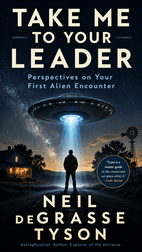
5 Main Takeaways from Take Me to Your Leader
Challenge your anthropocentric bias when imagining aliens
The book shows that our visions of extraterrestrials are stuck in human-centric molds—humanoid bodies, carbon-based biochemistry, and water dependence. Tyson argues that real alien life could be radically different, from silicon-based to ammonia-breathing, and that the most honest science is to admit we don't know until we find one.
Physics isn't optional—even for alien powers
Tyson uses concepts like gravitational time dilation for time-stopping and electromagnetic fields for telekinesis to show that the laws of physics are universal constraints. Any scientifically credible alien power must respect these laws, or it risks absurd consequences like creating a black hole.
Extraordinary claims demand extraordinary evidence
The book dismantles UFO conspiracy theories and alien abduction narratives by insisting on physical proof over witness testimony. Tyson notes that the smartphone era makes it harder to hide lack of evidence, and the rational response to no data is to withhold belief, not embrace conspiracy.
Alien contact is a mirror for human flaws
From colonial history to the Red Scare, Tyson reveals how our fear of aliens reflects our fear of the 'other' here on Earth. The epilogue’s playful abduction scenario critiques our misplaced priorities—spending billions on pets while ignoring homelessness—and hopes extraterrestrial wisdom might save us from ourselves.
The universe doesn't revolve around us—embrace that
A core theme is humanity’s cosmic insignificance. Tyson uses alien perspectives to show that our sun is just an average star, our planet is ordinary, and any advanced civilization would see us as primitive. Adopting this humility is the first step toward genuine scientific curiosity and survival.
Executive Analysis
These five takeaways form a cohesive argument: humanity must shed its self-centered worldview—both in how we imagine aliens and how we govern ourselves. Tyson uses science to dismantle our comforting biases, then turns the lens back on Earth, showing that our fear of the unknown and our lack of evidence-based thinking are the real obstacles to understanding our place in the cosmos. The book’s central thesis is that thinking about aliens is really thinking about ourselves—and that a dose of cosmic humility could save us from our own worst impulses.
This book matters because it bridges hard science and cultural critique in a way few popular science books attempt. Tyson doesn’t just explain exoplanet habitability or the periodic table’s universality; he forces readers to examine their own assumptions about intelligence, evidence, and progress. For the reader, it’s a wake-up call to think more critically about sensational claims and to approach the universe with wonder rather than fear. In the genre of astrobiology and science communication, "Take Me to Your Leader" stands out for its sharp, skeptical yet hopeful tone—a rare combination that makes complex ideas both accessible and personally relevant.
Chapter-by-Chapter Key Takeaways
Alien to Us (Chapter 1)
Our alien imaginings are riddled with human biases: humanoid forms, carbon-based biochemistry, and liquid water dependence.
Genuine alien life could be radically different: non-DNA, silicon-based, ammonia-breathing, or entirely unknowable.
Historical and cultural factors (racism, the Red Scare, religious dogma) shape our fear of the "other"—whether alien or human.
The most scientifically honest approach may be to admit we don't know what an alien looks like until we find one.
Try this: Question every assumption you make about extraterrestrial life—whether it’s shape, chemistry, or motivation—and consciously remember that your default bias is human-centric.
Alien to Them (Chapter 2)
Humans assume the universe revolves around us, but alien perspectives show we are
Try this: Adopt a cosmic perspective: whenever you feel the universe revolves around your problems, remind yourself that from an alien viewpoint, Earth is an average rock orbiting an average star.
Alien Intelligence (Chapter 3)
Try this: Define intelligence broadly by starting with observable behaviors (problem-solving, tool use) rather than human-like traits, and apply that same openness to understanding non-human intelligence on Earth.
Alien Science & Technology (Chapter 4)
Internal conflict is inevitable for any species that colonizes the galaxy, mirroring Earth's colonial wars.
The Periodic Table is a universal artifact—any scientifically advanced alien would recognize its
Try this: When evaluating claims about alien technology or future scenarios, always anchor your thinking in the periodic table and physics—they are the only universal constants we can rely on.
Next chapter: “Alien Powers” is locked
Keep learning from Take Me to Your Leader — and unlock all 600+ book summaries with audio, mindmaps and AI Q&A.
$0.00 due today · 7 days free, then $89.99/year ($7.49/mo) · Cancel anytime before day 7
plus sales tax where applicable