STRIKE FIRST Quotes
by Mete Aksoy
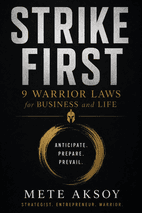
This page collects the most memorable lines from Mete Aksoy's book STRIKE FIRST. Readers will find sharp insights on strategy, discipline, and overcoming obstacles. The quotes cut through complexity to reveal simple truths about winning in business and life. Each line is designed to be a mental shortcut for tough decisions.
What makes the book so quotable is its blend of ancient military wisdom and modern practicality. Aksoy does not just state ideas. He frames them in ways that stick. The language is direct, the metaphors are powerful, and the lessons are immediately applicable. These are phrases you will remember and share.
Top Quotes from STRIKE FIRST
“The winners were those who treated business not as a game of chance but as a campaign of discipline.”
Aksoy contrasts the mindset of successful versus unsuccessful individuals in business.
It reframes success as a matter of deliberate structure rather than luck, which is both motivating and actionable. The military metaphor makes the point stick.
“But Alexander understood that not losing is not the same as winning.”
Alexander the Great rejects his general Parmenion's cautious advice at Gaugamela.
It distills the fundamental difference between survival and victory, a core theme of the chapter. This line challenges readers to rethink passive strategies.
“Do not fight your opponent head-on! Instead, move to his rear or his flanks. Attack from there, and victory is yours!”
General William T. Sherman's description of the Law of Maneuver, quoted by the author.
It encapsulates the core principle of avoiding frontal assaults and using flanking maneuvers to achieve victory with minimal cost.
“Bounce a tennis ball, and it bounces back. Drop an egg, and it shatters. Rigid structures inevitably break. But flexible systems evade the blow.”
Explaining the necessity of flexibility over rigidity in the face of change.
The simple, visual analogy makes the abstract concept of adaptability instantly memorable and relatable.
“Victory does not belong to the side with the bigger pile; it belongs to the side that can stay concentrated longer than the other side can stay coherent.”
The author concludes the core argument of the Law of Mass, emphasizing sustained focus over raw size.
This line reframes victory as a function of endurance and unity, challenging conventional assumptions about power and inspiring disciplined persistence.
“The person who wants many things gets nothing. The person who wills one thing gets everything.”
Kierkegaard's insight on double-mindedness from his book 'Purity of Heart Is to Will One Thing'.
It expresses a profound truth about focus and commitment, resonating with anyone striving for meaningful achievement.
“Complexity is the luxury of keeping every idea you like. Simplicity is the discipline of sacrificing the ideas you love.”
The author contrasts complexity and simplicity when explaining the Law of Simplicity.
This antithesis captures the painful but necessary act of subtraction, making it a memorable mantra for decision-makers.
Themes Behind the Quotes
The quotes in STRIKE FIRST center on strategic discipline. Aksoy emphasizes that true success comes from aligning every action with a clear objective. Emotions and distractions must be set aside. Another core theme is self conquest. Overcoming internal fears and biases is the first and greatest victory. This inner mastery enables clear thinking and decisive action.
Concentration of force appears repeatedly. The book argues that being strong at the decisive point requires accepting weakness elsewhere. Flexibility is equally important. Rigid plans break under pressure while adaptive systems survive and thrive. Finally, the theme of simplicity through sacrifice stands out. Letting go of good ideas to focus on the essential is the hallmark of great strategy. These themes weave together into a practical philosophy for competition.
Quotes by Chapter
WHAT ARE THESE NINE LAWS?
“The hierarchy is simple: laws shape strategy; strategy drives operations; operations guide tactics.”
Author Mete Aksoy explains how the nine Laws relate to strategy, operations, and tactics.
This line crystallizes the chain of strategic thinking in a memorable, almost mathematical form. It empowers readers to see how abstract principles translate into concrete actions.
“When you read “enemy” in this book, do not think of a person to be harmed. Think of an obstacle to be overcome.”
Aksoy clarifies the nonviolent application of military concepts to everyday challenges.
This quote defuses potential ethical concerns while preserving the strategic intensity. It opens the door to using adversarial thinking for self-improvement and problem-solving.
“The ultimate conquest is of the self, not of the other.”
Aksoy summarizes the moral compass of his book after discussing self-defense and internal barriers.
It delivers a profound, Stoic-like truth that redirects ambition inward. The simplicity and finality of the statement make it unforgettable.
LAW I: THE LAW OF THE OBJECTIVE
“Under the Law of the Objective, emotions are irrelevant; only the alignment with the Final Objective matters.”
The author explains the core principle of the Law of the Objective in the opening section.
This line distills the chapter's cold, unsentimental philosophy into a single, unforgettable directive. It forces readers to confront the tension between feeling and effectiveness.
“Most people call it kindness. Often, it’s just fear of responsibility.”
The author critiques the tendency to avoid unsentimental resolve by labeling it as compassion.
The quote turns a common moral self-image on its head, revealing hidden cowardice behind the mask of virtue. It sticks with readers because it challenges their own rationalizations.
“The moment a commander goes public with a dispute, he stops advising policy and starts competing with it.”
The author analyzes General MacArthur's public challenge to President Truman during the Korean War.
This line crystallizes a critical leadership lesson: once dissent becomes public, it becomes a power struggle. It resonates because it applies to any hierarchical organization.
“If you cannot deploy coldness about your own work, you will fill your arsenal with blanks.”
The author uses Jerry Seinfeld's ruthless editing process to illustrate strategic coldness in creative work.
The vivid metaphor of 'blanks' makes the abstract concept of self-criticism tangible and memorable. It pushes readers to examine their own tolerance for mediocrity.
LAW II: THE LAW OF OFFENSE
“He proved the paradox: what looks safest can be fatal; what looks dangerous, driving at the enemy's heart, can be the safest move.”
Describes Alexander's decisive charge at Gaugamela.
It encapsulates the counterintuitive logic of offense that defines the Law of Offense. The paradox resonates because it overturns conventional risk assessment.
“In the modern age, perception is not decoration; it is terrain.”
From the section on the Hybrid Warrior and modern power.
It powerfully asserts that controlling perception is a strategic necessity, not an optional extra. This line is highly quotable for leaders in the information age.
“The first and greatest victory is to conquer yourself, not to destroy individuals.”
The author's reminder about the metaphorical use of the Law of Offense.
It provides an ethical anchor for the aggressive principles in the book. This moral framing prevents misinterpretation and elevates the discussion beyond brute force.
LAW III: THE LAW OF SECURITY
“You cannot swing a sword effectively if you are worried about the dagger at your back.”
The author explains the foundational role of rear security in the Law of Security.
This vivid metaphor instantly conveys why absolute security is necessary before any aggressive action, making the abstract principle tangible.
“A surprise attack from the rear does not just damage the body; it shatters the mind. It creates panic. And panic is the mother of defeat.”
The author elaborates on why rear attacks are so devastating, drawing on Clausewitz.
It distills the psychological shock of an ambush into a stark, memorable chain of cause and effect that applies to any competitive arena.
“In strategy, the side that changes the question often wins.”
The author contrasts Nokia's hardware focus with Apple's software-led redefinition of the mobile phone.
This line captures the essence of strategic innovation, reminding readers that reframing the problem can be more powerful than winning the old game.
“The most serious threats show up as progress; they don't look like an adversary, they look like the new normal.”
The author warns about the disguised nature of existential dangers in organizational life.
It delivers a chilling insight about complacency: the deadliest attacks arrive disguised as harmless trends, making them easy to ignore until it is too late.
LAW IV: THE LAW OF MANEUVER
“The moment your retreat is cut, your supply lines are severed, and your map stops making sense, you are no longer commanding troops. You are managing panic.”
Describing General Mack's surrender at the Battle of Ulm after Napoleon cut off his options.
It vividly illustrates how maneuver destroys the enemy's ability to function, reducing command to chaos.
“Do not try to build a fortress that stands outside of conflict. Such a thing does not exist. Instead, embrace the flux.”
The author's application of Heraclitus' philosophy to strategy, arguing that conflict is perpetual.
It challenges the desire for permanent safety and urges acceptance of constant change as the source of strength.
LAW V: THE LAW OF MASS
“When you defend everything, you end up defending nothing.”
The author explains why small players fail when fear makes them try to defend everything at once.
This line distills a universal strategic truth about the fatal cost of trying to protect every front, resonating with anyone facing limited resources.
“You do not need to be stronger everywhere; you only need to be stronger where strength decides.”
The author summarizes Clausewitz's insight on achieving relative superiority at the enemy's center of gravity.
It encapsulates the core principle of strategic concentration, freeing readers from the illusion that they must match the opponent's total strength.
“Greatness requires the killing of alternatives.”
The author discusses the sacrifice demanded by the Law of Mass and the need to eliminate other options to concentrate force.
Its brutal clarity forces readers to confront the painful trade-offs essential for breakthrough achievement, making it a memorable call to ruthless prioritization.
LAW VI: THE LAW OF ECONOMY
“To be strong at the decisive point, you must dare to be weak everywhere else.”
The author explains the psychological trap of the Law of Economy.
It captures the counterintuitive courage required for strategic focus, challenging the instinct to defend everything.
“A light bulb illuminates a room, but a laser cuts through steel. They use the same energy; the only difference is concentration.”
The author's concluding metaphor for the Law of Economy.
Visceral and memorable, it illustrates how concentrated effort creates disproportionate power, making the principle instantly understandable.
“Strategy is not about what you buy; it is about what you have the courage to sell.”
Alan Mulally's decision to sell Ford's luxury brands to save the company.
It challenges conventional thinking and is applicable to business and personal decisions, emphasizing sacrifice over acquisition.
LAW VII: THE LAW OF SIMPLICITY
“No captain can do very wrong if he places his ship alongside that of the enemy.”
Admiral Nelson's order to his captains at the Battle of Trafalgar, as recounted in the chapter.
It embodies radical simplicity in command, empowering subordinates to act decisively under chaos.