STRIKE FIRST — Interactive Mindmaps

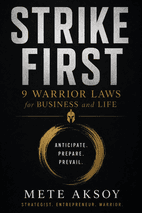
STRIKE FIRST by Mete Aksoy Book Cover

by Mete Aksoy

Mete Aksoy's STRIKE FIRST presents nine warrior laws drawn from military history as a strategic framework for overcoming obstacles in business and personal life, distinguishing decisive action from aggression and self-mastery from conquest. Written for leaders and entrepreneurs seeking clarity in competitive environments.

On Insta.page you also get an Apply This Book tool that lets you combine insights from up to 3 books to solve your specific situation.

Chapter mindmaps

Free preview: chapters 1–4 are fully interactive. Click any node to expand or collapse. Subscribe to unlock the rest.

Chapter 1: WHAT ARE THESE NINE LAWS?

Key concepts: WHAT ARE THESE NINE LAWS?

1. WHAT ARE THESE NINE LAWS?

The Nine Universal Laws

  • Objective, Offensive, Security, Maneuver, Mass
  • Economy of Force, Simplicity, Unity of Command, Surprise
  • They are conditions for victory, not tactical gimmicks
  • Violating them makes failure almost inevitable

Laws vs. Tactics and Maxims

  • Laws are timeless; tactics are situational
  • Laws form a hierarchy: strategy, operations, tactics
  • Maxims are practical derivations from studying the Laws
  • Maxims make the Laws actionable in real life

Application Beyond the Battlefield

  • Laws apply to business, leadership, and personal growth
  • Winners treat business as a campaign of discipline
  • Strategy logic works under uncertainty and competition
  • Corporate metaphors like 'campaigns' reflect real dynamics

Ethical Framework and Moral Compass

  • Target systems and internal barriers, never people
  • Legitimate self-defense within legal and ethical bounds
  • Deepest victory is over your own limits, not others
  • Laws are about structure, not violence

Language, Sources, and Promise

  • Use 'Law' to emphasize binding nature over 'principle'
  • Drawn from military manuals and business books
  • Laws are the timeless warp; Maxims are the actionable weft
  • Book offers practical system for real-world strategy

Chapter 2: LAW I: THE LAW OF THE OBJECTIVE

Key concepts: LAW I: THE LAW OF THE OBJECTIVE

2. LAW I: THE LAW OF THE OBJECTIVE

Core Principle: Unsentimental Elimination of Resistance

  • Victory requires absolute focus on the final objective
  • Emotions and sentiment must not override strategic goals
  • Win so decisively that resistance becomes unthinkable
  • History judges outcomes, not gentleness of methods

Five Operational Maxims

  • Strategic Coldness: Protect the goal despite opposition
  • Map the Campaign: Identify only objectives serving the final goal
  • Isolate the Vital, Sacrifice the Rest: Concentrate on key hinge points
  • Clarify the First Objective: Explain it simply to a junior employee

Cruelty Well Used vs. Cruelty Ill Used

  • Swift, decisive cuts offend less than prolonged hesitation
  • Sherman burned Atlanta once to end a war faster
  • Iacocca fired 60,000 once to save 85,000 jobs
  • Hard cuts must be lawful and respect human dignity

Leadership Character and Shared Sacrifice

  • Leaders must earn moral authority to demand sacrifice
  • Iacocca cut his salary to $1; Sherman accepted lasting hatred
  • Musk's Twitter cuts felt cold without shared burden
  • Character determines if victory is worth celebrating

The Equation of Ends and Means

  • Victory is a math problem: match resources to objectives
  • Honda shelved car dream, launched motorized bicycle instead
  • Stirling redefined tools with Jeeps and surprise, not bigger bombers
  • Include intangible variables: spirit, will, courage, intelligence

Chapter 3: LAW II: THE LAW OF OFFENSE

Key concepts: LAW II: THE LAW OF OFFENSE

3. LAW II: THE LAW OF OFFENSE

Defense Alone Cannot Win

  • No war won by sitting back
  • Defense hands enemy control of timing
  • Alexander proved attack at heart is safest
  • Constant defense never wipes out aggression

Ground Shapes Fighting Style

  • Europe's forests reward chess-like play
  • Open Steppe forces poker mindset
  • America blends Western power with Steppe openness
  • Blended fighter tends to win

Strike First

  • Initiative forces opponent to react
  • Know yourself and enemy before striking
  • Waiting for first strike is moral failure
  • Absolute commitment raises stakes to win

Wage Offensive Defense

  • Every offensive plan must include defense
  • Moltke: strategic offense, tactical defense
  • Wellington: strategic defense, tactical offense
  • Defense is setup for knockout blow

Multiply Force with Velocity

  • Speed makes blow invisible and unstoppable
  • First movers write default; latecomers fight uphill
  • Double velocity quadruples impact
  • OODA Loop winners fight in opponent's future

Concentrate the Strike

  • Hit the pillar holding up opposition
  • Be weak elsewhere to be strong at decisive point
  • Sun Tzu: millstone falling on egg
  • Napoleon concentrated forces at decisive point

Unleash Total Force

  • War is violence pushed to outer limits
  • Fair fight is a failed plan
  • Powell Doctrine: overwhelming force or don't move
  • Execute with full intensity against obstacles

Chapter 4: LAW III: THE LAW OF SECURITY

Key concepts: LAW III: THE LAW OF SECURITY

4. LAW III: THE LAW OF SECURITY

Core Principle: Refuse to Be a Victim

  • Eliminate blind spots to prevent rear attacks
  • Primal instinct: sit with back to wall
  • Coworkers exploit exposed vulnerabilities
  • Nokia and Colonial Pipeline failed from neglect

Maxims 1-3: Position and Concealment

  • Fortify high ground: own unique position
  • Conceal intentions: control what you reveal
  • Be formless: adapt like water to terrain
  • Netflix cannibalized DVD model to survive

Maxims 4-5: Intelligence and Misdirection

  • Deploy intelligence: fighting blind is death
  • Midway: code-breaking enabled ambush
  • Master strategic misdirection: control story
  • Operation Mincemeat fooled German forces

Maxims 6-7: Preparation and Action

  • Rehearse execution: practice before reality
  • Act decisively: calculated risk beats caution
  • Best defense is often offense
  • Hannibal and Washington defied cold logic

Key Takeaways

  • Pseudo-rationalism kills courage and action
  • Balance self-protection with offense
  • Seven maxims form a complete system
  • Retreat invites attack; adapt and strike

Continue exploring STRIKE FIRST