STRIKE FIRST Key Takeaways
by Mete Aksoy
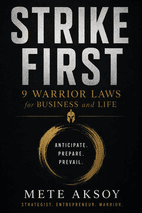
5 Main Takeaways from STRIKE FIRST
Clarify your objective and triage without sentiment
The Law of the Objective demands that you identify your critical goal and ruthlessly cut anything that doesn't serve it. Lee Iacocca saved Chrysler by sacrificing lesser goals and slashing his own salary to $1, proving that shared burden legitimizes hard cuts. Hesitation that drags out pain is cruelty ill used—cut decisively, then rebuild.
Achieve security through action, not overanalysis
Pseudo-rationalism kills courage; real security comes from decisive movement and calculated risk. The seven maxims of security—establish invulnerability, conceal intentions, stay formless, gather intelligence, use misdirection, prepare for contingencies, and take risks—form a complete system. Attacking is often the best defense, and a static posture invites attack.
Maneuver by breaking rules and controlling the narrative
Opportunity is useless without flexibility—break rules that create rigidity. Steal unclaimed value from anywhere, refine it, and deploy it; the world rewards the deployer. Use narrative to reframe accusations and turn disasters into advantages, flowing like water to adapt fast and never confuse stability with safety.
Concentrate force at the decisive point, accept vulnerability elsewhere
The Law of Mass says relative superiority wins, not total size—be five times stronger at the decisive point even if ten times weaker elsewhere. The Law of Economy (Pareto Principle) forces you to accept vulnerability in non-critical areas to deliver devastating impact. Gandhi peeled back the British Empire to the salt monopoly and struck there.
Simplify ruthlessly and unite command to eliminate friction
Simplicity erases traces, removes psychological cushions, and forces direct accountability—travel light and betray your past self if it doesn't serve the objective. Unity of Command binds leaders into a coalition and fosters brotherhood through shared identity, turning individual ego into collective power. Without unity, coordinated achievement is impossible.
Executive Analysis
These five takeaways form a coherent strategic system rooted in nine universal laws that govern competition, uncertainty, and limited resources. The book argues that victory—whether in business, leadership, or personal growth—requires a disciplined focus on a clear objective, a secure and adaptive posture, the ability to concentrate force at the decisive point while economizing elsewhere, and the simplicity and unity to execute without friction. The ultimate enemy is internal: fear, ego, and inefficiency, so strategic thinking becomes a tool for legitimate self-defense and self-mastery, not aggression.
This book matters because it translates timeless military principles into actionable frameworks that cut through modern complexity and indecision. Unlike typical strategy guides that offer tactical gimmicks, Strike First demands moral courage and self-sacrifice from its readers. It sits at the intersection of military history, business strategy, and personal development, offering a holistic approach that helps leaders make hard decisions quickly and build resilient organizations. Its emphasis on the binding nature of the laws (violate them and fail) gives it a rare, no-nonsense authority in the genre.
Chapter-by-Chapter Key Takeaways
WHAT ARE THESE NINE LAWS? (Chapter 1)
The nine Laws (Objective, Offensive, Security, Maneuver, Mass, Economy of Force, Simplicity, Unity of Command, Surprise) are universal conditions for victory, not tactical gimmicks.
These Laws apply far beyond the battlefield—to business, leadership, and personal growth—because they address universal realities of competition, uncertainty, and limited resources.
The "enemy" in this book is always an obstacle or internal barrier (fear, ego, inefficiency), not a person to be harmed.
The ultimate conquest is of the self, not others; strategic thinking is a tool for legitimate self-defense and disciplined pursuit of goals, not aggression.
The author uses "Law" instead of "principle" to stress their binding nature: violate them and you move toward failure.
Try this: Identify your current obstacle or internal barrier (fear, ego, inefficiency), then map it against the nine laws to diagnose which one you are violating—and immediately correct that violation.
LAW I: THE LAW OF THE OBJECTIVE (Chapter 2)
Triage is the model: Save what can be saved first, cut what cannot, act fast – and don’t mourn the amputated limb while the patient is still bleeding.
Intermediate objectives must be clear and prioritized: Iacocca mapped the chaos. He rebuilt finance, marketing, and quality control before anything else, sacrificing lesser goals to protect the critical one.
Leaders must earn the right to demand sacrifice: Iacocca reduced his salary to $1. Sherman accepted lasting hatred. Shared burden legitimizes hard cuts. Without it, ruthlessness feels cold and hollow.
Cruelty well used is swift and final: Machiavelli’s distinction applies. Cut decisively once, for the survival of the whole, then rebuild. Hesitation that drags out pain is cruelty ill used.
Character determines whether victory is worth celebrating: The Law of the Objective is a scalpel. Used with discipline and shared sacrifice, it saves. Used for pure efficiency without human connection, it severs something essential.
Ends and means must be matched: Miscalculate, and you become the sacrifice. Solve the equation in your intermediate steps, and always act lawfully.
Try this: Define your single most critical objective and triage your resources today: cut any activity, project, or expense that does not serve that objective, and share the burden of sacrifice by leading from the front.
LAW III: THE LAW OF SECURITY (Chapter 4)
Pseudo-rationalism kills the courage and perseverance needed for great acts. Real security comes from decisive action, not endless calculation.
Self-protection must be balanced with offense; sometimes attacking is the best form of defense.
The seven maxims form a complete system: establish an invulnerable position, conceal intentions, remain formless, gather intelligence, use misdirection, prepare for every contingency, and be willing to take calculated risks.
Retreating only invites attack. The most secure posture is one that moves, adapts, and strikes when the moment is right.
Try this: Stop overanalyzing: take one decisive action that simultaneously protects your position and pressures your obstacle, even if it means attacking instead of retreating.
LAW IV: THE LAW OF MANEUVER (Chapter 5)
Opportunity is useless without the flexibility to seize it—rules create rigidity; break the ones that don’t matter.
“Stealing” ideas is about liberating unclaimed value: take, refine, execute, deploy. The world rewards the deployer.
Use narrative to control the battlefield—reframe accusations, shift frames, win the story war.
Turn disasters into advantages: lightness lets you pivot when success becomes weight.
Maneuver means flowing like water—adapt fast, stay unstoppable, and never confuse stability with safety.
Try this: Break one rule that limits your flexibility today, then steal and adapt a proven idea from outside your field—use narrative to reframe any pushback as a strategic advantage.
Next chapter: “LAW V: THE LAW OF MASS” is locked
Keep learning from STRIKE FIRST — and unlock all 600+ book summaries with audio, mindmaps and AI Q&A.
$0.00 due today · 7 days free, then $89.99/year ($7.49/mo) · Cancel anytime before day 7
plus sales tax where applicable