SOLD OUT Coach Quotes
by John Meese
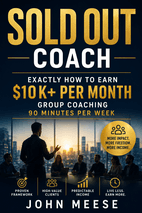
On this page you will find a collection of lines from SOLD OUT Coach by John Meese. They cover everything from choosing the right clients to running a group program that stays full. Some are blunt observations about pricing and attention. Others are reminders that meaningful work comes down to real humans helping real humans.
The book is quotable because it reads like a conversation with someone who has lived the advice. Meese mixes practical strategy with honest reflection, and he does not hide the tension between ambition and authenticity. These lines are easy to share, whether you need a nudge for your own coaching work or a fresh way to talk about building a business with heart.
Top Quotes from SOLD OUT Coach
“When you unwrap all the tactics, funnels, and clever copy... there's a human under the hood of your business who just wants to get paid well to do meaningful work.”
The author reflects on what clients ultimately want beneath their business tactics.
It strips away business jargon and reminds readers that meaningful work and fair pay are universal human desires.
“He spent three years leading a SOLD OUT group coaching program with just 12 members (who paid the highest price possible), and occasionally he gave a Sermon on the Mount.”
The author uses Jesus's ministry as an example of group coaching.
It makes a bold, memorable analogy that challenges conventional scale and fame.
“While the SOLD OUT Coach Playbook is simple, it is not easy.”
The opening line of the chapter.
It captures the core challenge of any worthwhile endeavor. Readers appreciate the honesty that simplicity doesn't equal ease.
“When people pay a premium, they pay attention.”
The author explains the psychological effect of the $2K price point.
It's a memorable mantra about the value of commitment and premium pricing.
“Your Bullseye Target Client is the perfect fit client where you can make the greatest impact on their life; in return, they are willing to make the greatest investment.”
The author defines the ideal client for a premium coaching program.
It frames target selection as a reciprocal relationship: deep impact on the client's life and a meaningful investment from them.
“You must resist the urge to help people who don’t want to be helped (yet).”
The author advises against trying to coach people who aren’t ready for change.
It turns a common coaching frustration into a clear boundary. Readers recognize the wasted effort of trying to force readiness.
Themes Behind the Quotes
The first big theme is focus. The book keeps returning to the idea that you should not try to help everyone. Instead, you need a clear picture of the person you serve best and the goal they care about most. From there, everything gets simpler. A small group of committed clients can be more powerful than a huge audience, especially when they pay a significant price. That payment changes the relationship, because people who invest deeply tend to pay attention and take action.
The second theme is humanness. Behind the funnels, pricing, and frameworks is a person doing meaningful work and building a life they want. The book honors the courage it takes to make a real promise and face the fear of launching something new. It makes room for play, family, and rest. Success is not measured by size alone. It is measured by impact, fit, and the freedom to stay connected to the work and people who matter.
Quotes by Chapter
Ready to get SOLD OUT?
“Answer five quick questions at soldoutquiz.com to see if you're ready to launch your own SOLD OUT group coaching program.”
From the chapter's opening call to action.
It frames readiness as a concrete first step, inviting readers to self-assess before starting.
“If you're ready, you'll get my green light to launch along with your personalized next steps.”
The author explains what happens after taking the quiz.
It creates a clear, motivating reward for taking action.
“If you're not ready (or almost ready), you'll get instant advice on what you need to focus on next.”
The author addresses those who may not pass the readiness quiz.
It reassures readers that a 'not ready' result is still useful and constructive.
“In every case, read this book to learn the entire SOLD OUT Coach playbook so you can earn $10K+ per month group coaching 90 minutes per week.”
The author's closing push to read the book.
It ties the book directly to a concrete, high-income outcome with a time-efficient promise.
Introduction
“Good work is done by humans helping humans chase their daydreams—despite their fears.”
The author affirms the human-centered nature of meaningful work.
It's a concise, warm statement that reframes ambition as helping others pursue dreams.
“Plenty of people still say you should preach to an audience of thousands every single day if you want to get noticed, but clearly, lasting impact requires you to go deep with a small group of superfans.”
The author contrasts preaching to the masses with going deep.
It argues that true influence comes from depth with a small group, a counterintuitive and compelling insight.
Group coaching is better than 1-on-1 coaching
“My SOLD OUT group coaching program gives me freedom to write books, speak on other people's podcasts, host mastermind retreats, and wrestle with my kids in Jiu-Jitsu (when we're not homeschooling, building sandcastles, or playing Fortnite).”
Author opens by describing the lifestyle his group coaching program funds.
It turns abstract business advice into a vivid, specific vision of freedom. Readers can picture the life they're working toward, which makes the rest of the chapter feel personally motivating.
“No matter how you frame it, you're selling time (your scarcest resource), and it's natural to subtly change your advice, framework, or coaching style to each individual client.”
Author explaining the hidden cost of one-on-one coaching.
It reframes hourly coaching as trading time for money, a limitation many entrepreneurs feel but struggle to name. It also shows why personalization may quietly undermine consistency.
“Personalization feels like a perk, but it makes it incredibly difficult to develop a useful repeatable framework you can leverage to develop courses or books.”
From the author's list of reasons group coaching wins.
It flips the assumption that customization is always better. Readers see how standardization can unlock bigger opportunities.
“The forcing function of making a single promise that requires a repeatable framework raises the stakes, and the most exhilarating moment is also the most terrifying: when you enroll your first client and realize, “OMG, what if I only get one client in my group. What will they think of me?!””
Author describing the fear of launching a group coaching program.
It captures the vulnerable moment behind a bold business move. The humor makes the fear relatable and the risk feel worth taking.
Your SOLD OUT Coach Operating System
“Within this book, you have all the information you require to create your own SOLD OUT group coaching program, but the real work is putting those principles into practice.”
The author explaining the gap between reading and doing.
It highlights the common trap of collecting information without applying it. This motivates readers to take action rather than just consume.
Step 1: Find Your Bullseye Target Client
“If you think that your audience won't pay you thousands of dollars for a group coaching program, you're mostly right.”
Opening line of the step on finding your target client.
It validates a common fear while setting up the counterintuitive logic that follows.
“Most people will not pay a premium, no matter how good your offer is—but when you sell a group coaching program, you only need a handful of people to enroll.”
The author explains why broad appeal isn't necessary for a group program.
This shifts the reader's focus from mass market to the few decisive buyers who make a program viable.
Bullseye Target Client = maximum impact = maximum income
“Once you enroll five clients, your new program is SOLD OUT, which elevates your authority, inspires new interest, and allows you to incrementally raise your price and the size of each cohort until you're charging up to 12 clients $5K or $10K each.”
The author opens the chapter with the payoff of enrolling a small target group.
It makes the business case for niching concrete: five ideal clients can create sold-out programs, authority, and price increases.
“When you're selling a group coaching program for $2K or $5K or $10K, the stakes are much higher.”
The author contrasts low-cost products with high-end group coaching.
It raises the stakes of target selection, making precision feel essential rather than optional.
“Realistically, the bullseye is only 10% of any target (at most), but it's worth it to find that bullseye before you take a single shot.”
The author explains why the bullseye is rare and worth finding.
It acknowledges the discipline required to focus on a small slice of the market and rewards the reader with a clear action: find your bullseye before shooting.
Your Bullseye Target Client is OPEN to change
“This is your Bullseye Target Client; they are Engaged in seeking a solution (perhaps even before they know you exist).”
The author defines the ideal client as someone in the Engaged stage of buyer awareness.
It gives a vivid picture of the exact person worth targeting. The phrase captures the thrill of being found by someone already looking for you.
“You're wasting your energy selling solutions to people in the Oblivious stage (while Pondering people will happily waste your time).”
The author explains why trying to sell to uninterested audiences is a trap.
It names the two biggest time-wasters for coaches in one blunt sentence. The parenthetical twist makes the warning feel practical and personal.
“Focus your time and energy on people Engaged in change (and trust that folks in Need will find you too).”
The author summarizes the action step after walking through the four buyer-awareness stages.
It gives clear, positive direction while easing the fear of missing out on desperate clients. The reassurance makes the advice feel sustainable.
Intent matters more than identity
“The correct answer is B, and it’s really no contest.”
The author answers his own pop quiz about selling a weight-loss program.
It’s a punchy, confident line that makes audience selection feel obvious. Readers remember the principle because of its directness.
“Some of the corporate guys might be interested in your program, and they can probably pay for it, but that’s a gamble because /dentity doesn't matter as much as Intent (people who want to lose weight).”
The author explains why the smaller group of people who want to lose weight is the better audience.
It's the clearest statement of the chapter's central idea: intent matters more than demographic identity. The line challenges readers to prioritize motivation over categories.
“Your Bullseye Target Client is actually an answer to two questions: 1. Identity: Who is your Target Client? 2. Intent: What is their most important goal right now?”
The author introduces his definition of a Bullseye Target Client.
It turns a fuzzy marketing concept into a clear two-part diagnostic. This is the practical takeaway readers can apply immediately.
“Despite their diversity, every single one of those clients had the same /ntent to grow their online education business by creating a SOLD OUT group coaching program.”
The author reflects on the range of clients he has coached.
It shows intent can unify radically different people. This makes the case that a shared goal is a stronger basis for targeting than shared traits.
The best group coaching programs combat tragedy
“I believe the cure to every war, disease, and divorce is available—just not easily available online.”
The author states his core conviction about hidden wisdom.
It is a provocative, memorable line that frames access to expertise as a global and moral issue.