SOLD OUT Coach Key Takeaways
by John Meese
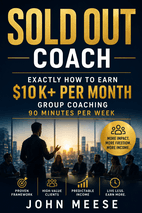
5 Main Takeaways from SOLD OUT Coach
Find one Bullseye Target Client with urgent intent
Don't waste energy on a broad audience. The buyers who will fill a group coaching program are engaged, actively seeking a solution, and willing to pay premium prices. When you combine identity with intent, even ten percent of an audience is more than enough to sell out a small cohort.
Sell a 10X Promise, not your program's features
Clients buy a future version of themselves, so your promise should follow the shape 'get {result} without {roadblock}' and speak to both desire and fear. Mike Pacchione's immediate sellout shows that a specific, dramatic, emotionally resonant promise can do the heavy lifting that marketing usually does.
Use Handraisers to start conversations, not sales funnels
A one-line 'Wanna 10X?' email with no links gets replies instead of clicks, and every reply is a qualified lead. Pair it with 'Who do you know?' to invite self-referrals, then use those replies to schedule Serve Calls.
Serve to sell with a free coaching call
The Serve Call is a 45-minute customer-research conversation built on Relationship, Results, Roadblocks, Resources, Recap, and Recommendation. When you genuinely serve first, the offer feels natural and clients often close themselves.
Get SOLD OUT first, then scale your systems
Start with five founding members at $2K, give ten Serve Calls, and use a sold-out announcement as your strongest authority signal. Then build a Client Creation Machine around the celebration flywheel and Attract-Nurture-Sell systems so growth continues without burning you out.
Executive Analysis
These five takeaways form a single argument: high-ticket group coaching is not about audience size or marketing volume; it is about precision and service. By narrowing to a Bullseye Target Client with urgent intent, the coach creates the conditions for a 10X Promise that speaks directly to the client's desire and fear. Handraisers replace broad funnels with personal conversations, and the free Serve Call replaces pitching with proof, turning strangers into committed founding members. Finally, celebrating client wins and building an Attract-Nurture-Sell machine makes the business durable rather than dependent on the coach's effort.
This book matters because it offers a practical, humane alternative to the exhaustion of one-on-one coaching, course creation, and social-media hustle. It sits in the online-business genre but distinguishes itself by focusing on a 90-minute weekly commitment, a small cohort, and a deeply relational sales process. Readers get more than theory: the SOLD OUT Coach OS, handraiser templates, Serve Call scripts, and revenue models make the playbook actionable immediately. The deeper message—stewarding wisdom rather than merely maximizing income—gives the work lasting purpose.
Chapter-by-Chapter Key Takeaways
Ready to get SOLD OUT? (Chapter 1)
The soldoutquiz.com assessment offers a quick, practical way to gauge your launch readiness through five targeted questions.
You'll receive either personalized next steps and a green light to launch, or specific advice on what to improve before moving forward.
The book's promise centers on a repeatable playbook for building group coaching that earns $10K+ per month in just 90 minutes per week.
This section functions as a launchpad, connecting everything you've learned to your very next action.
Try this: Take the five-question SOLD OUT Quiz at soldoutquiz.com to get a personalized launch-readiness verdict and choose your immediate next step before building anything else.
Introduction (Introduction)
The traditional paths to growth—raising rates, selling courses, or chasing social media—are dead ends because they either cap your time or burn you out.
Group coaching is not a new trend; it's an ancient model based on deep, small-group transformation rather than mass exposure.
A single 90-minute weekly workshop with 5 to 12 clients can replace a full-time income.
You don't need an audience, ads, or a huge following. You need a proven playbook and the willingness to start small.
The goal is to get paid well for meaningful work, not just to work harder.
Try this: Abandon the income ceiling of private clients and one-off courses; build a small group coaching program around a single weekly 90-minute workshop that replaces a full-time income.
Group coaching is better than 1-on-1 coaching (Chapter 2)
One-on-one coaching is limited by time and hourly rate, while group coaching builds an asset that scales.
Group coaching forces clarity around a shared goal and a repeatable framework, which improves results and creates future products.
Positive peer pressure and shared momentum make group clients more committed than isolated individuals.
You do not need to carry the group alone; members contribute value and reduce the pressure on you.
Watching peers grow expands what clients believe is possible for themselves.
The best path from one-on-one is one-to-few, which lowers the risk and lets you test your framework.
Real-world examples show that group coaching can support very different goals, from lifestyle freedom to a seven-figure business.
A group coaching program earning $10K per month from 90 minutes of coaching per week is achievable with the right playbook.
Try this: Map your transition from one-on-one coaching to a one-to-few group model by defining one shared goal and one repeatable framework, then let peer momentum do some of the work.
Your SOLD OUT Coach Operating System (Chapter 3)
The SOLD OUT Coach OS is a free AI-powered CRM that turns the playbook's principles into daily, actionable workflows.
Core tools cover the full client lifecycle: lead tracking, Serve Call scheduling, enrollment, cohort planning, and sales call documentation.
The resource library includes ready-made templates for 10X Promises and handraisers to accelerate your content creation.
Built-in AI agents provide coaching support, sales accountability, and voice-matched writing assistance.
The system was created through real use in the author's own coaching program, making it a practical, battle-tested resource.
Access to the entire operating system is available at SOLDOUTCoachOS.com.
Try this: Claim your free SOLD OUT Coach OS account at SOLDOUTCoachOS.com and load the lead tracking, Serve Call, and cohort planning templates into your daily workflow before your next launch.
Step 1: Find Your Bullseye Target Client (Chapter 4)
You don’t need a large audience to sell a group program, only a small group of committed buyers.
Launch with a founding cohort of five clients to keep the group intimate and the goal achievable.
A $2K price point makes the offer feel premium while remaining affordable for many serious prospects.
When clients pay a meaningful amount, they engage more deeply and get better results.
Try this: Commit to a founding cohort of exactly five clients at a premium price like $2K, and let that small, committed group prove your framework before scaling.
Bullseye Target Client = maximum impact = maximum income (Chapter 5)
Selling out a small program of five clients creates scarcity, authority, and room to raise prices incrementally.
Low-priced products can be sold to a broad audience, but high-ticket group coaching demands precision.
A Bullseye Target Client is the intersection of maximum impact for them and maximum investment from them.
The bullseye is realistically only about ten percent of any audience, but that's more than enough when you know exactly who they are.
The most effective bullseye definitions are highly specific, naming not just who the client is, but what they're struggling with and why the stakes are high right now.
Try this: Define your Bullseye Target Client as the intersection of maximum impact for them and maximum investment from them, and get hyper-specific about their struggle and urgency.
Your Bullseye Target Client is OPEN to change (Chapter 6)
Don't target Oblivious clients. They don't know they have a problem and won't respond to your attempts to convince them.
Beware the Pondering majority. Roughly 75% of your audience is thinking about change but not ready to buy. They'll consume your free content but won't pay for a solution.
The Bullseye Target Client is Engaged. They're actively seeking a solution, have made it a priority, and are willing to pay a premium for faster results.
Handle Need clients with care. Desperate clients can be profitable but also disruptive. In group settings, limit their numbers and manage them closely to protect the group's energy.
Try this: Ignore the oblivious and merely pondering segments of your audience; aim your first launch only at engaged clients who are actively seeking a solution and willing to pay.
Intent matters more than identity (Chapter 7)
Intent is more predictive of buying behavior than identity. A small group with urgent intent beats a large group with mere demographic fit.
Identity answers "who," and intent answers "what do they want right now." You need both, but intent is the stronger signal.
Even when identity and intent overlap (like pregnant women and morning sickness), the emotional driver is the intent, not the label.
Diverse audiences can share the same intent. That shared goal is what makes them a market.
To find your bullseye, get specific: combine a clear identity with a sharply defined, deeply felt intent. Vague targeting leads to vague results.
Try this: Build your targeting around the client's urgent intent rather than demographic labels, and combine a clear identity with a sharply felt, specific desire.
The best group coaching programs combat tragedy (Chapter 8)
Group coaching programs thrive when you have a clear Bullseye Target Client, because clarity attracts the right people and repels the wrong ones.
The greatest tragedy in professional services is that decades of valuable wisdom often die with the person who accumulated it.
Professionals become willing to share their knowledge when they're paid for advice rather than effort, which breaks the cycle of being overworked and underpaid.
The mission isn't just to build a successful business, but to steward wisdom: collect it, protect it, and multiply it so it outlasts you.
A scalable group program is the vehicle for turning your smarts into wealth without sacrificing your life.
Try this: Position your group coaching program as a way to steward your hard-won wisdom so it outlasts you, not as another vehicle for trading time for money.
You’re not selling advice, you’re selling a promise (Chapter 9)
Clients buy a future version of themselves, not your program's features.
Different offer types require different promises: 10% for courses, Infinite for memberships, 10X for group coaching.
A 10X Promise must be specific, dramatic, and tied to your Bullseye Target Client's deepest desires.
The higher the price, the more compelling and concrete the promise needs to be.
A clear 10X Promise can replace heavy marketing, as Mike Pacchione proved by selling out immediately after stating his.
Try this: Write a specific, dramatic 10X Promise that sells a future version of your client's life, not the features of your program.
Your 10X Promise = get {result} without {roadblock} (Chapter 10)
A 10X Promise always follows the shape: get {result} without {roadblock}—even when the words aren’t literal.
Choose the result based on what your Bullseye Target Client wants right now, not just what you think they need to learn.
Select the roadblock based on the result you promise. The bigger the result, the more crucial it is to acknowledge the specific doubt that would make it unbelievable.
Vivid verbs help, but the real power comes from precision: one clear result and one resonant roadblock.
If your promise feels too long or tries to do too much, refine it until it sounds like the thing your client would whisper to a friend.
Try this: Sharpen your 10X Promise into the shape 'get {result} without {roadblock},' choosing a result your Bullseye Target Client wants right now and a roadblock that makes it feel impossible.
Your 10X Promise = get {desire} without {fear} (Chapter 11)
The 10X Promise has an emotional twin: Get {desire} without {fear}, and it works by speaking to what your client truly wants and what they're secretly dreading.
Fear, not lack of information, is the real reason your Bullseye Target Client hasn't already solved their problem.
You can address fear directly by naming it or by promising its opposite, both approaches make your client feel deeply understood.
A generic promise about benefits is weak. A specific promise that acknowledges the client's fear (like Shawn Blanc's focus program) transforms an intriguing idea into a compelling call to action.
Try this: Name the client's desire and their fear in your promise, because fear rather than information is what has kept them stuck.
Your 10X Promise should pass the purple elephant test (Chapter 12)
A 10X Promise should pair the result the client wants with the fear they want to avoid.
The purple elephant test asks: can your promise be imagined clearly, without extra explanation?
Vague language like "get more focused" fails; vivid language like "radiate authority without being a jerk" wins.
To find your promise, start with a specific person and describe how their life changes, then identify the fear that comes with that change.
The best promises are short, specific, and emotionally reassuring all at once.
Try this: Run your promise through the purple elephant test: if someone can't vividly picture it without further explanation, rewrite it with more precise and emotional language.
Use your 10X Promise offer while it’s still a hypothesis (Chapter 13)
The 10X Promise is a hypothesis, not a finished product. Use it before it feels perfect.
A promise only needs to resonate with your Bullseye Target Client, not with everyone.
Naming the desire and removing the fear behind it makes the promise magnetic.
The author's first promise was far less vivid than today's version, yet it still sold the program.
Real feedback comes from using the promise in email invitations and free coaching calls.
Keep inviting clients until your first cohort sells out, then edit or rewrite based on what you learned.
The promise is never permanent, so treat every version as an update rather than a final draft.
Try this: Treat your 10X Promise as a hypothesis and send it out while it's still imperfect; edit it only after real clients respond to it.
Step 3: Send Compelling Handraisers (Chapter 14)
Ask a question so specific that only your Bullseye Target Client would respond, and the raised hand does your qualifying work for you.
Silence from the crowd is a good sign—it means you are not wasting time on people who are not ready to buy.
A handraise is low stakes, so it makes it safe for genuinely interested people to step forward without feeling pushy.
The handraise is just the opening; the real enrollment happens in a private sidebar conversation where you can tailor your message and build trust.
Try this: Create a Handraiser that asks a question so specific only your Bullseye Target Client will answer, and treat silence from everyone else as a sign that you're not wasting time.
You can’t sell a group coaching program like you sell a course (Chapter 15)
The longer the sales process, the more places you can lose a high-ticket buyer. A 15-step funnel designed for courses is a liability for group coaching.
Online marketing best practices are built for scale, which means they prioritize efficiency over personal connection. That distance works for low-ticket products but undermines high-ticket ones.
A group coaching purchase is not an impulse buy. It requires trust, clarity, and a sense of human connection.
Sending prospects to a sales page and hoping they buy places all the burden on the prospect. The better approach is to reduce friction and increase access.
Inviting a Handraiser, someone who replies to express interest, closes the gap between you and your client. It turns a transactional process into a relationship-driven conversation.
Try this: Stop building course-style funnels for high-ticket group coaching; shorten the process and invite Handraisers into personal conversations instead of sending them to a sales page.
Handraisers are invitation emails asking for a reply (Chapter 16)
A Handraiser is an email designed to generate replies, not clicks, by intentionally omitting links and formatting that encourage visiting a sales page.
The email asks a simple question with minimal context, making a reply the only way to learn more.
Unlike traditional marketing that funnels readers to a sales page, a Handraiser starts a conversation and positions the reply as the primary conversion event.
Every reply is a clear signal of genuine interest, acting like a raised hand in a crowded room and allowing for a more personal, tailored follow-up.
Try this: Send a Handraiser as an invitation email with no links, no sales page, and no design; make the reply the only way to learn more and treat every reply as a raised hand.
Test your 10X Promise with the simplest Handraiser: Wanna 10X? (Chapter 17)
The "Wanna 10X?" Handraiser is a simple one-line question built directly from your 10X Promise, free of any product or sales context.
It works because it acts as a genuine personal plot twist in an inbox full of impersonal marketing.
You only need a small number of curious replies to fill a group coaching program, making this a highly efficient way to start one-on-one conversations.
Real-world examples show dramatic results: Shawn Blanc earned an extra $100K in six months by replacing his fancy funnel with this question, and Austin Saylor got nearly 400 replies from 3,750 subscribers.
Variations are fine, but the promise must stay the focus, never the product, and the email should be stripped of any design elements that dilute its directness.
Try this: Send the simplest one-line 'Wanna 10X?' Handraiser built directly from your promise, stripped of product context and design, and let the curious replies open one-on-one conversations.
Ask “Who do you know?” to get self-referrals from your contacts (Chapter 18)
The “Who do you know?” Handraiser is best paired with the “Wanna 10X?” message and sent to the same audience within the same week.
It works as an email, text, or DM, and is effective whether you have a large list or just a few personal contacts.
The template feels like a referral request but is designed to trigger self-referrals from your ideal clients.
Personalize the fields carefully, especially the criteria and the humblebrag event, to make the message feel tailor-made.
Skip the fancy email signature and keep the subject line focused on your 10X Promise.
Real-world examples show this method can sell out programs and generate significant revenue, even with only a few dozen contacts.
Try this: Pair your 'Wanna 10X?' email with a 'Who do you know?' Handraiser sent to the same contacts within the same week, and personalize it enough that your ideal client self-refers.
How to reply to Handraiser replies to schedule Serve Calls (Chapter 19)
Never go straight for the sale after a Handraiser reply, always ask for more context first.
Your Bullseye Target Client will reveal themselves through the amount and quality of personal detail they share.
Acknowledge what a person tells you before inviting them to schedule a call.
Always hyperlink your scheduling link to the call invitation, and be ready to resend it if someone replies with "yes" instead of booking.
The coaching call is not the pitch, it's the serve, and it's the core of Step 4.
Try this: Reply to every Handraiser by first asking for context, acknowledging what they share, and then hyperlinking your scheduling link to book a Serve Call.
Step 4: Serve to Sell with 1 Free Coaching Call (Chapter 20)
Free coaching calls aren't about pitching—they're about proving your value through genuine service.
Thirty-five calls without a sale isn't a failure of effort; it's a sign of a flawed approach.
The Serve Call Method built trust and momentum so that the offer felt like a natural next step, not a pushy ask.
A small, quick turnaround (three calls, three sales) can validate a method faster than a hundred lukewarm conversations.
Try this: Replace your pitch with a free coaching call that proves value first; make the offer a natural next step rather than a pushy ask.
Serve Calls are customer research coaching conversations that lead to a sale (Chapter 21)
A Serve Call is a 45-minute coaching conversation that produces both customer research and a potential sale, with success about half the time.
The method uses six intentional stages: Relationship, Results, Roadblocks, Resources, Recap, and Recommendation.
No script is needed; natural follow-up questions like “and what else?” are essential for uncovering meaningful insights.
The closing recommendation explicitly names the client’s desired result and their proven resources, making the offer feel like a natural fit.
The SOLD OUT Coach OS provides a Serve Call Guide and an AI evaluator called CloseMate to help you practice, measure, and improve your calls.
Try this: Run every Serve Call through the six stages—Relationship, Results, Roadblocks, Resources, Recap, Recommendation—and ask 'And what else?' to uncover what truly matters.
Results. What is your most important goal right now? (Chapter 23)
The shift from Relationship to Results should feel natural, not abrupt—use "What's on your mind?" to transition smoothly.
The core question, "What is your most important goal right now?" opens the door for the client to share what truly matters to them.
Follow-up questions like "Why is that important?" and "And what else?" encourage deeper, more honest answers.
Avoid mentioning your expertise or offer during this phase; the goal is to listen, not to steer.
Simply asking thoughtful, specific questions about someone's goals is a valuable experience in itself—one that builds trust and sets the stage for real results.
Try this: Open the Results stage with 'What is your most important goal right now?' and keep listening without mentioning your expertise or offer until you understand what they truly want.
Roadblocks. How is that going so far? (Chapter 24)
Roadblocks are the fears or facts that prevent the Bullseye Target Client from reaching their desired results, and they often require careful handling.
Start with a safe, simple question like "How is that going so far?" to create a comfortable opening for honest conversation.
Adjust your question based on the client's energy, using variations like "What stands between you and accomplishing your goal?"
Use active listening phrases such as "That sounds frustrating, tell me more" to deepen the dialogue and show genuine care.
Follow up with kind, probing questions to reveal the full scope of the roadblock, and don't rush this step, the extra time can lead to major emotional connections and more effective coaching.
Try this: Ask 'How is that going so far?' to surface roadblocks, then use active listening and probing follow-ups to uncover the fear or fact blocking progress.
Resources. What have you tried before today? (Chapter 25)
The transition from Roadblocks to Resources begins with asking what’s stopping the person from achieving this alone, which plants the idea that help might be useful.
Ask “What have you tried before today?” and genuinely listen for assets, experiences, and wins.
Resources aren’t just obvious things like money or clients. They include skills, past successes, networks, and credibility.
Follow-up questions should feel natural and open-ended, inviting the person to share what they’re proud of.
A single hidden Resource can completely change your assessment of someone, turning a seemingly bad prospect into an ideal client.
The goal isn’t to evaluate someone’s worth on a narrow set of criteria. It’s to see the full picture of what they’re working with.
Try this: Ask 'What have you tried before today?' and listen for hidden resources—skills, past wins, networks, credibility—that can transform your assessment of a prospect.
Recap. What is your most useful takeaway from today’s call so far? (Chapter 26)
The Recap uses one powerful question: "What is your most useful takeaway from today's conversation so far?"
This question assumes value, personalizes learning, gives you feedback, and reminds clients how useful you are.
The phrase "so far" keeps the conversation open and signals more value to come.
Clients often share emotional takeaways like feeling seen or understood—these are just as valid as practical advice.
If the client can't give a clear answer, treat it as a signal to revisit earlier steps (Results, Roadblocks, Resources) rather than pushing forward.
Never assign homework or suggest post-call actions in a Serve Call; it eliminates the chance of closing the sale.
Try this: Use 'What is your most useful takeaway from today's conversation so far?' to build value, personalize learning, and remind clients how useful you are.
Recommendation. I believe I can help you. Would you like me to share how? (Chapter 27)
The Reciprocity Effect creates a natural opening for your offer once your client acknowledges the value you’ve provided.
The first yes comes from asking permission to pitch, and even a “yes, but…” counts.
The second yes comes from mirroring your client’s own words into a personalized diagnosis; it’s validation, not persuasion.
The third yes comes from presenting a 10X Promise without the details, letting desire take the lead.
Expect the third yes to come with an objection. Resolve it, restate the invitation, and repeat until you get a firm commitment.
Try this: Close your Serve Call with a triple yes: ask permission to share how you can help, mirror their words into a diagnosis, then present your 10X Promise and resolve objections until you get a clear commitment.
Step 5: Get Your Cohort SOLD OUT (Chapter 28)
Start your first cohort small: limit it to five clients at $2K, even if you could sell more or charge more.
Ten Serve Calls are your benchmark: give ten calls and expect five enrollments; give twenty calls and you can add five more spots at $3K.
Grow incrementally: after your first sellout, double to ten clients at $4K, then twelve clients at $5K—always letting demand guide your expansion.
Use sold-out status as leverage: being a SOLD OUT Coach gives you credibility and momentum that makes higher prices and larger cohorts far easier to achieve.
Run cohorts continuously: like Melissa, consider overlapping cohorts (one starting, one ending) to keep your revenue flowing monthly.
Try this: Start with five clients at $2K, give ten Serve Calls, and grow your cohort size and price incrementally to $3K, $4K, and $5K as demand and sold-out status allow.
The majority of buyers ignore you (until you’re SOLD OUT) (Chapter 29)
The majority of buyers won't engage with a new offer until they see others commit first—that's called the chasm.
A private, personal sales process keeps you out of the public eye until your program is already full.
Announcing a sold-out program is the single strongest authority signal you can send to the cautious majority.
Once you're sold out, you're no longer selling a concept; you're leading a proven group that others now want to join.
The early majority isn't ignoring you out of disinterest—they're waiting for the exact moment you become SOLD OUT.
Try this: Plan to sell your first cohort privately and personally, then announce the sold-out milestone as the strongest authority signal to attract the cautious majority.
Call your first clients “founding members” (never say “beta”) (Chapter 30)
Founding members are Innovators and Early Adopters who trust you and believe in your 10X Promise, not just anyone willing to pay.
They will accept an unfinished experience, but they will not accept a half-hearted effort. Commitment matters more than polish.
Never call your program “beta” or your first clients “beta members,” even as a marketing tactic or a way to get feedback.
Offering free or discounted “beta” spots distorts the coach-client dynamic, turning the coach into the student in an unhealthy way.
Use “founding members” instead. It honors the role of your first clients, creates a sense of shared creation, and elevates the entire first cohort experience.
Try this: Call your first clients 'founding members,' never 'beta,' and honor them as committed co-creators of the program rather than discounted test subjects.
Coach your Bullseye Target Client to a clear decision (yes or no) (Chapter 31)
Coach every Serve Call to a clear yes or no, and always welcome a yes with a deposit link right then.
For undecided clients, ask what they need to decide—and give only that. Schedule a follow-up if they want to delay.
Use your 10X Promise as the anchor in all follow-up messages and pitch decks, with testimonials leading the proof.
The three hurdles are Credibility, Believability, and Scarcity. Know which one you're facing by listening to their questions.
Believability is where most people get stuck—they're scared, not skeptical. Share stories and belief to help them move forward.
For price objections, reframe with ROI questions, and the $1 question to uncover the true hurdle.
Try this: Coach every Serve Call to a clear yes or no; welcome yes with a deposit link, give undecided clients only what they need to decide, and identify whether the hurdle is credibility, believability, or scarcity.
If at first you don’t get SOLD OUT, serve and serve again (Chapter 32)
The entire system is just two handraisers, ten Serve Calls, and SOLD OUT. Advanced tactics build on this foundation.
Give ten Serve Calls to your Bullseye Target Client before evaluating whether the process works.
A Serve Call isn’t complete until it ends in a clear yes or no. Chase down every “maybe” with a nudge.
Follow the Serve Call Method precisely, especially the Recap and Triple Yes Recommendation.
If eighty percent say no, audit who you were actually speaking with. You may have attracted ponders instead of engaged buyers.
If your process checks out and you still get zero closes, revisit your Bullseye Target Client and your 10X Promise. The problem might be who you’re serving or what you’re promising.
Try this: Give another round of ten Serve Calls before changing anything if you're not sold out; then audit your audience and promise if the no-rate stays high.
Send a SOLD OUT Handraiser to create sales momentum (Chapter 33)
Use the SOLD OUT moment as a catalyst for the next cohort by celebrating your current members, not just announcing the milestone.
A class photo and a heartfelt note about your clients’ 10X outcomes add proof and warmth to your handraiser.
Invite interested prospects to be "first to know" about future spots, which lets you schedule Serve Calls and collect deposits far in advance.
Momentum is built on repetition: handraiser, Serve Call, sold out, then repeat.
Leverage campaign strategy tools and daily follow-up nudges to keep conversations moving even between cohorts.
Try this: Turn your sold-out cohort into a SOLD OUT Handraiser with a class photo and a heartfelt note, and invite prospects to be first to know about the next spots.
Step 6: Celebrate Clients to Create More Clients (Chapter 34)
Celebrating client wins is a client attraction strategy, not just a nice gesture.
When your target audience is invisible or can’t publicly express interest, lead with a client’s success story instead of a direct offer.
A Showcase Handraiser—highlighting someone’s transformation—can generate qualified calls and enrollments without any public launch.
Visible success creates a “that could be me” response in ideal clients, which builds trust faster than any pitch.
The celebration flywheel: help clients succeed → celebrate them → attract new clients → help them succeed → repeat.
Try this: Create a celebration flywheel by helping clients succeed, publicly celebrating their wins, and using those stories to attract the next ideal clients.
Showcase your superfans to get SOLD OUT with a casual Q&A (Chapter 35)
The Showcase is a live, casual Q&A with a successful client, where the client does the talking and you naturally get the credit.
The invitation email intentionally leaves out the date and time to filter for genuine interest rather than casual availability.
Use a simple calendar invite and a video call, not a webinar platform, to keep the experience personal and close the gap between you and your audience.
The agenda is simple: welcome, interview, open Q&A, then extend an invitation to join your program.
Always offer one-on-one Serve Calls during and after the Showcase to move serious prospects forward.
Follow up with a Replay Handraiser to catch people who missed the live event and keep your funnel active.
Try this: Host a live casual Q&A Showcase with a successful client, keep the invitation date-free to filter for true interest, and offer one-on-one Serve Calls during and after the event.
Send the proudest parent’s Graduation Handraiser (Chapter 36)
The Graduation Handraiser is the second natural marketing moment in every cohort, and it works especially well on social media.
Celebrate every graduate by name and tag them if possible; include a class photo to make the post more personal and visual.
The tone should be that of a proud parent, not a salesperson, showing real transformation and connection.
A humble line like “I don’t know if they’ll comment” can spark tagged clients to publicly share testimonials.
Even without an explicit call to action, these posts attract your ideal clients through the social proof in both the post and the comments.
In email, close with a soft question about being the first to know about the next cohort to invite easy next-step responses.
Try this: Send a proud-parent Graduation Handraiser after each cohort, naming and tagging every graduate, including a class photo, and letting their public response create social proof.
Celebrate your “client of the week” to show samples of success (Chapter 37)
A “client of the week” email is a simple Handraiser format that turns one success story into a consistent source of new inquiries.
The structure stays tight: what you did, why it worked, how you did it, and a clear call to action.
The sample email demonstrates how a specific result, like $181k from a “dead” email list, can capture attention and make the reader self-identify as a potential client.
The real problem being solved isn’t technical; it’s the absence of a follow-up system, which makes the solution relatable.
When choosing a call to action, asking for a direct reply feels more personal than a keyword, though both have advantages depending on your goals.
This approach works because it celebrates the client, not yourself, making it feel less like bragging and more like sharing a useful story.
Try this: Write a 'client of the week' Handraiser that shows what you did, why it worked, and how you did it, and ask for a direct reply so readers can self-identify as future clients.
Ask, “Can I quote you on that?” to collect the best testimonials (Chapter 38)
Direct testimonial requests often yield generic praise or get delayed indefinitely, so stop making them the primary strategy.
Instead, ask clients about their takeaways and results, then listen closely for the good stuff they say spontaneously.
The question "Can I quote you on that?" captures authentic words with minimal pressure, and clients almost always say yes.
Build a running catalog of these quotes to create a large library of proof over time.
Celebrating client wins is a core marketing principle that attracts both prospective clients and skeptics, because it demonstrates real results rather than making claims.
Try this: Ask clients for their takeaways and listen for authentic success quotes; then ask 'Can I quote you on that?' to build a library of powerful testimonials.
Step 7: Scale Your Client Creation Machine (Chapter 39)
A Client Creation Machine is built from three interlocking systems: attract with free sample solutions, nurture subscribers to know, like, and trust you, and sell by helping your audience believe in your 10X Promise.
A simple machine amplifies your focused effort, but an advanced machine generates growth even when you cannot work.
Selling out your first cohorts can happen on effort alone, but scaling beyond that requires a repeatable system.
The author’s personal story proves that unpredictable, overwhelming life events happen to everyone. The businesses that endure are the ones built on systems, not on willpower alone.
Try this: Build a Client Creation Machine from three systems—attract with free samples, nurture to know-like-trust, and sell through belief—so your revenue survives even when you can't work.
Attract your Bullseye Target Client with free sample solutions (Chapter 40)
Attract is about getting email subscribers, not making sales. Nurture and Sell come later.
Email is the most effective ownership-free channel for building a direct audience.
Average earnings are $1 per subscriber per month, but a focused audience can earn far more.
A focused list of a few hundred engaged subscribers can outperform a massive unfocused list.
Magnetic assets should offer a quick win, a sense of DIY progress, or proof that your 10X Promise is possible.
Share your assets at strategic events where your target client already gathers, ideally with an endorsement.
Most subscribers won’t become clients, and that’s normal. Keep collecting the right ones.
Try this: Attract your target client by publishing a focused, free sample solution that delivers a quick win and collecting email subscribers at events where they already gather.
Nurture your subscribers to know, like, and trust you (Chapter 41)
Subscribers enter as strangers; the Nurture system is what turns them into people who know, like, and trust you.
Think of trust as an empty battery that only fills up when you give value first.
Nurture content should either build credibility through clear teaching or inspire believability by helping people picture their own success.
Show up weekly—writing, video, or audio—and be consistent above all else.
Consider automating your nurturing sequence so every new subscriber receives value over the long term, even when you're not actively creating.
Try this: Nurture new subscribers on a consistent weekly schedule with content that either builds credibility or helps them picture their own success, and automate the sequence so it runs long term.
Sell your 10X Promise by helping your audience believe (Chapter 42)
A strong Sell system doesn’t just convert ready buyers; it helps hesitant ones believe their transformation is possible.
Selling is a human, ethical act when the product genuinely improves the buyer’s life.
Repeatedly proving credibility can backfire once you’ve established trust—the real blocker is belief, not expertise.
Use vivid, real client stories and lifestyle examples to help your audience see themselves in the success.
Regularly audit all three systems (Attract, Nurture, Sell) and improve them together to scale sustainably.
Try this: Sell your program by helping people believe their transformation is possible: share vivid client stories and lifestyle examples instead of repeatedly proving your expertise.
Earn $100K+ from group coaching (first yearly, then quarterly) (Chapter 43)
Start small and build momentum: a first cohort of five clients at $2K can quickly become a $25K launch by adding five more at $3K.
Sell your second cohort while delivering the first to maintain cash flow and cross the $10K per month average early.
Raise prices to $5K per person by the third cohort; twelve participants running five times a year brings in $300K.
There is no single right model. You can mix cohort size, price, and frequency to hit $100K per quarter in many different ways.
Real coaches prove the math works: $20K per client with five clients, $5K per client with twenty clients, or $10K per client with twelve clients all lead to significant revenue.
The real aim is to avoid burnout. SOLD OUT means building a business that sustains you, not drains you.
Try this: Model your revenue path from one $25K launch to $300K years by increasing cohort size, price, and frequency; choose a mix that sustains you rather than burning you out.
Conclusion (Conclusion)
The seven steps of the SOLD OUT Coach Playbook form a complete system, and the reader now has everything needed to execute it.
Simple does not equal easy. Expect to take chances, face vulnerability, and iterate based on feedback from your target client.
Persistence matters. If you do not get SOLD OUT on the first try, keep serving and refining.
Reviews with real results are valuable to the author and to future readers. There is a direct link to make leaving one effortless.
The deeper mission is stewarding wisdom, and group coaching is a vehicle for sharing that wisdom while earning a fair income.
Three additional resources are available: SOLDOUTQuiz.com for instant advice, SOLDOUTCoachOS.co for AI-powered sales software, and YourSmartScan.com for a personalized Authority SmartScan report.
This is the author's fourth book, and continued writing depends on the usefulness readers find in each one.
Try this: Keep executing the seven-step playbook even when it feels simple but hard; if the first cohort doesn't sell out, serve again, refine your promise, and steward your wisdom.