Risk and Reward Quotes
by Ben Carlson
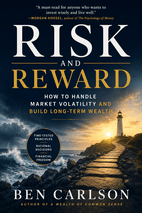
Looking for the best quotes from Risk and Reward by Ben Carlson? Below are the lines that stand out most across the book.
The quotes are organized by chapter, each with a short note on where it appears and why it stands out.
Top Quotes from Risk and Reward
“Buy and hold is the worst form of investing, except for all those other investment strategies that have been tried from time to time.”
The author discusses the relative merits of long-term investing.
This clever twist on Churchill's famous line about democracy resonates because it humorously acknowledges the flaws of buy-and-hold while asserting its superiority over alternatives.
“I know everything he's ‘bout to say against me. I am a f***ing bum. I do live in a trailer with my mom.”
B-Rabbit's self-deprecating lyrics in the rap battle from the movie 8 Mile, as described by the author.
This line captures the surprising power of vulnerability and self-awareness, disarming an opponent by taking away their ammunition.
“Here, tell these people something they don’t know about me.”
B-Rabbit's final mic-drop line in the same rap battle.
This quote epitomizes a masterful rhetorical twist, turning the opponent's strategy against them and leaving them speechless.
“The price of admission to the stock market is bone-crushing volatility, a lumpy return stream and the anguish of witnessing a chunk of your life savings evaporate before your eyes.”
The author describes the harsh reality of stock investing.
It vividly captures the emotional and financial pain investors must endure, making the trade-off for long-term gains feel visceral and honest.
“If you had the courage to buy in the midst of a panic, you were handsomely rewarded.”
The author discusses the historical pattern that good returns tend to follow bad ones.
It offers a powerful, contrarian lesson: the best opportunities often arise during the worst moments, rewarding bravery when others flee.
“There is no such thing as always or never in the financial markets.”
The author cautions that even a historically reliable portfolio like 60/40 could have a negative decade.
This line humbles any investor with overconfidence, serving as a timeless reminder of the inherent uncertainty in markets.
Quotes by Chapter
2. Doing Nothing Is Hard Work
“The best investors make a habit of putting procedures in place, in advance, that help inhibit the hot reactions of the emotional brain.”
Opening quote by Jason Zweig at the start of the chapter.
It encapsulates the core theme that disciplined advance planning, not emotion, drives successful investing.
“It is time to act, it will be because your plan tells you to, not because of some scary headlines or talking head on financial television forcing your hand.”
A line from the chapter's advice on following a pre-set investment plan.
It powerfully contrasts reactive decision-making with the disciplined, plan-based approach required for long-term success.
“Making it look easy requires plenty of hard work.”
Closing observation after explaining the difficulty of doing nothing.
This concise sentence highlights the paradox that the seemingly passive act of inaction demands great effort and self-control.
3. The Great Inflation
“There was a recession to kick off the decade which lasted most of 1970. Then came the nasty downturn from late 1973 through the spring of 1975 when the unemployment rate reached nearly 9% and the stock market got cut in half.”
Describing the economic hardships of the 1970s.
The stark image of the stock market being cut in half powerfully conveys the devastation of the period.
“The Federal Reserve was forced to jack up interest rates into double-digit territory to tame the inflationary beast.”
Explaining the Fed's aggressive response to high inflation.
The metaphor 'inflationary beast' personifies inflation as a fearsome monster, making the struggle vivid and memorable.
“In December 1970, the Time magazine cover story showed a picture of a dollar with a tear running down George Washington's cheek. It said the dollar was worth 73 cents.”
A Time magazine cover illustrating inflation's erosion of purchasing power.
The tear on George Washington's cheek is a poignant visual that emotionally crystallizes the pain of inflation.
“The U.S. was in a recession for one-third of this dreadful period.”
Summarizing the prolonged economic downturn from 1970 to the early 1980s.
This simple statistic underscores the relentless nature of the economic crisis, making the reader feel the duration of suffering.
4. The Three Best Inflation Hedges
“True wealth is the spending you don't see.”
The author describes how millionaires next door accumulate wealth by living below their means.
This line encapsulates a counterintuitive truth about wealth—that real financial security comes from restraint, not display.
“A 3% inflation rate cuts the value of a dollar in half in 23 years. At 4%, inflation cuts your money in half in 17 years.”
The author illustrates the corrosive effect of inflation on purchasing power.
These concrete numbers make the abstract threat of inflation visceral and impossible to ignore.
“You can complain all you want about this, but it’s not going away as long as the economy keeps growing and workers demand higher wages.”
After explaining how inflation destroys value, the author pushes back against complacency.
This blunt, unsentimental line forces readers to accept inflation as a permanent reality and motivates them to take defensive action.
“There's only one guaranteed way to lose money to inflation — don’t invest your savings at all.”
The author concludes the section on staying invested through market cycles.
This stark warning cuts through complexity, delivering a memorable call to action that frames inaction as the surest path to loss.
5. Timing the Market
“From the time Buffett bought America through the end of 2024, the S&P 500 was up a staggering 750%, good enough for an annualized return of more than 14% per year.”
The author illustrates the long-term payoff of buying an S&P 500 index fund in October 2008, despite an immediate 30%+ crash.
It vividly demonstrates that staying invested through a severe downturn can yield extraordinary wealth over time, reinforcing the principle of short-term pain for long-term gain.
“The good news is you don't have to pinpoint the exact bottom of a bear market to make out like a bandit.”
The author reassures readers that predicting market bottoms is unnecessary for investment success.
This line liberates investors from the impossible task of market timing, emphasizing that a long horizon, not perfect timing, is what leads to outsized returns.
“Investing looks easy in the rearview mirror, but the future is always unknown.”
The author warns against hindsight bias after discussing how no one predicted the bull market of 1966.
It succinctly captures the dangerous illusion that past market moves were obvious, reminding readers that uncertainty is the only constant in investing.
“It just requires a touch of discipline and a dash of automation.”
The author concludes the chapter by summarizing what is needed to succeed without forecasting.
This memorable, almost poetic line simplifies the path to successful investing, making it feel achievable and encouraging readers to adopt systematic, hands-off strategies.
6. The Most Important Concept in Investing
“You lose money fast in the stock market. You can’t make it fast.”
A quote from legendary investor Peter Lynch at the start of the chapter.
It captures a brutal truth about investing that is easy to forget, emphasizing patience over quick gains.
“Ignore the noise is financial advice that sounds useful in theory but is now impossible in practice.”
The author’s own observation about modern investing in an always-on information environment.
It frankly admits the gap between ideal advice and real-world behavior, validating the frustration many investors feel.
“The more often you look at your performance, the more likely you'll feel the down days.”
The author explains Richard Thaler’s concept of myopic loss aversion.
It gives a concrete, memorable reason why frequent portfolio checking leads to emotional pain, changing how readers view their habits.
7. The Worst Crash of All Time
“If you're not willing to react with equanimity to a market price decline of 50% two or three times a century you're not fit to be a common shareholder.”
Charlie Munger said this as a guiding principle for investors.
It distills the essential temperament required for stock market investing, framing volatility as a normal, expected occurrence rather than a crisis.
“The stock market collapsed by 86% in total, by far the worst crash in U.S. stock market history.”
The author describes the magnitude of the Great Depression crash.
The stark number 86% makes the historical scale visceral, grounding any discussion of market risk in an actual worst-case scenario.
“You would need a gain of 615% just to break even on an 86% loss.”
Explaining the mathematical brutality of large losses.
It powerfully illustrates the asymmetry of losses versus gains, making a compelling case for avoiding catastrophic drawdowns.
“It’s also incredible that you only get around a one percentage point difference in long-term annual returns by taking out the Great Depression crash.”
Comparing long-term stock returns with and without the worst crash.
This surprising fact reinforces the resilience of long-term compounding and challenges the instinct to flee markets after extreme events.
8. Normal Accidents in the Stock Market
“Risk can never be eliminated from high-risk systems, and we will never eliminate more than a few systems at best. At the very least, however, we stop blaming the wrong people and the wrong factors, and stop trying to fix the systems in ways that only make them riskier.”
The author quotes Charles Perrow's warning against the misguided attempt to eliminate risk from complex systems.
This line resonates because it challenges the common desire to make systems perfectly safe, pointing out that such efforts can actually increase risk. It shifts blame from individual errors to systemic design.
“Trying to eliminate risk when dealing with the markets is a futile exercise because risk never completely goes away; it just changes shape.”
The author explains why risk persists in financial markets.
It's a concise reminder that risk cannot be destroyed, only transformed, which is a fundamental concept in investing.