Risk and Reward Key Takeaways — Chapter-by-Chapter Lessons | Insta.Page

Risk and Reward Key Takeaways

by Ben Carlson
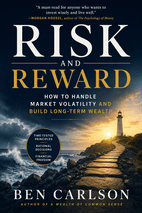
Risk and Reward by Ben Carlson Book Cover

5 Main Takeaways from Risk and Reward

Volatility is the price of long-term stock returns.

Ben Carlson shows that drawdowns of 10% or more occur roughly one-third of the time, and the market is below all-time highs 93% of the time. Instead of fearing these drops, investors must accept them as the unavoidable cost of earning the equity risk premium over decades.

Doing nothing is the hardest and most valuable investment skill.

Action bias—the urge to trade or change your portfolio during turmoil—almost always leads to worse outcomes. Carlson compares it to a soccer goalie who saves more penalties by staying still. The real work is pre-committing to a strategy and ignoring headlines so you can let compounding work.

Losses hurt far more than gains help—check your portfolio less.

Myopic loss aversion means the more often you look at your account, the more you see short-term losses and the more likely you are to panic. Carlson advises turning off alerts and looking away, because discipline in your attention is more important than stock-picking skill.

Diversification is not about maximizing returns—it's about survival.

The book warns that individual countries like Japan can lose decades, and even a 60/40 portfolio has survived every 10-year period. Carlson argues that owning a mix of stocks, bonds, and real assets is an honest admission that no one knows which asset will win next.

Compounding is fragile; never interrupt it unnecessarily.

Charlie Munger's rule is the golden thread: the biggest threat to compounding is selling out of fear or chasing fads. Carlson illustrates with Japan's 35-year recovery and the 2008 crash—those who stayed invested captured massive rebounds, while those who sold locked in losses.

Executive Analysis

These five takeaways form a coherent thesis: successful investing is not about brilliance or timing but about enduring volatility with patience, diversification, and minimal interference. Carlson repeatedly shows that the market's noise—crashes, inflation, bubbles—is normal, and that the only reliable way to capture returns is to accept short-term pain for long-term gain. The book's central argument is that the investor's own behavior is the biggest variable, and that simple, disciplined strategies consistently outperform complex, emotion-driven ones.

This book matters because it cuts through the noise of daily financial media and gives readers a durable framework for decades of investing. Carlson stands out in the genre by combining historical data with behavioral psychology—he doesn't just say "stay the course" but explains why it's so hard and how to build the mental muscles to do it. For anyone tired of get-rich-quick schemes or market-timing advice, 'Risk and Reward' offers a sober, evidence-based path to building real wealth.

Chapter-by-Chapter Key Takeaways

Introduction (Introduction)

  • Buy-and-hold is often derided as the worst strategy, but it has outlasted every other method when put to the test.

  • Admitting a strategy’s weaknesses (like B‑Rabbit’s self-deprecation) can be more effective than defending it.

  • The most resilient investment approach is not the one that pretends to be perfect, but the one that acknowledges its limitations and sticks around anyway.

Try this: Embrace buy-and-hold by admitting its weaknesses—like B-Rabbit's self-deprecation—so you stay committed when it’s hardest.

1. It Was the Worst of Times (Chapter 1)

  • Volatility is not optional—it’s the price you pay for the stock market’s long-term returns. Expect brutal drops.

  • Good returns follow bad returns. The worst years often set the stage for the best subsequent gains.

  • Bonds provide a reliable ballast during stock downturns, making a 60/40 portfolio far less painful.

  • A longer time horizon is your best friend. Even a 60/40 mix has never lost money over a 10-year period (as of calendar year-end).

  • Fear is the enemy. The ability to buy when everyone else is scared is what separates successful investors from the rest.

Try this: Prepare for volatility as non-optional: build a 60/40 portfolio and commit to holding it for at least 10 years, because fear is the real enemy.

2. Doing Nothing Is Hard Work (Chapter 2)

  • Action bias is costly – Both in soccer and investing, the urge to “do something” often leads to worse outcomes than standing still.

  • Plan before emotions strike – Pre-commit to a strategy that overrides fear and greed; don’t let headlines or impulses dictate your moves.

  • Doing nothing is a skill – It requires deliberate practice to sit on your hands when every fiber of your being says to move.

  • Make it look easy – The appearance of effortless patience is built on the hard work of setting rules and sticking to them.

Try this: Create a written investment plan before emotions strike, then practice doing nothing—ignore headlines and resist the urge to act.

3. The Great Inflation (Chapter 3)

  • The 1970s were defined by persistent, high inflation that required two brutal recessions in the early 1980s to finally tame.

  • A dollar in 1970 lost more than half its purchasing power by the end of the decade, eroding savings and living standards.

  • Stocks are not a reliable short-term hedge against rapidly rising inflation; the data shows poor returns when inflation is high and still climbing.

  • The era serves as a lasting warning: inflation doesn't just hurt consumers—it fundamentally distorts the value of financial assets and punishes passive investors.

Try this: Protect your purchasing power by investing in your career skills, owning a home with a fixed-rate mortgage, and staying fully invested in stocks for the long run.

4. The Three Best Inflation Hedges (Chapter 4)

  • A good job is your first inflation hedge – because it provides rising income that can keep pace with or exceed inflation.

  • Home ownership works as a hedge – historically, it’s done well during inflationary spikes, especially when mortgages are fixed-rate and the property appreciates.

  • Stocks for the long run – short-term inflationary periods can destroy real returns, but staying invested through full cycles delivers real gains over decades.

  • Don’t let worst-case periods scare you out of the market – combine bad decades with good ones, and the long-term real return is solid.

  • The only foolproof way to lose to inflation is to keep your savings in cash – no investment, no hedge.

Try this: Stop trying to time the market: even buying at the worst possible moment in 2008 worked if you held on, so focus on time in the market.

5. Timing the Market (Chapter 5)

  • Buying at the worst possible moment (October 2008) still produced huge long-term gains if you stayed invested.

  • You cannot predict market tops or bottoms, even with perfect information about the past.

  • Hindsight bias makes investing seem easy, but the future is always uncertain.

  • Successful investing requires a long time horizon, not market-timing skill.

Try this: Reduce how often you check your portfolio—turn off alerts and limit reviews to quarterly—to avoid myopic loss aversion.

6. The Most Important Concept in Investing (Chapter 6)

  • Losses hurt more than gains help – Loss aversion is magnified when you look at your portfolio too often.

  • Myopic loss aversion – Frequent checking increases the odds of seeing short-term losses, which can trigger emotional decisions.

  • The information age amplifies the problem – Constant alerts and real-time data make it harder to stay calm and stick to a long-term plan.

  • The real enemy is your own attention – The most valuable skill in investing is not stock-picking but the discipline to look away.

Try this: Prepare for prolonged crashes like the Great Depression by ensuring your time horizon is at least 25 years before you need the money.

7. The Worst Crash of All Time (Chapter 7)

  • The Great Crash was not a single event but a prolonged period of extreme volatility, including months of 20%+ losses and an 86% total decline.

  • Even with that devastation, long-term annual returns from 1926 onward hovered around 11%—only one percentage point lower than if you excluded the Depression entirely.

  • The market took 25 years to recoup its nominal peak, underscoring that decades-long time horizons are essential for weathering the worst of what stocks can throw at you.

Try this: Accept that crashes are normal accidents in a complex system—don't try to eliminate risk, just extend your time horizon.

8. Normal Accidents in the Stock Market (Chapter 8)

  • Normal accidents are not rare exceptions—they are features of complex systems, and the stock market is no exception.

  • Trying to eliminate all risk is counterproductive; it only shifts risk into less visible forms.

  • The Great Depression shows that even catastrophic losses can be recovered over long horizons, but the math demands patience.

  • Modern safeguards reduce certain risks but cannot prevent future crashes—they just change the nature of the next one.

  • Long-term mindset is the only reliable antidote: the more bearish the short run feels, the more important it is to stick with the big picture.

Try this: Distinguish recessionary bear markets from non-recessionary ones by using mental models like Mr. Market to stay grounded during downturns.

9. The Two Types of Bear Markets (Chapter 9)

  • There are two distinct types of bear markets: recessionary (deeper, longer) and non-recessionary (shallower, shorter).

  • Strong initial rallies from a bottom can be indistinguishable from dead cat bounces; don’t rely on early gains alone to confirm a reversal.

  • The market’s daily mood swings are best ignored through steady, long-term discipline.

  • Use mental models like Mr. Market, the tree, and the dog walking to stay grounded during downturns.

Try this: Ignore the economy's headlines: the stock market bottoms before the economy does, so patience during recessions is rewarded with strong subsequent returns.

10. The Stock Market vs. the Economy (Chapter 10)

  • The economy is in recession only about 16% of the time, yet the stock market can drop 50% or more in a downturn—its swings are far larger than the economy’s.

  • Stock market returns following a recession are historically strong, with average gains of nearly 94% over the following five years.

  • The market is forward-looking but not all-knowing; it often rises during recessions and falls before them.

  • The Great Financial Crisis shows that the market bottoms well before the economy does—patience during downturns is rewarded.

  • Stock price volatility far exceeds changes in dividends or fundamentals because investor emotions amplify short-term movements.

Try this: If you must day trade, limit it to 5-10% of your portfolio as a behavioral release valve, but expect it to add stress, not fun.

11. Day Trading (Chapter 11)

  • Day trading, especially forex, has extremely poor success rates—around 70–80% of participants lose money consistently.

  • Unlike long-term investing, the longer you day trade, the more likely you are to lose.

  • If you must speculate, limit it to a small, separate portion of your portfolio (5–10%) as a "behavioral release valve."

  • Even a small speculative account can create disproportionate stress, undermining the purpose of "fun" investing.

Try this: Accept that volatility is a feature, not a bug—you cannot get long-term gains without short-term pain, so reinterpret drawdowns as the price of the risk premium.

12. Volatility Is a Feature, Not a Bug (Chapter 12)

  • The market is below its all-time highs 93% of the time—volatility is the norm, not a glitch.

  • Drawdowns of 10% or more occur roughly one-third of the time; 20% drops happen about one-sixth of the time.

  • Volatility only hurts if you react to it poorly; otherwise, it’s the source of the risk premium.

  • Short-term pain is the price you pay for long-term gains—you cannot have one without the other.

Try this: Buy stocks when they're most out of favor: the 'death of equities' narrative is usually a bottom signal that separates disciplined investors from panicked ones.

13. The Death of Equities (Chapter 13)

  • The best time to buy stocks is when they’re most out of favor. Popular fear often marks the bottom.

  • Older investors who lived through multiple cycles tend to stay the course; younger investors’ panic breaks the compounding chain.

  • Economic expansions can create new classes of investors, but the discipline to hold through downturns is what separates lasting wealth from short-term relief.

  • The pattern repeats: every generation forgets that stocks are bought to be held, not traded away at the first sign of trouble.

Try this: Never interrupt compounding unnecessarily—resist the urge to sell during downturns and let the long-term average of three winning years out of four work for you.

14. The First Rule of Compounding (Chapter 14)

  • Compounding requires exponential thinking, which our linear brains naturally resist—patience is nonnegotiable.

  • Charlie Munger's rule is the golden thread: never interrupt compounding unnecessarily, whether through panic or impatience.

  • Annual stock returns are wildly inconsistent, with the majority far from the long-term average; double-digit swings are the norm, not the exception.

  • Despite volatility, stocks are positive roughly three out of four years, but enduring the downturns is what unlocks the long-term payoff.

  • Discipline, not timing, is the true superpower behind compounding's wonder.

Try this: Watch for exponential returns that outpace fundamentals—like Japan's bubble—and avoid the 'neighbor getting rich' effect by sticking to a diversified plan.

15. The Biggest Bubble Ever (Chapter 15)

  • Exponential returns disguise fragility. When a market grows far faster than the underlying economy or corporate profits, it’s not a sign of genius—it’s a warning.

  • The “neighbor getting rich” effect clouds judgment. The social proof of everyone around you making money makes you feel left out, which overrides rational analysis.

  • A bubble can persist for years, but the reversion can last decades. Japan’s stock market took 35 years to recover its peak, and real estate never has. The damage is not temporary—it’s generational.

Try this: Diversify globally to protect against Japan-style lost decades: mean reversion is unpredictable, so home country bias is a single point of failure.

16. Now Show Japan (Chapter 16)

  • Mean reversion is powerful but unpredictable—neither booms nor busts last forever.

  • Japan’s 30-year stagnation looks terrible in isolation, but the full cycle (boom + bust) still produced decent long-term returns.

  • Avoid home country bias: concentrating investments in one region creates a single point of failure.

  • Use diversification to protect against extreme outliers like Japan—they’re rare, but they happen.

Try this: Acknowledge that even 10-year stretches can have zero returns—use bonds and gold as ballast, not as return-maximizers, to survive lost decades.

17. The Lost Decades (Chapter 17)

  • Lost decades are rare but real—they remind us that equity risk premium isn’t guaranteed over any specific ten-year stretch.

  • Diversification isn’t about maximizing returns; it’s an honest admission that you don’t know which assets will win or lose in advance.

  • The period 2000–2009 shows that “safe” assets like bonds and gold can decisively outperform stocks for years at a time.

  • Long-term investing requires patience, but also a plan that acknowledges the possibility of long stretches with zero or negative returns.

Try this: Build a simple stock/bond portfolio based on Modern Portfolio Theory, but don't over-optimize: discipline beats complex calculations.

18. The Perfect Portfolio (Chapter 18)

  • Diversification isn’t about maximizing returns; it’s about surviving the inevitable runs of bad luck in any single asset or region.

  • Modern Portfolio Theory (MPT) provides a mathematical foundation for mixing assets to reduce volatility without sacrificing long-term gains.

  • Even the theory’s creator didn’t rely on complex calculations—he stuck with a simple stock/bond split, proving that discipline often beats optimization.

  • Past performance is a poor predictor of future dominance; the best-performing country in one decade can be the worst in the next.

Try this: Stop chasing last year's winners—diversification isn't old-fashioned, and reacting to every headline turns market noise into a personal roller coaster.

You Need to Invest (Conclusion)

  • Diversification isn't old-fashioned—chasing last year's winner is a guaranteed way to buy high and sell low.

  • Reacting to every headline turns the market's natural noise into your personal roller coaster of poor decisions.

  • Bear markets test your plan—panicking and selling locks in losses, but riding them out (with a solid allocation) captures the eventual rebound.

  • Overnight wealth is a fantasy—speculation isn't investing, and the only reliable path to riches is patient, consistent discipline.

Try this: Remember that simplicity is an edge only if you stick with it; market advice is useless in real time, so optimize for your own ability to stay the course.

20 Things I Believe About Investing (Epilogue)

  • Simplicity is an edge, but only if you have the conviction to stick with it when the market makes complex strategies look brilliant.

  • Market advice is almost useless in real time because your emotional state will align you against whatever medicine you need most.

  • Disagreements are natural; they usually reflect different goals and timelines, not someone being wrong.

  • Optimism is a prerequisite, not a personality flaw. Without it, the whole exercise of investing collapses.

  • The perfect metric doesn’t exist, so don’t waste energy searching for one. Instead, focus on context, time horizon, and your own ability to stay the course.

Continue Exploring