Replaceable You Quotes
by Mary Roach
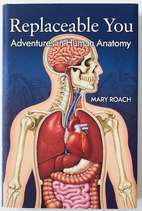
This collection brings together the strangest, funniest, and most human moments from Mary Roach's exploration of bodies and their replacements. You will find lines that make you laugh out loud, lines that make you wince, and lines that make you think twice about what it means to be you.
What makes this book so quotable is Roach's ability to find the perfect, bizarre detail or the unexpected punchline in the middle of a medical miracle. She has a knack for turning the clinical into the comic and the grotesque into the touching, all without losing respect for the people and science involved.
Top Quotes from Replaceable You
“HOW TO MAKE A NEW NOSE FOR SOMEONE: WHICH IS OFF ENTIRELY: AND THE DOG HAS EATEN IT.”
The title of a 15th-century treatise on nasal reconstruction by Bavarian surgeon Heinrich von Pfalzpaint.
This ridiculously specific and deadpan title captures the bizarre, practical challenges of historical medicine. It is simultaneously funny and poignant, illustrating how catastrophe and resourcefulness went hand in hand.
“It can sneeze smartly, distinguish good from bad smells . . . or [be] well blown without danger of falling into the handkerchief.”
Eighteenth-century Welsh naturalist Thomas Pennant marveling at the reconstructed nose of an oxcart driver.
The description is both absurd and unexpectedly respectful, celebrating a rebuilt nose's full functionality. It underscores the blend of wonder and practicality that defined early plastic surgery successes.
“He said, ‘Will I be going oink oink oink after this?”
Muhammad Mohiuddin recounts first xenotransplant patient David Bennett's joking concern about receiving a pig heart.
This moment of dark humor humanizes a groundbreaking medical procedure and highlights the surreal anxiety faced by patients.
“Thus began a brief, surreal chapter of medical history wherein livestock were ushered inside the homes of moribund patients.”
The author narrates the 1878 trend of milk transfusions, where goats and cows were brought to patients' bedsides.
This sentence encapsulates the bizarre desperation of early medicine, highlighting how far we've come—and how strange the path was.
“Cupping a warm, beating heart in your hand is as surreal as you might imagine. It's the stuff of slasher films and human sacrifice, but to me it doesn’t feel disturbing. Is there a word for awe mixed with tenderness? That's how it feels.”
The author describes the experience of holding a beating heart connected to a perfusion rig.
This passage captures the profound emotional paradox of touching a living organ—both shocking and deeply moving—inviting readers to share in that wonder.
“So if you're not going to have sex with a penis, or with anybody, forget the damn thing.”
Garcia advising patients who don't plan to use a vaginal canal.
Blunt and liberating, it reframes surgery as optional and patient-centered, not mandatory.
“And here we see how the anus can be used as a substitute for the male brain.”
The author's sardonic comment after recounting a historical anecdote about male surgeons' attitudes.
A sharp, humorous critique of male-centric medical decision-making.
Themes Behind the Quotes
A major theme is the tension between our desire to fix and upgrade the human body and the stubborn, messy reality of biology. Time and again, clever inventions and bold surgeries run up against infection, rejection, or just plain weirdness. The quotes highlight how our bodies are not machines, no matter how much we treat them as such.
Another thread is the surprising humor and dignity found in the most awkward situations. Whether it is a nose eaten by a dog or a patient worrying about sounding like a pig, these moments remind us that facing our physical limits is both absurd and deeply human. The book also questions what makes us ourselves, from skin to organs to prosthetics, and how we adapt to loss.
Quotes by Chapter
Chapter 1. To Build a Nose: The Dawn of Replacement Body Parts
“It’s no mystery that religion's showrunners chose fire as the setting for Hell.”
The author reflecting on the horror of the 1942 Cocoanut Grove fire, which killed 492 people and left burn patients with grotesque injuries.
This darkly witty one-liner connects human suffering with theological imagery, making the reader pause. It encapsulates the chapter's theme that the body's destruction is both a medical and a spiritual ordeal.
“If the sexual theory accounts for the process, the skin that grows after the application of the frog grafts must be of the nature of a new breed, a cross between human and frog epidermal elements.”
Physician William Allen speculating in an 1884 Lancet article about how frog skin grafts might heal human wounds.
The bizarre sexual theory and the phrase 'new breed, a cross between human and frog' highlight the wild speculation of early medical science. It perfectly captures the historically strange, almost Frankenstein-like attempts to repair the human body.
Chapter 2. Gimme Some Skin: Replacing the Human Exterior
“It’s just skin. I don’t love you for your physical appearance. I love you because you're you.”
Jerry tells Diana this after she fears he will leave her because of her severe burns.
Captures unconditional love that transcends physical appearance, offering a deeply moving moment of reassurance in the face of devastating injury.
“I was trying to look for a place to ‘stop, drop, and roll,’ but every time I looked down I saw the ground on fire.”
Diana describes the moment she was on fire after a gas can explosion.
Viscerally conveys the horror and disorientation of being burned alive, making the reader feel the surreal terror of the experience.
“I’m thinking, he’s going to leave me. I couldn’t understand why he was still there, unless it was out of guilt.”
Diana after first seeing her burned face in a mirror, reflecting on her husband's presence.
Reveals profound vulnerability and the fear of abandonment that often accompanies severe disfigurement, making her inner turmoil intensely relatable.
Chapter 3. Mixed Meats: Humans with Pig Organs, and Pigs with Human Organs
“Thus, any damage inflicted upon the human body—even in death—is thought to disrespect ancestors.”
From a paper on xenotransplantation explaining Confucian beliefs about organ donation in China.
It encapsulates a deep cultural and philosophical barrier to organ donation, making the ethical dilemma visceral and concrete.
“If you can fund me with two million dollars, I can try something else.”
Muhammad Mohiuddin responds to religious leaders questioning his use of pigs for xenotransplantation.
It starkly contrasts idealism with financial reality, revealing how funding constraints drive scientific choices.
“Through the genetic manipulation, a porcine organ could be better than a human organ!”
Shaoping Deng exclaims during dinner, describing the potential of gene-edited pig organs.
This bold, optimistic declaration captures the transformative promise of xenotransplantation and challenges assumptions about organ superiority.
Chapter 4. Heart in a Box: Creating Ultra-LongLife Organs
“Chnician, “we just slapped the cells across the face and stunned them long enough for the pacemaker to take back control.””
Wyeth explains his defibrillation technique after the heart went into fibrillation.
The humorous analogy demystifies a dramatic medical intervention, making it relatable while underscoring the delicate balance of biological systems.
“Every once in a while, there's a Lord of the Flies-type situation, where the kids begin to make their own rules and things go haywire.”
Wyeth describes how heart muscle cells can generate their own electrical impulses, causing arrhythmias.
The literary reference to chaos and loss of order vividly illustrates how individual cells can rebel, turning a physiological process into a gripping narrative.
Chapter 5. The Vagina Dialogue: Repurposing Your Parts
“The bit you don't see is going to cost you a lot.”
Dr. Maurice Garcia explaining to trans women the trade-off of having a vaginal canal versus vulvoplasty.
It succinctly captures the hidden burdens of surgical choices, challenging assumptions about what constitutes success.
“I can’t help but feel there's a bit of an element of Oh, they’re just transgender patients, we can try anything.”
Garcia criticizing surgeons who use risky techniques like fibula bone for neopenis.
Highlights the ethical problem of treating transgender patients as experimental subjects.
Chapter 6. Giving the Finger: Some Transplants Are Tougher Than Others
“It's been somewhat sobering in terms of what happens over time,” Bojovic said. “We've done some incredible stuff, incredible technical feats, but at the end of the day it’s been humbling—our inability to win the immunosuppressive battle. And to see how the human body seems on some level to always sort of win no matter what you do.”
Plastic surgeon Branko Bojovic reflects on the long-term outcomes of composite tissue transplants.
This captures the humbling tension between surgical ambition and biological reality, reminding readers that even the most astonishing medical feats are limited by the body's immune system.
“At first,” he wrote, describing the cases, “the absence of the glans penis results in very weak orgasms and ejaculations. In time, however, new ‘erotic zones’ apparently develop, and the orgasm approaches normal intensity.”
Soviet surgeon A. P. Frumkin documenting the sexual recovery of soldiers after genital reconstruction.
The quote illustrates the body's remarkable capacity to adapt and create new sources of pleasure after loss, offering a hopeful yet clinical perspective on human resilience.
“If, on a dig in some distant future, this man’s skeleton is somehow unearthed, scientists may conclude that a unique species of hominid once roamed the Caucasus.”
The author's thought after seeing an X-ray of the finger bone inside the neopenis.
This line blends dark humor with a poignant commentary on how medical interventions could mislead future anthropologists, highlighting the strange and lasting consequences of transplantation.
Chapter 7. The Cut-Off Point: Longing for a Prosthetic Leg
“My foot had become a science experiment,” she wrote in her memoir, Just One Foot, “a mess of flesh and bones but few working nerves.”
Judy Berna reflects on her painful childhood with a deformed foot.
This vivid metaphor captures the dehumanizing experience of living with a limb that causes constant suffering, making the case for amputation emotionally clear.
“Your hip joint wears out, you replace it,” she wrote in an email. “How is this so different?”
Judy Berna justifies her elective amputation by comparing it to a standard joint replacement.
This simple, logical question challenges the stigma against voluntary amputation and frames it as a rational medical choice.
“They fight it so long that they lose these chunks of their lives, time that they could have spent acclimating to their prosthetic, getting their coordination back, their body back.”
Clayton Frech describes the tragic cost of refusing amputation due to false hope.
It powerfully illustrates how the pursuit of limb salvage can steal years of a person's life, emphasizing the value of accepting a prosthetic.
“I can’t tell you,” she is saying, “how often friends send me news stories about the ‘next big thing.’ I try to be polite. But no, there will not ever be a twenty-dollar custom 3D printed leg that means you don’t have to go to a prosthetist.”
Judy Berna pushes back against media hype about cheap, miraculous prosthetics.
This pragmatic, grounded statement undercuts unrealistic optimism and highlights the real, ongoing work of prosthetic care.
Chapter 8. Joint Ventures: Woodworking Without Wood
“For a misanthrope, John Charnley was a surprisingly committed humanitarian.”
After describing John Charnley's misanthropic personality.
This line captures the paradox of a flawed individual whose work saved countless lives, making it a memorable and thought-provoking reflection on human nature.
“We can only marvel at the lives saved and improved by this intolerant and condescending man.”
The author's concluding thought on John Charnley's legacy.
It resonates because it forces readers to reconcile the unpleasantness of a person with the magnitude of their positive impact, challenging simplistic judgments of character.
“The progress made over two hundred years of materials science is bound to come up short in the face of six million years of evolutionary tinkering.”
After discussing the failed attempts to replicate ivory's architecture synthetically.
This line underscores the humility required in medicine and technology, reminding readers that nature's ingenuity often outpaces human innovation.
“It was one of the most terrifying things I’ve ever seen.”
The author watching a time-lapse video of bacteria forming aggregates in synovial fluid.
The visceral honesty of this reaction makes the invisible threat of biofilm infections feel immediate and unnerving, leaving a lasting impression on the reader.