Rage and the Republic Quotes
by Jonathan Turley
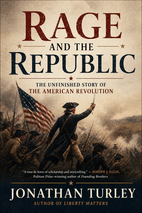
This page collects some of the most memorable lines from Jonathan Turley's book. You will find quotations from revolutionaries, philosophers, and critics of democracy. They speak across centuries with surprising relevance to today. What makes this book so quotable is how it captures the tension between freedom and order, the thrill of rebellion and the caution of experience. These quotes are not just historical artifacts. They are sharp, often uncomfortable, and meant to be shared.
Turley weaves these voices into a narrative about the dangers of popular rage. The quotes offer a mix of idealism and cynicism. They remind us that the same impulses that topple tyrants can also destroy republics. Whether you agree or disagree, each line sticks with you.
Top Quotes from Rage and the Republic
“We have it in our power to begin the world over again... The birth-day of a new world is at hand, and a race of men perhaps as numerous as all Europe contains, are to receive their portion of freedom from the events of a few months.”
Paine writes in Common Sense, calling for a radical new beginning.
It epitomizes the bold, optimistic vision of the American Revolution as a global turning point for human freedom.
“These are the times that try men’s souls. The summer soldier, and the sunshine patriot will, in times of crisis, shrink from the service of his country.”
Paine opens The American Crisis during a low point in the Revolutionary War.
This iconic line challenges complacency and has become a timeless rallying cry for perseverance in the face of adversity.
“There is nothing quite as inconvenient as a revolutionary after a revolution.”
The author reflects on Thomas Paine's waning popularity after the American Revolution succeeded.
This line succinctly captures the irony that the very qualities that make a revolutionary effective during upheaval become problematic once order is restored.
“The sacred rights of mankind are not to be rummaged for, among old parchments, or musty records. They are written, as with a sun beam, in the whole volume of human nature, by the hand of the divinity itself; and can never be erased or obscured by mortal power.”
Alexander Hamilton declares that natural rights are inherent, not derived from historical documents.
The vivid imagery contrasting dusty records with a divine sunbeam powerfully elevates rights above human authority, making it a memorable rallying cry for universal liberty.
“Thirsting for freedom has evil cupbearers presiding over the feast, and has drunk too deeply of the strong wine of freedom.”
Plato’s prediction about democratic excess, as referenced in the chapter.
This vivid imagery illustrates how the pursuit of liberty can devolve into chaos when not tempered by restraint.
“Man is born free; and everywhere he is in chains.”
Opening line of Jean-Jacques Rousseau's 'The Social Contract'.
It is one of the most famous and evocative statements of Enlightenment thought, encapsulating the tension between natural liberty and social oppression.
“Those who would give up essential Liberty, to purchase a little temporary Safety, deserve neither Liberty nor Safety.”
Benjamin Franklin's warning in a letter about a tax dispute during the French and Indian War, cautioning against sacrificing fundamental rights for security.
This timeless aphorism powerfully captures the danger of trading liberty for temporary safety, remaining a central reference in debates about civil liberties and government overreach.
Themes Behind the Quotes
One major theme is the tension between liberty and order. The book shows how revolutionary energy can easily tip into mob rule. Many quotes warn against the dangers of direct democracy when passions run high. There is a recurring concern that the pursuit of freedom, if unchecked, leads to chaos and then to a new form of oppression.
Another theme is the fragile nature of constitutional systems. Even the most stable republics face moments of doubt. The quotes highlight how easily decent citizens can be swept into destructive acts when they feel righteous anger. The book also examines the cycle of revolution, where today's rebels become tomorrow's reactionaries. It asks whether any system can survive the rage of its own people.
Quotes by Chapter
Chapter 1: The True Pain: From Ruin to Revolution
“Nothing tends toward a greater corruption of manners and principles than a too great distress of circumstances.”
From Paine's first pamphlet, The Case of the Officers of Excise, arguing for better pay.
This line distills Paine's belief that poverty and desperation breed moral decay, a theme that resonates in his later revolutionary writings.
Chapter 2: The True Paine: The “Happy Something” of America
“There is a happy something in the climate of America.”
Thomas Paine remarks upon arriving in the colonies.
This phrase captures Paine's sense of newfound possibility and the unique conditions in America that inspired his revolutionary zeal.
“A French bastard landing with an armed banditti, and establishing himself as king of England against the consent of the natives, in plain terms a very paltry rascally original—it certainly hath no divinity in it.”
Paine attacks the lineage of King George III in Common Sense.
It showcases Paine's irreverent, mocking tone that strips monarchy of its mystique and resonates with a populace ready to break from tradition.
Chapter 3: The Birth of a New Age: The Enlightenment and the Cause of “Independency”
“If God did not exist, it would be necessary to invent him.”
Voltaire's observation is cited in the chapter's discussion of divine authority as a tool for social order.
It encapsulates the pragmatic, often cynical view of religion as a political invention, and remains a provocative statement about the intersection of faith and governance.
“The God who gave us life, gave us liberty at the same time: the hand of force may destroy, but it cannot disjoin them.”
Thomas Jefferson articulates the inseparability of life and liberty in his natural rights philosophy.
The poetic parallelism and defiant assertion that force cannot sever these divine gifts make it a stirring defense of freedom, often quoted in debates about human rights.
Chapter 4: Of Democracy and Demagogues: Ancient Athens and the Rise of the Demos
“The one thing that remains consistent in mobocracies throughout history is that the mob itself was never wrong, but rather misled.”
From the chapter's discussion of how mob rule repeatedly turns on its own leaders.
It captures the timeless pattern of populist movements deflecting blame while preserving the mob's self-righteousness, a warning still relevant today.
“It was little more than systemic and sanitized mob justice.”
Describing the Athenian practice of ostracism.
This line strips away the noble gloss from a democratic institution, revealing the raw, arbitrary power of majority rule.
“In the end, it was a democracy that would put him to death.”
After recounting Socrates's experience under oligarchy, tyranny, and restored democracy.
It delivers a sharp ironic punch, challenging the idealization of democracy by showing it can kill its most inconvenient truth-teller.
“His experience left him with a particularly deep-seated distrust of direct democratic systems, and he saw the need for a strong ruler to control the passions of the public.”
Explaining Socrates's political views after living through Athens's political swings.
It encapsulates the ancient tension between democratic freedom and the need for order, a dilemma that persists in modern governance.
Chapter 5: Philadelphia: The American Revolution and “the Inclemencies of the Season”
“Sobriety, abstinence, and severity were never remarkable characteristics of democracy.”
John Adams, commenting on democracy.
This line succinctly captures a timeless critique of democratic excess, highlighting the tension between popular rule and self-restraint.
“When party operates to produce party laws, a single house is a single person, and subject to the haste, rashness, and passion of individual sovereignty.”
Thomas Paine, rejecting unicameralism after witnessing its effects in Philadelphia.
Paine’s metaphor warns against unchecked majority power and resonates with ongoing debates about institutional checks on popular passion.
“Why Precipitate this Measure. Before We are prepared to build the new House, why should We pull down the old one, and expose ourselves to all the Inclemencies of the Season.”
James Wilson cautioning against dissolving colonial governments during the Continental Congress.
The house-building metaphor powerfully captures the risk of revolutionary haste, warning that dismantling existing order without a stable replacement invites chaos—a prophetic insight given the Fort Wilson riot.
Chapter 6: Paris: The French Revolution and the Razor of the Republic
“The greatest danger revealed by the French Revolution is when a great body of people commit atrocities out of virtue.”
The author reflects on the moral paradox of the Revolution after quoting Rufus King.
It encapsulates the chilling irony that virtuous intentions can justify the worst atrocities, a warning against unchecked popular zeal.
“Therefore, what is the Third Estate? Everything; but an everything shackled and oppressed. What would it be without the privileged order? Everything, but an everything free and flourishing.”
Abbé Sieyès in his pamphlet 'What Is the Third Estate?' argues for the supremacy of the common people.
This rhetorical question powerfully sums up the revolutionary demand for equality and the rejection of aristocratic privilege.
“To burn a book of argument is to say: ‘We do not have enough wit to reply to it.”
Voltaire mocking the authorities in Geneva for burning Rousseau's 'The Social Contract'.
It defends free expression by exposing censorship as an admission of intellectual weakness, a timeless argument for open debate.
Chapter 7: Paine’s Bridge: Revolution and Governance in an Age of Rage
“I had rather erect the largest arch in the world than be the greater emperor in it.”
Paine expressing his passion for engineering over political power.
This line captures Paine's idealistic prioritization of constructive achievement over personal ambition, revealing his character as a visionary inventor.
“Government by precedent, without any regard to the principle of the precedent, is one of the vilest systems that can be set up.”
Paine arguing against Edmund Burke's reliance on tradition for political legitimacy.
A powerful indictment of blind adherence to tradition, it distills Paine's radical belief that each generation must judge government on its own merits.
“The vanity and presumption of governing beyond the grave is the most ridiculous and insolent of all tyrannies.”
Paine rejecting the idea that past generations can bind the living.
Its memorable phrasing and moral force make it a timeless condemnation of inherited authority and a rallying cry for democratic renewal.
“Not only between those who are living, but between those who are living, those who are dead, and those who are to be born.”
Edmund Burke defining the social contract as intergenerational.
This eloquent retort to Paine's individualism encapsulates a conservative view of society as a pact across time, offering a profound counterpoint to revolutionary thought.
Chapter 8: The American Jacobin: The Return of the Bourgeois Revolutionary
“Despite having the most successful and stable constitutional system in history, there is still that moment: a fleeting doubt as to whether the system could survive the morning, survive the times we are living in, survive us.”
The author reflects on the fragility of constitutional order amid rising protests and political violence.
This passage captures a universal anxiety about whether democratic institutions can withstand contemporary rage, making it both poignant and thought-provoking.
“The problem is controlling the mob when today’s revolutionaries become tomorrow's reactionaries.”
The author discusses how politicians who embrace popular movements risk being consumed by them.
It succinctly warns of the cyclical danger that revolutionary fervor inevitably turns against its own enablers, a timeless political insight.
“It is the release of decent, law-abiding citizens to engage in crimes as a righteous act, in righteous rage.”
Describing affluent liberals who justify shoplifting as political protest against billionaires.
This line exposes the moral hypocrisy behind self-righteous anger, resonating because it challenges readers to question the limits of righteous indignation.
“There is the same blissful ignorance that allowed Rousseauian dilettantes to mutate into monsters, escalating radical agendas with every failure.”
Comparing modern radical intellectuals to the dilettantes of the French Revolution who became monsters.
It powerfully draws a historical parallel, warning that naive idealism can lead to disastrous extremism when unchecked by accountability.