Rage and the Republic Key Takeaways
by Jonathan Turley
As an Amazon Associate, we earn from qualifying purchases.
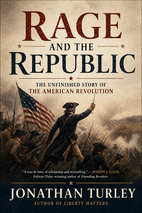
5 Main Takeaways from Rage and the Republic
Democracy without safeguards breeds tyranny
Turley traces how Paine's initial faith in popular virtue collapsed during the French Revolution, as unchecked majority rule led to the Terror. The same pattern—democracy dissolving into chaos and then authoritarianism—threatens any society that discards constitutional checks and balances in the name of the 'general will.'
Constitutional safeguards are not optional—they are essential
The American founders built a system that accepted factionalism as inevitable but channeled it through deliberation and counter-majoritarian institutions. France's rejection of checks in favor of unicameralism allowed mob rule to metastasize, proving that stability and liberty require more than just popular consent.
Radical simplicity is a recurring, dangerous seduction
From Jacobin clubs to modern calls to 'unleash the general will,' the allure of simple democratic solutions ignores a catastrophic historical record. Turley shows that every era believes its problems are unique, but the demand for radical purity repeatedly ends in coercion and loss of freedom.
Rights need institutional teeth, not just declarations
Legal positivism—the idea that rights are granted by government—makes them revocable. Turley warns that court-packing, attacks on judicial independence, and bypassing the amendment process undermine the structural protections that keep rights from becoming empty promises.
American identity rests on shared ideas, not blood or land
Turley concludes that the 'happy something' of America is a commitment to certain inalienable rights and self-reliant enterprise. Each generation must rediscover this civic creed, because the greatest threat to democracy is tyranny from within, cloaked in democratic language.
Executive Analysis
These five takeaways form Turley's central thesis: that the tension between democratic rage and constitutional republicanism is a recurring historical pattern, from Paine's revolutionary fervor to modern populist movements. By juxtaposing the American and French Revolutions, Turley argues that the Madisonian system of checks and balances is not outdated but essential for preventing the Icarian fall of democracy into mob rule and eventual autocracy. The book warns that abandoning structural safeguards—whether through court-packing, media echo chambers, or demands for radical simplicity—repeats the very errors that destroyed revolutionary France.
This book matters because it offers a timely, historically grounded diagnosis of contemporary political dysfunction. Turley bridges the gap between the Founding era and current crises in journalism, higher education, and economic populism, making ancient and eighteenth-century insights actionable for today. Sitting at the intersection of political history, constitutional law, and current affairs, 'Rage and the Republic' serves as a cautionary tale and a practical guide for preserving liberal democracy against the seductive pull of radicalism and the erosion of institutional trust.
Chapter-by-Chapter Key Takeaways
The True Pain: From Ruin to Revolution (Chapter 1)
Paine’s childhood as a religious outsider shaped his later critiques of organized religion.
His father’s intervention kept him off the doomed privateer Terrible, likely saving his life.
Prize money from privateering funded his education and introduction to Benjamin Franklin.
His first successful writing as an excise officer taught him the power of persuasion—even when Parliament ignored him.
A lifetime of personal and financial failures made Paine willing to reinvent himself in America.
Try this: Use personal setbacks and failures as motivation to reinvent yourself and seize new opportunities, just as Paine did when he left England for America.
The True Paine: The “Happy Something” of America (Chapter 2)
Paine’s arrival in America gave him a society without calcified class barriers—precisely what he needed to reinvent himself.
Common Sense was a masterclass in accessible, biting prose that attacked the myth of English history and hereditary monarchy.
By keeping prices low, Paine ensured the pamphlet reached common people, making it the world’s first bestseller.
The work directly influenced the Declaration of Independence and turned around a struggling Continental Army.
Paine’s revolutionary impulse had a dark side—his call for loyalty oaths and political taxes revealed a willingness to use coercion against dissenters.
His style—direct, mocking, and unpretentious—set him apart from other founders and made him the voice of the Revolution for ordinary Americans.
Try this: Write and communicate with direct, accessible language and keep your message affordable to reach the broadest possible audience—your influence depends on being understood by common people.
Of Democracy and Demagogues: Ancient Athens and the Rise of the Demos (Chapter 4)
Socrates saw the demos as a collective tyrant (demos tyrannos) whose unchecked power replicated the dangers of autocracy.
His ideal of the philosopher king emphasized rule by virtue and knowledge, not popular consent.
The Icarus analogy captures the Socratic critique: democracy’s freedom leads to self-destructive excess.
This fear directly influenced the American founders, who sought to harness democratic power while restraining its Icarian tendencies.
The chapter sets up a comparative study of two revolutionary cities—Philadelphia and Paris—both haunted by Athens’ ghost.
Try this: Advocate for institutional checks on majority power even when you agree with the popular will, because unchecked democracy can quickly replicate the dangers of autocracy.
Philadelphia: The American Revolution and “the Inclemencies of the Season” (Chapter 5)
The price of principles: Paine's Rights of Man sold nearly a million copies but earned him exile, conviction, and near-death.
Class warfare by other means: The attacks on Paine were explicitly classist—dismissing his logic as belonging to shoemakers and barbers.
The Philadelphia miracle: While Paine became drunk on French revolutionary fervor, the American system proved that stability and liberty could coexist through constitutional safeguards.
Wilson's vindication: The man most personally victimized by mob violence became the Constitution's most steadfast defender.
The warning embedded in success: Franklin's caveat—“a republic, if you can keep it”—was not a celebration but a challenge. Democracy gives people power, including the power of their own destruction.
Try this: Defend constitutional safeguards and the rule of law as bulwarks against mob violence, recognizing that stability and liberty require more than just popular consent.
Next chapter: “Paine’s Bridge: Revolution and Governance in an Age of Rage” is locked
Keep learning from Rage and the Republic — and unlock all 700+ book summaries with audio, mindmaps and AI Q&A.
$0.00 due today · 7 days free, then $89.99/year ($7.49/mo) · Cancel anytime before day 7
plus sales tax where applicable