Rage and the Republic — Interactive Mindmaps

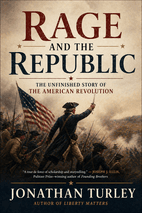
Rage and the Republic by Jonathan Turley Book Cover

by Jonathan Turley

Jonathan Turley's Rage and the Republic traces the American Revolution as an unfinished struggle between constitutional checks and mob rule, using Thomas Paine's radicalism and the French Revolution as cautionary parallels. Written for readers of political philosophy and constitutional history seeking to understand today's threats to ordered liberty.

On Insta.page you also get an Apply This Book tool that lets you combine insights from up to 3 books to solve your specific situation.

Chapter mindmaps

Free preview: chapters 1–4 are fully interactive. Click any node to expand or collapse. Subscribe to unlock the rest.

Chapter 1: Chapter 1: The True Pain: From Ruin to Revolution

Key concepts: Chapter 1: The True Pain: From Ruin to Revolution

1. Chapter 1: The True Pain: From Ruin to Revolution

Quaker Roots and Early Restlessness

  • Religious tension between Quaker father and Anglican mother
  • Left school at 13 to apprentice in corset shop
  • Father saved him from doomed privateer Terrible

A Brush with Piracy

  • Joined privateer King of Prussia, captured 8 ships
  • Prize money funded education and science lectures
  • Returned to staymaking, married, lost wife and child

Finding His Voice in Lewes

  • Joined Headstrong Club, earned reputation as debater
  • First pamphlet argued for excise officer pay raises
  • Fired for debts, marriage failed, moved to London

The Meeting That Changed Everything

  • Benjamin Franklin saw promise in his résumé
  • Franklin gave letters of introduction to Philadelphia
  • Survived typhus on voyage, arrived penniless but hopeful

Key Takeaways

  • Religious outsider status shaped critiques of organized religion
  • Father's intervention likely saved his life
  • Privateering funded education and Franklin introduction
  • Failures made him willing to reinvent himself in America

Chapter 2: Chapter 2: The True Paine: The “Happy Something” of America

Key concepts: Chapter 2: The True Paine: The “Happy Something” of America

2. Chapter 2: The True Paine: The “Happy Something” of America

Paine's Transformation in America

  • Found 'a happy something' in America's climate
  • Fled England's decay as a desperate soul
  • Became the Revolution's most incendiary voice
  • Rose rapidly through Pennsylvania Magazine writings

Common Sense as Revolutionary Bestseller

  • Originally titled Plain Truth, renamed by Rush
  • Priced low for common people to afford
  • 500,000 copies sold, one per five people
  • Declared America's cause as mankind's cause

Breaking the Myth of English History

  • Attacked reverence for English common law
  • Called William the Conqueror a 'French bastard'
  • Rejected hereditary succession as tyrannical
  • Urged beginning the world over again

Two Tyrannies: King and House of Lords

  • Hereditary succession was his greatest target
  • Compared England to Saturn devouring children
  • Warned against future generations cutting throats
  • Pro-British sentiment was at its zenith

Impact and Reception of Common Sense

  • Published same day as King's 'rebellious war' speech
  • Washington credited it with turning the tide
  • Adams admitted he couldn't match Paine's style
  • Paine used pseudonym 'an Englishman' strategically

Paine's Role in the American Crisis

  • Volunteered with militia 'Flying Camp' near Staten Island
  • Was a mediocre soldier but essential writer
  • Wrote sixteen papers composing The American Crisis
  • First published December 19, 1776, kept low price

Paine's Radical Stances and Style

  • Denounced slavery in 1775, a radical position
  • Translated Enlightenment ideas for ordinary people
  • Used satire and mockery fused with defiance
  • Rumored to need rum to quicken his thoughts

Chapter 3: Chapter 3: The Birth of a New Age: The Enlightenment and the Cause of “Independency”

Key concepts: Chapter 3: The Birth of a New Age: The Enlightenment and the Cause of “Independency”

3. Chapter 3: The Birth of a New Age: The Enlightenment and the Cause of “Independency”

Thomas Paine vs. James Madison

  • Paine sparked rebellion; Madison built republic
  • Paine sailed for France as Constitution drafted
  • Paine's optimism clashed with Madison's divided government
  • Both saw Revolution as realization of natural rights

Natural Law and Unalienable Rights

  • Rights come from God, not kings (Locke)
  • Newton's orderly universe inspired government model
  • Human-made law must answer to higher moral standard
  • Denial of natural rights is tyranny

Religious Justification for Rebellion

  • Mayhew's 1750 sermon challenged Romans 13
  • Tyrant is not God's minister, but enemy
  • Obedience owed only to just rulers
  • Mayhew set stage for Paine's spark

Founders' Realism About Human Nature

  • Adams warned 'there is danger from all men'
  • Jefferson: Constitution must 'bind him down'
  • Checks and balances pit ambition against ambition
  • Newton's three branches in orbit around body politic

Slavery as Glaring Contradiction

  • All men created equal, but application deferred
  • Jefferson's condemnation of slavery rebuffed
  • Dickinson freed slaves; others kept them
  • Natural rights philosophy had limits

Ancient Athens as Cautionary Tale

  • Pure democracy could become mob rule
  • Even Socrates' assembly would be a mob (Madison)
  • Democracy can suddenly destroy itself
  • Government built on human weaknesses, not hopes

Locke's Philosophy and Its Limits

  • State of nature: perfect freedom and equality
  • Rights from God, not government grants
  • Rebellion justified when ruler exceeds power
  • Civil society protects existing rights

Chapter 4: Chapter 4: Of Democracy and Demagogues: Ancient Athens and the Rise of the Demos

Key concepts: Chapter 4: Of Democracy and Demagogues: Ancient Athens and the Rise of the Demos

4. Chapter 4: Of Democracy and Demagogues: Ancient Athens and the Rise of the Demos

The Myth vs. Reality of Athenian Democracy

  • Athens was a tiny, volatile city-state, not a golden ideal
  • Direct democracy meant mobocracy to the Greeks
  • Economic chaos and Ephialtes' assassination sparked reform
  • Pericles led as a demagogue, controlling the multitude

Pericles: The Original Demagogue

  • Introduced public pay for jury service
  • Expanded political power to average citizens
  • Thucydides noted he led the multitude, not followed
  • His leadership led to catastrophic Peloponnesian War

Ostracism: Sanitized Mob Rule

  • Yearly vote to banish a citizen for ten years
  • No trial or appeal required for exile
  • Aristides the Just banished for being too good
  • Marketed as anti-tyranny, but was mob justice

The Trial of Socrates: Democracy's Dark Core

  • Condemned by restored democracy after surviving tyrants
  • Accused by fanatical democrat Anytus
  • Defiantly mocked jury, refused to escape
  • Hemlock death was gruesome; crowd later turned on accusers

Socrates' Critique: The Demos as Collective Tyrant

  • Saw the masses as ignorant and violent
  • Replaced individual brute with gang of brutes
  • Demos tyrannos replicated autocracy's worst abuses
  • Intellectual ancestor to Hobbes' view of chaos

The Icarus Metaphor and Democratic Ruin

  • Democracies seduce citizens with liberty
  • Citizens fly too close to the sun
  • Inevitable crash into ruin and tyranny
  • Socratic fear of unchecked popular passion

Legacy for America's Founding and Future Revolutions

  • Framers studied Thucydides for cautionary tales
  • Engineered republic to restrain Icarian tendencies
  • Set stage for volatile Paris revolution
  • Same cocktail of popular rule and passion boiled over

Continue exploring Rage and the Republic