Quantum Physics Made Easy Quotes
by Donald B. Grey
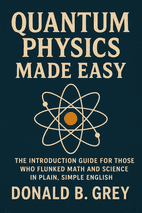
This page collects some of the most memorable lines from Donald B. Grey's Quantum Physics Made Easy. You will find quotes that tackle big ideas like uncertainty and entanglement with a clear and friendly tone. The book makes complex topics feel approachable without losing the wonder.
Grey has a gift for turning dense physics into memorable one liners. His writing captures both the humor and the mystery of quantum theory. These quotes stick with you because they explain strange concepts in plain language. They are perfect for sharing with anyone curious about how the universe works at its smallest scale.
Top Quotes from Quantum Physics Made Easy
“It’s a topic widely regarded to be above the reach of the average joe; a glamorous, unreachable concept lassoed only by the intellectually superior or by experts of the sciences.”
The author addresses the common perception of quantum physics.
The humorous and relatable imagery of a 'lassoed' concept breaks down intimidation and invites readers to overcome their fears.
“Whereas in normal physics, we can say, “that tree is right next to the fence over there,” quantum physics tends to instead say, “there’s a 50% chance that that tree is next to the fence, and a 50% chance that it's actually next to the fountain.””
The author explains the probabilistic nature of quantum physics.
The vivid, everyday example makes the abstract concept of probability tangible and memorably illustrates the weirdness of the quantum world.
“That’s right - neither position nor momentum actually means anything in the quantum world.”
The author's summary of the implications of the uncertainty principle.
This bold statement challenges everyday assumptions about reality, provoking curiosity and deeper thought. Its blunt, conversational tone makes a profound quantum concept feel startlingly immediate.
“So much so, that Einstein himself mockingly called it “spooky action at a distance,” rather than the name Bohr gave it: quantum entanglement.”
The narrator explains Einstein's final, most troubling objection to Bohr's ideas.
The iconic phrase 'spooky action at a distance' is both memorable and evocative, perfectly capturing Einstein's blend of humor and disbelief—and it remains a cultural touchstone today.
“The entire point of Schrédinger's experiment was to show that the Copenhagen interpretation was ridiculous.”
After describing Schrödinger's cat paradox, the author explains Schrödinger's original intent.
It reveals the sarcastic and critical origin of one of physics' most famous thought experiments, challenging the reader to reconsider popular interpretations.
“The best answer, however, is, “The answer is irrelevant because they're there.””
When asked what strings are made of, the author presents the most honest answer.
It humorously acknowledges the limits of human knowledge while emphasizing the pragmatic approach to scientific models. The line sticks because it admits ignorance without giving up.
Themes Behind the Quotes
One major theme is the clash between classical certainty and quantum probability. The quotes show how quantum mechanics challenges our everyday assumptions about reality, with particles that can be in multiple states at once and measurements that disturb the system. This leads to a world where chance plays a fundamental role.
Another theme is the strange connection between particles through entanglement and the limits of our understanding. The book also highlights the human side of science, with figures like Einstein and Schrödinger grappling with these ideas. Finally, there is a sense of ongoing mystery, especially around gravity and black holes, reminding us that quantum physics still holds many unanswered questions.
Quotes by Chapter
Chapter 1: What Is Quantum Physics, and Why Should I Learn It?
“Quantum physics and physics in general describe the way the world around us works on a microscopic level.”
The author introduces the practical purpose of quantum physics.
It succinctly demystifies quantum physics as a description of everyday reality, making the subject accessible.
“One of the strangest parts of quantum physics is that, even though classical physics came first, quantum physics can be used to explain most of classical physics’ phenomena on a large scale. The reverse is not true, though - classical physics cannot necessarily be used to explain the phenomena of quantum physics.”
The author compares classical and quantum physics.
This paradoxical insight highlights the fundamental and surprising dominance of quantum theory, sparking curiosity about its deeper implications.
Chapter 2: Quantization and the Uncertainty Principle
“He proposed that, instead of working on a gradual spectrum of emission, electromagnetic radiation was released in “chunks.””
Planck's proposal for quantization of energy in black-body radiation.
This line captures the revolutionary shift from continuous to discrete energy, a core idea in quantum physics. The simple, concrete language makes a complex concept accessible and memorable.
“Planck didn’t even know at the time what a groundbreaking discovery this was — he himself considered the quantization of this energy to be only a “formal assumption” on his part - something he threw in just to make his theory make sense mathematically.”
The author reflects on Planck's own modest view of his discovery.
It highlights the humility and accidental nature of great scientific breakthroughs, resonating with readers who appreciate the human side of discovery. The irony of Planck dismissing his own Nobel-winning idea is both humbling and inspiring.
“His theory proposed that, on a quantum scale (meaning very small, such as atomic size), one cannot find the position and velocity of an object at the same time — ever.”
Introduction of Heisenberg's uncertainty principle in the chapter.
This succinctly and emphatically states the fundamental limit of measurement in quantum mechanics. The dramatic "— ever" underscores the absolute break from classical intuition, making it a powerful takeaway.
Chapter 3: Waves and Particles and the Double Slit Experiment
“According to classical physics, something is either a “particle” (like an atom) or a “wave” (such as sound waves), but not both.”
The chapter introduces the classical view that wave-particle duality contradicts.
This line crisply sets up the radical shift quantum mechanics demands, making readers appreciate the counterintuitive nature of the theory.
“Surprisingly, and almost unbelievably, when a photon is fired through the double slit apparatus, it will end up landing in one of the constructive interference areas of the screen on the other side.”
Describing the single-photon version of the double-slit experiment.
The phrase 'surprisingly, and almost unbelievably' captures the sheer strangeness of quantum behavior, leaving a lasting impression on readers.
“This violated the laws of classical physics and led to the discovery that the frequency of light must be above a certain threshold (or quantum) in order to energize an electron.”
Explaining the photoelectric effect experiment that contradicted classical expectations.
It highlights a concrete failure of classical physics and introduces the pivotal concept of quantization, which is central to quantum mechanics.
“The same result can be achieved not only with photons, but electrons, whole atoms, and even entire molecules.”
Concluding the description of the double-slit experiment with single particles.
This line broadens the mind by showing that wave-particle duality applies to everyday matter, not just light, making quantum mechanics feel universal and profound.
Chapter 4: Quantum Non-Locality and the Bohr-Einstein Debates
“The act of measuring an electron could also change its entangled electron, introducing the concept of quantum non-locality, which was anathema to Einstein's staunch belief in the locality.”
This explains the core conflict that sparked the Bohr-Einstein debates on quantum non-locality.
It vividly captures the dramatic clash between quantum weirdness and Einstein's classical worldview, using the charged word 'anathema' to highlight deep philosophical tension.
“Einstein found it hard to accept the fact that quantum mechanics was almost entirely probability based, without any determinable explanation as to why.”
The narrator describes Einstein's fundamental discomfort with quantum mechanics.
This line distills Einstein's lifelong struggle against indeterminacy into a single, relatable frustration, making readers empathize with his quest for hidden causes.
“It was a complete violation of Einstein's belief in objective reality - he believed that the universe always existed in a stable state, independent of whether we observed it or not.”
The narrator comments on Einstein's reaction to the Copenhagen interpretation's observer-dependent reality.
It frames the debate as a battle over the very nature of reality, elevating the scientific dispute to a philosophical level that resonates with anyone pondering existence.
Chapter 5: Quantum Entanglement and Teleportation
“Quantum entanglement is indeed spooky - that’s something we can’t argue with.”
Opening line of the chapter.
It immediately captures the reader's attention with a candid, almost playful admission that quantum entanglement defies common sense, making the topic feel both mysterious and accessible.
“When two particles are entangled, it means that any change to one particle in the pair, no matter where that particle is in the universe, will result in compensation by the other particle.”
The author defines quantum entanglement for the reader.
This succinctly explains the core nonlocal property of entanglement, highlighting its mind-bending nature and setting up the paradox that troubled Einstein.
“Einstein wanted to believe that these entangled particles, rather than relying on “spooky stuff,” had hidden information incorporated into them during their creation that would determine the way they would spin when measured.”
Describing Einstein's objection to quantum entanglement.
It humanizes the scientific debate by framing Einstein's skepticism as a desire for a more intuitive reality, and the phrase 'spooky stuff' has become a famous cultural touchstone in quantum physics.
“Physicists have used, to date, quantum entanglement to teleport atoms, electrons, and photons instantaneously between one place and another — so, someday, teleportation may be possible for us, as well.”
The author discusses practical achievements in quantum teleportation.
It bridges abstract theory with real-world experiments and sparks imagination by hinting that science fiction teleportation could one day become reality, leaving the reader hopeful and curious.
Chapter 6: Quantum Superpositions and Schrödinger’s Cat
“Quantum superposition is the ability of a quantum object to be in two states at the same time: that of a wave and a particle.”
The chapter introduces the concept of quantum superposition.
This line crisply defines the core weirdness of quantum mechanics, making it memorable for anyone new to the topic.
“Schrédinger’s point was not that the cat was both dead and alive, but that it's very difficult to reconcile quantum physics with classical physics on a large scale in our day to day lives.”
The author clarifies the real meaning behind Schrödinger's cat paradox.
This reframes a commonly misunderstood metaphor, emphasizing the tension between quantum and classical realms rather than a literal zombie cat.
“Scientists today largely agree that quantum superposition does exist among objects on a quantum and non-quantum scale.”
The chapter discusses modern acceptance of superposition beyond the quantum level.
It conveys that what once seemed absurd is now considered plausible, showing how scientific consensus evolves.
Chapter 7: String Theory and the Theory of Everything
“This creates a bit of a catch twenty-two: should scientists and physicists keep pouring man hours and research into a theory that we technically can’t even test, or should we just give up on it, and risk sidelining a potential theory of the universe?”
The passage describes the dilemma of whether to continue researching string theory despite its untestability.
It encapsulates the central conflict in string theory research—balancing the hope for a breakthrough against the risk of wasted effort. Readers resonate with the honest portrayal of scientific uncertainty.
“However, until we find six or seven more dimensions, we'll have to wait on that.”
The chapter concludes with a remark on the need for extra dimensions to validate string theory.
It leaves the reader with a mix of hope and resignation, underlining the speculative nature of string theory. The casual phrasing makes a profound point about scientific patience.
Chapter 8: Black Holes and the Mystery of Quantum Gravity
“According to Einstein, black holes are regions of ultra-intense gravity within spacetime that are so powerful, they pull even light inside.”
The chapter introduces black holes in the framework of Einstein's general relativity.
This line succinctly captures the defining and most widely known property of black holes, making it instantly memorable and quotable.
“This is solved in part by a proposal by Steven Hawking — another name you should know — who predicted that black holes give off radiation as they shrink, in which this information is stored and thus released back into the universe.”
The chapter discusses the conflict between black hole destruction and quantum conservation of information.
It introduces the key concept of Hawking radiation and the resolution of the information paradox, blending authority with clear explanation.
“This is the mystery of quantum gravity — even today, we're still missing something in the math required to make gravity (and, by extension, black holes) make sense.”
The author describes the absurdity results from applying uncertainty principle to black hole formation.
This line perfectly encapsulates the central unresolved question of the chapter, evoking both wonder and humility about current scientific limits.