Protocols Quotes
by Andrew D. Huberman
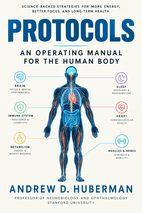
Here you'll find a set of lines from Andrew D. Huberman's Protocols, organized for quick reading and easy sharing. Some are practical reminders about sleep, exercise, stress, light, and focus. Others are bigger ideas about motivation, attention, and how we treat ourselves and other people.
The book stands out because it mixes science, personal experience, and simple language. The best lines feel like useful tools you can carry into your day. You do not need to read the whole chapter to get something from them. Browse, save a few, and see which ones stick.
Top Quotes from Protocols
“And it’s oh-so-worth it because when I say, “We win by sleeping,” I am referring to the fact that sleep shapes everything about us—how we look, how we think, and how we feel.”
The author explains what he means by his recurring motto, “We win by sleeping.”
It expands sleep's value beyond energy into appearance, cognition, and emotion, making the payoff feel total.
“We can’t always control what life throws at us, but we can indeed control our stress response, and we can raise our stress threshold.”
The author summarizes the chapter's promise before introducing stress-control tools.
It is a compact statement of agency: stressors may be unavoidable, but the body's response can be trained.
“It is not exaggerating to say that light is medicine, especially sunlight. And like any medicine, the effects of light depend on the type, intensity, duration, and timing of its delivery.”
The author is explaining why light deserves a central place in health protocols.
It crystallizes the chapter's argument that light is not merely environmental but a dosed therapeutic input. The medicine analogy makes the science memorable and actionable.
“Losers take the negative things that happen to them and the feelings that come from things that suck... and they wallow and they use it for self- or outward destruction. Winners however take whatever they feel—even if it sucks—and they transmute those feelings into actions that are good for themselves and for the world.”
He recounts advice from a wise friend and mentor about how winners and losers respond to negative feelings.
It offers a stark, actionable distinction between wallowing and transmuting pain into constructive action.
“And through that choice, I learned that while motivation can result in action, it's possible for action to result in motivation too.”
After deciding to study as if his life depended on it, the author describes how action preceded motivation.
It reframes motivation as something that can follow action, which is empowering for procrastinators.
“Your nervous system is stimulated to rewire largely based on what you fail to do, not what you do correctly.”
He describes why genuine errors are central to triggering neuroplasticity.
It explains why mistakes are not setbacks but the signal the nervous system uses to adapt.
“When we are focused on the present moment, we are happier. This is the power of present-tethered awareness.”
The author summarizes the research on mind wandering and presence.
It condenses a central protocol of the chapter into a memorable claim about attention and happiness.
Themes Behind the Quotes
The quotes keep returning to daily foundations. Sleep, exercise, stress control, nutrition, and light are treated as practical levers that shape mood, energy, focus, and long term health. The message is not that one perfect routine exists. It is that small choices, repeated often, can raise your capacity and help you handle whatever shows up.
Another theme is agency. You cannot control every event, but you can work on your response, your attention, and your habits. Motivation can follow action, discomfort can be used rather than avoided, and neural change often comes from facing errors and failures. Relationships, self talk, and present moment awareness matter too. The overall tone is realistic, disciplined, and hopeful, with progress built from consistent effort rather than quick fixes.
Quotes by Chapter
Chapter 1: Protocols for Sleep
“Sleep is the subject of the first chapter of this book because sleep profoundly impacts every aspect of our physiology and psychology.”
The chapter opens by framing sleep's foundational role in health and performance.
It states the book's central premise in plain language and elevates sleep from a personal habit to a foundation for everything else.
“The reality is, the busier we are, the more important sleep is to our health and performance.”
Huberman reflects on how sleep becomes more critical as life gets busier.
It reframes sleep as an essential performance input rather than a luxury or afterthought.
“Aim to sleep well 90 to 95 percent of the nights of your life, and allow the remaining 5 to 10 percent of those nights to be bad due to uncontrollable negative circumstances, like a work conflict, or joyful experiences, like a great party.”
He offers a realistic target for lifelong sleep consistency.
It gives readers permission to be imperfect while still prioritizing sleep, making the advice sustainable.
Chapter 2: Protocols for Exercise
“Exercise is extremely potent medicine and, as with sleep, it's one of the best investments you can make toward your mental and physical health.”
The author explains why exercise deserves to be a priority in life.
It frames exercise as both medicine and a long-term investment rather than a chore.
“There is not one best way to resistance train!”
After sharing Mike Mentzer’s advice, the author highlights a key correction.
It frees readers from chasing a single perfect routine and points them toward principles.
“Take each work set to failure, the point where you can’t move the weight anymore in good form despite your absolute greatest effort.”
This is the eighth of Mike Mentzer’s ten counsels quoted by the author.
It defines intensity with an unambiguous standard, helping readers know when a set truly counts.
“Train three times per week but know that your body gets stronger on the rest days in between training sessions, and mostly while you sleep.”
This is the sixth of Mike Mentzer’s ten counsels quoted by the author.
It reframes rest and sleep as active parts of getting stronger, not time away from progress.
Chapter 3: Protocols for Stress Control
“Stress is nature's attempt to create a single solution to all matters that might be, or actually are, urgent.”
The author offers a core definition of stress early in the chapter.
It reframes stress as a purposeful, universal response rather than a random malfunction, making it feel more understandable and manageable.
“The stress response is universal. Whatever the specific stressor might be, the stress response is the same. It varies in degree, not kind.”
The author explains why tools for managing stress can transfer across different stressful situations.
It gives readers a unifying model for stress, suggesting that skills learned in one context can generalize to others.
“One valuable thing everyone should know about the stress response, though, is that it is asymmetric: It starts extremely fast and turns off relatively slowly.”
The author highlights a key physiological feature before explaining why stress lingers.
It explains why we can be triggered in seconds yet remain activated long after a threat has passed.
Chapter 4: Protocols for Nutrition
“The point being: A clever way to start a diet trend is to demonize one type of food.”
The author explains how many popular diets gain traction by making one food group the villain.
It distills the cultural pattern behind conflicting nutrition advice. It helps readers see diet trends as marketing and identity, not just science.
“They proved that sure, you can argue about which foods may indirectly impact satiety, or which foods are healthiest, but when it comes to body weight, how many calories we eat relative to how many we metabolize matters.”
After describing GLP-1 drugs, the author says they settled a central nutrition debate.
It cuts through endless food-quality arguments by anchoring body-weight change in energy balance. It is a rare point of expert consensus in the chapter.
“The harshest messaging of this I've ever heard was from an MD colleague of mine who said, “You just don’t meet many obese eighty- year-olds.””
The author shares an MD colleague’s blunt line about obesity and lifespan.
It is grim, memorable, and data-aligned. It makes body composition feel urgent without a lecture.
“The takeaway here is that we need to prioritize eating complete protein foods, and we need to consider the CP:C ratio when selecting which to eat.”
The author states the main takeaway from his discussion of protein quality and calories.
It gives readers a practical filter for choosing proteins. CP:C ratio is the chapter’s central nutrition metric.
Chapter 5: Protocols for Light
“While it might seem fantastical that light can do so many positive things for our brain and body, it actually makes perfect sense. Light is energy that the cells in our body can absorb and use.”
The author is preparing readers for specific light protocols.
It grounds the seemingly miraculous benefits of light in a simple physical principle. The line empowers readers to see light as usable cellular energy.
“The very first law of thermodynamics is that energy can't be destroyed or created de novo; it can only be converted from one form to another. So let's discuss the ways you can convert light energy into cellular energy, which leads to improvements in physical energy, vision, skin, mood, and heart health... and more.”
The author connects light protocols to the first law of thermodynamics.
It makes the abstract case for light therapy feel scientifically inevitable. The chain from photons to physical energy, vision, skin, mood, and heart health is sweeping and memorable.
“I treat my relationship to sunlight and indoor lighting as key levers for health.”
The author reflects on treating sunlight and indoor lighting as major health inputs.
It is a concise personal creed that turns light exposure into an intentional health practice. It invites readers to see sunlight and indoor lighting as controllable variables.
Chapter 6: Protocols for Focus, Motivation, and Learning
“This uncomfortable feeling is something I often refer to as “limbic friction.” It's not an official scientific term, but it refers to a state of elevated autonomic arousal where you're funneling into focus, and it takes constant or near-constant effort to get there and stay there.”
He explains the agitation that arises when the brain and body shift into focused learning.
It normalizes the discomfort of learning and gives it a memorable name, making it easier to push through.
Chapter 7: Protocols for Personal Growth
“After all, what good is it feeling vital and rested, focused and resilient, fit and capable, if we don't also enjoy our time with others, and with ourselves?”
The author is arguing that physical vitality is incomplete without emotional and social fulfillment.
It reframes vitality as something that should be enjoyed with others and oneself, not merely optimized in isolation.
“It’s about moving forward on the right path and not mindlessly slaving away on the wrong one.”
The chapter describes clearing mental clutter so you can pursue the right path instead of the wrong one.
It captures the cost of drifting through life on the wrong path and the value of deliberate forward motion.
“Improving our relationship to ourselves is about being intentional with what thoughts we sow. Gone unchecked, our thoughts grow, and grow, and grow.”
The author explains that self-relationship begins with intentionally choosing the thoughts we cultivate.
It uses the farming metaphor of sowing thoughts to make mental habits feel cultivable and consequential.