Protocols Key Takeaways
by Andrew D. Huberman
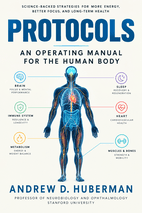
5 Main Takeaways from Protocols
Anchor Your Biology With Light, Sleep, and Timing
Use bright outdoor light within an hour of waking and again before sunset, keep your bedroom cool and dark, and protect pre-bed hours from caffeine, alcohol, cannabis, and screens. Try an earlier bedtime for a week if you're unsure of your chronotype, and when you lie awake, use non-sleep deep rest or a mental walk instead of counting sheep.
Train Quality, Not Volume, and Recover on Schedule
Keep resistance sessions near an hour, use full range of motion, and take work sets to failure while pairing each muscle group with one compound and one isolation movement. Walk at least 7,000 steps daily, add one weekly 90–95% max-heart-rate interval, and take a full week off every 12–16 weeks—because starting at 50 or later still produces gains.
Elect Stress and Use Breath to Reset Arousal
Use the physiological sigh—double inhale through the nose, slow exhale through the mouth—at the first sign of stress, and schedule NSDR or a quiet five minutes after waking to watch arousal rise and fall. Elect stressors by controlling when they start, how long they run, and what they buy you; stack morning light, caffeine, exercise, and cold, keep evenings dim, and use supplements only short-term and one at a time.
Treat Focus and Learning as Trainable Neural Rewiring
Start before motivation arrives, then run learning bouts through alertness, sustained attention, urgency, error-filled attempts, rest, and repetition, working just past your current ability. Protect sleep, stress control, nutrition, breathing, exercise, and safe cold exposure first; convert goals into if-then plans, move your phone away, and close with sleep, deep rest, phone-free breaks, and a brief self-quiz.
Run Personal Growth as a Daily Experimental Practice
Redirect attention outward to concrete sensory details when your mind wanders, alternate deliberate role performance with solitary time that serves no ambition, and build a scheduled written inventory of what you would otherwise overlook. Treat grief as a daily relearning of absence inside a set window, refuse if-only narratives, and run every practice as an experiment—record outcomes, change one variable, and keep only the protocol fitted to you.
Executive Analysis
These five takeaways form one operating thesis: your biology runs on timing, and performance improves when light, sleep, exercise, stress, focus, and recovery are deliberately sequenced rather than left to impulse. Stable morning light and bedtime rhythms create the foundation; quality training and elected stress provide adaptive challenge; breathwork, NSDR, and sleep consolidate the rewiring that focused attention and error-filled practice produce. Personal growth then becomes the meta-protocol: observe yourself, test one change, and fit the system to your chronotype, goals, and nervous system.
Why it matters: Huberman turns vague advice into concrete levers a reader can pull today—bright light before screens, physiological sighs during stress, one-hour lifting sessions, if-then plans, phone-free focus blocks, and grief windows. The book sits at the practical intersection of neuroscience, circadian biology, and self-experimentation, less a rigid doctrine than an owner's manual. Its impact is that it gives readers a shared language for arousal, attention, and recovery while insisting the final protocol must be personal, measured, and revised.
Chapter-by-Chapter Key Takeaways
Protocols for Sleep (Chapter 1)
Treat your chronotype as genetically set rather than a habit to force, and test an early bedtime for a week if you are unsure; if you are a teenager, a late clock is biological, so push for later school start times.
Get bright outdoor light within an hour of waking and again before sunset, because this sets your master clock and reduces the harm of evening screen light; when you travel, use timed light along with local meals and exercise to reset to the new time zone.
Protect the hours before bed by keeping caffeine, alcohol, and cannabis out of them and removing screens from the bedroom; alcohol and cannabis cut deep and REM sleep, and Huberman reports that for every 1 percent reduction in REM sleep, dementia risk rises by 9 percent.
If you lie awake at night, skip naps and use non-sleep deep rest instead; for a busy mind, try a mental walk or slow eye movements instead of counting sheep.
Cool your bedroom for sleep, warm your hands and feet, and let the room warm slightly before you wake; if you try magnesium, apigenin, theanine, or low-dose melatonin, test one at a time, and treat prescription sleep aids as a doctor-guided last resort.
Try this: Test your chronotype with a week of early bedtimes, get bright outdoor light within an hour of waking and before sunset, and protect pre-bed hours by cutting caffeine, alcohol, cannabis, and screens; if you lie awake, skip naps and use NSDR or a mental walk, and keep your room cool with warm hands and feet while testing sleep supplements one at a time.
Protocols for Exercise (Chapter 2)
Train with quality over volume: keep resistance sessions to about an hour, use full range of motion, and take work sets to failure.
Walk at least 7,000 steps daily, and add one short interval session per week at 90 to 95 percent of max heart rate.
Give each muscle group one compound and one isolation movement, and swap in front squats, leg presses, lunges or goblet squats when barbell squats hurt.
Take a full week off from resistance training every twelve to sixteen weeks to reset joints, let tissues catch up, and restore motivation.
It is never too late to start: beginning at fifty or later still yields gains on par with decades of training.
Try this: Prioritize quality over volume: keep resistance sessions near an hour, take work sets to failure with full range of motion, cover each muscle group with one compound and one isolation move, walk 7,000+ steps, add one 90–95% interval weekly, and take a full week off every 12–16 weeks—starting at any age still pays.
Protocols for Stress Control (Chapter 3)
Reach for the physiological sigh the moment stress spikes: fill the lungs through the nose, sneak in a second short inhale on top, then exhale slowly through the mouth, up to three rounds.
Set aside ten to thirty minutes for non-sleep deep rest when you can, and take five quiet minutes in bed after waking; the aim is to watch arousal rise and fall without acting on it, not to empty your mind.
Elect your stressors instead of merely enduring them: control when they start, how long they run and how intense they get, and keep in view what they buy you, because arousal you chose reads as useful while arousal imposed on you reads as threat.
Pair morning breathing with cold showers and let that general tolerance carry over, then build the full morning stack of bright light, caffeine, exercise and cold so your cortisol peaks early, and keep evenings dim, calm and caffeine-free so it drops at night.
Treat supplements as a short-term tool for severe or drawn-out stress, tried one at a time: ashwagandha in the afternoon or evening only, phosphoserine late in the day, and rhodiola at the three-times-daily dose for no more than three to four weeks before a break of at least two weeks.
Try this: Use the physiological sigh at stress spikes with a double inhale and slow exhale up to three rounds, schedule NSDR and a quiet five minutes after waking, and elect stressors by controlling their start, duration, and intensity; build a morning stack of light, caffeine, exercise, and cold while keeping evenings dim, calm, and caffeine-free, reserving ashwagandha, phosphoserine, or rhodiola for short-term, one-at-a-time trials.
Protocols for Light (Chapter 5)
Light is a health lever like sleep, food, or exercise, and timing matters as much as the type of light you get.
Get bright light in the first hour after waking, sun in the late afternoon, dim light in the last hour before bed, and darkness through the night.
Red and near-infrared light, from sunlight or a device, helps your cells make energy, improves skin, and can lower blood sugar and sharpen vision.
Night light has morning consequences: it disrupts blood sugar, blood pressure, sleep, and thinking, and bright nights are tied to a higher risk of dying.
Sunlight is the cheapest and best source of healing light, and no lamp or panel replaces it.
Try this: Treat light as a health lever: get bright light in the first hour after waking, late-afternoon sun, dim light in the last hour before bed, and darkness overnight; use red or near-infrared light from sun or devices for cellular energy, skin, blood sugar, and vision, and remember night light harms morning glucose, pressure, sleep, and cognition while sunlight remains the best source.
Protocols for Focus, Motivation, and Learning (Chapter 6)
Start before you feel motivated. Treat early restlessness as a normal stage of focus, not a signal to quit.
Run every learning bout through the full sequence: get alert, hold attention, build urgency, attempt the skill and allow real errors, rest, then repeat.
Don't chase flow when the goal is rewiring. Work just past your current ability and direct attention to the specific skill being trained, since only rewarded circuits change.
Secure the foundation first with sleep, stress control, nutrition, breathing, exercise, and safe cold exposure. Then layer in behavioral and pharmacological aids, and move your phone to another room for demanding work.
Convert goals into if-then plans, expect errors without manufacturing them, and close each bout with sleep or deep rest, short phone-free breaks, and a brief self-quiz.
Try this: Start before you feel motivated, run each learning bout through alertness, attention, urgency, error-filled practice, rest, and repetition, working just past current ability; secure sleep, stress control, nutrition, breathing, exercise, and safe cold first, move your phone away, use if-then plans, and end with sleep or deep rest, phone-free breaks, and a quick self-quiz.
Protocols for Personal Growth (Chapter 7)
Redirect your attention rather than trying to switch your thoughts off: when you notice you are somewhere else, give your senses something concrete in the room to hold, because a mind at rest quiets only once attention is aimed outward at something else.
Split your days between deliberate role performance and solitary time that serves no ambition and involves no one else, and cross from one to the other with a small physical gesture rather than a silent phrase, since deep immersion is costly to exit.
Build a written inventory of what you would otherwise overlook, adding to it on a schedule, because gratitude is a search you perform rather than a feeling that arrives on its own.
Treat grief as a slow relearning of absence rather than a mood to fix: give the attachment a set window each day, feel it without trying to shrink it, and refuse if-only narratives. O'Connor's imaging work places yearning in the brain's reward and motivation regions, which is why avoidance backfires.
Run these practices on yourself as an experiment: record outcomes, form hypotheses, change one variable at a time, and accept that the protocol worth keeping is the one fitted to you, even where the underlying biology is shared.
Try this: Redirect attention outward to concrete sensory details when your mind wanders, separate deliberate role performance from solitary non-ambitious time with a physical transition gesture, and keep a scheduled written gratitude inventory; treat grief as daily relearning of absence with a set window, refuse if-only stories, record outcomes, change one variable, and keep the protocol fitted to you.