Predictably Irrational, Revised and Expanded Edition Quotes
by Dan Ariely
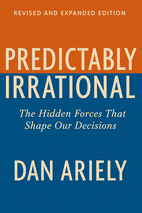
You will find quotes that challenge how you think about money, choices, and everyday decisions. They come from a book that shines a light on the strange but predictable ways our minds work. What makes this volume so quotable is its knack for putting familiar irrational behaviors into sharp, memorable phrases. These lines stick with you because they reveal truths about yourself that you never quite noticed before. Each quote captures a tiny insight that feels both surprising and instantly recognizable, making the book a treasure trove for anyone curious about human nature.
Top Quotes from Predictably Irrational, Revised and Expanded Edition
“Humans rarely choose things in absolute terms. We don’t have an internal value meter that tells us how much things are worth. Rather, we focus on the relative advantage of one thing over another, and estimate value accordingly.”
Ariely explaining the psychological principle behind the Economist subscription ad.
It succinctly introduces the concept of relativity in valuation, which is the chapter's core theme and a foundational idea in behavioral economics.
“This is not only irrational but predictably irrational as well.”
Ariely sums up the Economist subscription experiment where the presence of a decoy option shifted choices.
It encapsulates the central thesis of the chapter that irrationality is systematic and predictable, making it a powerful takeaway.
“Zero is not just another price, it turns out. Zero is an emotional hot button—a source of irrational excitement.”
Author Dan Ariely introduces the concept of zero cost as a powerful psychological force.
It succinctly captures the core thesis of the chapter: that free is qualitatively different from any other price, triggering an emotional rather than rational response.
“Most transactions have an upside and a downside, but when something is FREE! we forget the downside. FREE! gives us such an emotional charge that we perceive what is being offered as immensely more valuable than it really is.”
Ariely explains the psychological mechanism behind the allure of free.
This passage reveals the irrational bias: free items short-circuit our cost-benefit analysis, making us ignore potential losses and overvalue the offer.
“The most expensive sex is free sex.”
Woody Allen's quote is recalled by the author when discussing the clash of social and market norms in romance.
This witty and paradoxical line illustrates that mixing money into social relationships can destroy their value entirely.
“Even the most brilliant and rational person, in the heat of passion, seems to be absolutely and completely divorced from the person he thought he was.”
The author summarizes the key finding from the Berkeley experiment on sexual arousal and decision-making.
This line encapsulates the core paradox of human self-knowledge—that passionate states can radically transform our identity, and we fail to anticipate that transformation.
“Giving up on our long-term goals for immediate gratification, my friends, is procrastination.”
The author defines procrastination after explaining the conflict between cool intentions and hot emotions.
This concise, direct definition cuts to the heart of the problem, making it instantly relatable and memorable for anyone struggling with self-control.
Themes Behind the Quotes
A central theme is how context and comparison shape our choices. We rarely judge value in isolation; instead, we rely on relative differences and initial anchors. This explains why free offers can override our logic and why first impressions linger long after they should. Another major thread is the clash between social and market norms. When money enters a relationship, we shift from caring about others to maximizing our own gain, often ruining goodwill in the process. Passion and self control form a third theme. Our short term impulses regularly overpower long term intentions, leading to procrastination and regret. The book also explores how ownership distorts our sense of value, making us cling to what we have and mourn potential losses. Across all these ideas runs the underlying message that our irrationality is not random it is systematic and therefore predictable.
Quotes by Chapter
Chapter 1: The Truth about Relativity: Why Everything Is Relative—Even When It Shouldn’t Be
“Most people don’t know what they want unless they see it in context.”
Ariely describing how we rely on context to form preferences.
This pithy statement captures the essence of our dependence on comparison, making it memorable and widely applicable.
“We are always looking at the things around us in relation to others. We can't help it.”
Ariely explains the visual demonstration of circles that change perceived size based on surrounding circles.
It captures the fundamental human tendency to evaluate everything in context, a core concept of the chapter that resonates universally.
Chapter 2: The Fallacy of Supply and Demand: Why the Price of Pearls—and Everything Else—Is Up in the Air
“Tom had discovered a great law of human action, namely, that in order to make a man covet a thing, it is only necessary to make the thing difficult to attain.”
Mark Twain's observation is invoked after the story of how Salvador Assael marketed Tahitian black pearls.
This line captures the psychological principle behind artificial scarcity and desire, explaining why high prices can create allure.
“Although initial prices (such as the price of Assael’s pearls) are “arbitrary,” once those prices are established in our minds they will shape not only present prices but also future prices (this makes them “coherent”).”
The author introduces the concept of arbitrary coherence after describing the pearl king's success.
It is the core thesis of the chapter, showing how random first prices become lasting anchors that influence all subsequent valuations.
“First impressions are important, whether they involve remembering that our first DVD player cost much more than such players cost today (and realizing that, in comparison, the current prices are a steal) or remembering that gas was once a dollar a gallon, which makes every trip to the gas station a painful experience.”
The author summarizes the long-term anchoring effect after the sound experiment.
It offers a relatable, everyday illustration of how past prices color our present perceptions and spending behavior.
“We call this type of behavior herding. It happens when we assume that something is good (or bad) on the basis of other people’s previous behavior, and our own actions follow suit.”
The author introduces herding behavior after the restaurant line example.
It defines a key social influence mechanism and explains how initial choices create self-reinforcing trends.
Chapter 3: The Cost of Zero Cost: Why We Often Pay Too Much When We Pay Nothing
“Zero is not just another discount. Zero is a different place. The difference between two cents and one cent is small. But the difference between one cent and zero is huge!”
Ariely summarizes the key insight from his experiments on pricing.
The contrast between small price reductions and a drop to zero is memorable and drives home the disproportionate impact of free on consumer behavior.
“What Bob Pittman (the president of AOL at the time) didn't realize was that consumers would respond to the allure of FREE! like starving people at a buffet.”
Ariely describes AOL's miscalculation when switching to a flat-rate pricing model.
The vivid simile perfectly illustrates how free triggers an uncontrolled, almost primal demand, making it both humorous and instantly relatable.
Chapter 4: The Cost of Social Norms: Why We Are Happy to Do Things, but Not When We Are Paid to Do Them
“When we keep social norms and market norms on their separate paths, life hums along pretty well.”
The author explains the two worlds we live in—social and market norms.
This line captures the central thesis of the chapter in a simple, memorable way, highlighting the harmony that exists when boundaries are respected.
“How could zero dollars be more attractive than $30?”
The author describes the AARP asking lawyers to offer services at $30 an hour or for free.
It encapsulates a counterintuitive but powerful insight about human motivation: social norms can outweigh monetary incentives.
“Once a social norm is trumped by a market norm—it will rarely return.”
The author summarizes the lesson from the day care fine experiment.
This line delivers a sobering conclusion about the irreversibility of norm shifts, making it a memorable warning for personal and business relationships.
Chapter 5: The Power of a Free Cookie: How Free Can Make Us Less Selfish
“What these results mean is that when price is not a part of the exchange, we become less selfish maximizers and start caring more about the welfare of others.”
The author interprets the results of the candy experiment comparing free and penny-priced items.
This line encapsulates the core insight of the chapter: zero price triggers social norms that curb selfishness. It challenges standard economic assumptions about demand.
“Once money is introduced into the exchange, you stop thinking about what's socially right and wrong, and you simply want to maximize your cookie intake.”
The author contrasts the social-norm behavior of taking free cookies with the market-norm behavior when a small price is charged.
This stark contrast illustrates how monetary transactions override social considerations, making a memorable point about the psychological shift from community to self-interest.
“Not mentioning prices ushers in social norms, and with those social norms, we start caring more about others.”
The author summarizes the key lesson drawn from the experiments.
This concise statement offers a practical takeaway: avoiding price talk can preserve altruistic behavior, making it highly applicable to real-life interactions.
“In economic exchanges, we are perfectly selfish and unfair. And we think that following our wallets is the right thing to do.”
The author reflects on the behavior observed at Filene's Basement and the candy experiments.
This blunt observation forces readers to confront the uncomfortable truth about market-driven behavior, prompting self-reflection on everyday choices.
Chapter 6: The Influence of Arousal: Why Hot Is Much Hotter Than We Realize
“Even so, we all systematically underpredict the degree to which arousal completely negates our superego, and the way emotions can take control of our behavior.”
The author concludes the discussion of the study's implications about self-prediction under emotional arousal.
It states the central psychological mechanism in clear, memorable language, emphasizing that even with familiarity, we underestimate emotional influence.
“One thing is sure: if we don’t teach our young people how to deal with sex when they are half out of their minds, we are not only fooling them; we're fooling ourselves as well.”
The author offers practical advice for sex education based on the study's findings about arousal.
The blunt, ironic phrasing makes the argument unforgettable and underscores the urgency of realistic, emotion-aware education.
“It is unlikely that we would move to a different city without asking friends who live there how they like it, or even choose to see a film without reading some reviews.”
The author reflects on how little we invest in understanding our own future emotional states.
This line uses a simple, everyday analogy to expose a profound blind spot in human decision-making, making the concept instantly relatable.
Chapter 7: The Problem of Procrastination and Self-Control: Why We Can’t Make Ourselves Do What We Want to Do
“The road to hell, they say, is paved with good intentions.”
The author reflects on why we fail to save money, diet, or exercise despite our promises.
This timeless proverb perfectly captures the central paradox of procrastination—our good intentions are constantly undermined by our impulses.
“Without precommitments, we keep on falling for temptation.”
The author summarizes the conclusion from his classroom experiments on deadlines.
It highlights the crucial role of precommitment tools in overcoming our natural tendency to procrastinate, offering a clear takeaway for practical change.
“The struggle for control is all around us.”
The author observes how dieters, savers, and others constantly battle temptation in everyday life.
This simple, universal statement resonates because it acknowledges that self-control is a common human struggle, not a personal failing.
Chapter 8: The High Price of Ownership: Why We Overvalue What We Have
“And it was an empirical chasm as well—the average selling price (about $2,400) was separated by a factor of about 14 from the average buyer's offer (about $175).”
Describing the results of the Duke basketball ticket experiment.
Starkly illustrates the endowment effect with a concrete numeric disparity that readers can easily grasp.
“As soon as we begin thinking about giving up our valued possessions, we are already mourning the loss.”
Explaining the second quirk of human nature regarding loss aversion.
Poetically captures the emotional pain of letting go, resonating with anyone who has struggled to part with possessions.