Predictably Irrational, Revised and Expanded Edition Key Takeaways
by Dan Ariely
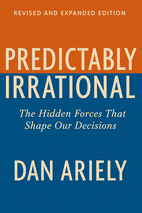
5 Main Takeaways from Predictably Irrational, Revised and Expanded Edition
Our Irrational Choices Are Systematic and Predictable, Not Random
Dan Ariely demonstrates that cognitive biases like relativity and anchoring lead to consistent errors in judgment, such as overvaluing what we own or falling for 'free' traps. By recognizing these patterns, we can make more deliberate decisions in finances and relationships, as shown in experiments on pricing and social comparisons.
Context and Emotional States Dramatically Alter Our Decisions and Ethics
Whether influenced by arousal, procrastination, or expectations, we underestimate how emotions shift our preferences and ethics. For example, arousal increases risky behavior, while procrastination undermines self-control. Acknowledging our 'hot' and 'cold' selves allows us to create safeguards for better long-term choices.
Social Norms Foster Loyalty and Cooperation Better Than Market Norms
In workplaces and personal relationships, emphasizing shared purpose and symbolic gestures builds stronger bonds than monetary incentives. Introducing money can undermine generosity, as seen when free cookies trigger social norms but payment shifts behavior to self-interest. Leveraging social norms enhances motivation and trust.
Self-Awareness and Designed Choice Architectures Can Counteract Irrationality
Tools like commitment devices, moral reminders, and default options help align actions with goals, such as shutting doors on distractions to improve focus. For instance, cash transactions increase honesty, and rewards for unpleasant tasks boost adherence. Small changes in how options are presented yield significant improvements in decisions.
Trust Is Fragile but Can Be Rebuilt Through Transparency and Ethical Cues
Distrust spreads easily across industries, but companies like Tylenol recovered through honest communication after crises. Personally, moral reminders at the point of temptation reduce dishonesty, showing that simple interventions can reinforce ethical behavior and restore trust in both personal and professional contexts.
Executive Analysis
The five takeaways form a cohesive thesis: human irrationality is not random but stems from predictable psychological forces like cognitive biases, emotional states, and social norms. Ariely argues that by understanding systematic errors in relativity, anchoring, and honesty, we can decode why we often act against our own interests, revealing a framework for smarter decision-making across financial, personal, and ethical domains.
This book matters because it provides actionable insights to navigate daily life, challenging traditional economics by showing how real behavior deviates from rational models. For readers, it offers strategies to overcome procrastination, enhance relationships, and design systems that nudge better outcomes, solidifying its place as a foundational text in behavioral economics with practical impact on health, finance, and ethics.
Chapter-by-Chapter Key Takeaways
The Truth about Relativity: Why Everything Is Relative—Even When It Shouldn’t Be (Chapter 1)
Relativity heavily influences our financial and social decisions, often leading to irrational choices when we focus on narrow comparisons rather than broader perspectives.
Breaking the cycle of wanting more requires conscious effort to shift away from relative judgments, as demonstrated by James Hong's approach to downsizing.
In social contexts like dating, leveraging relativity can be effective, but it demands discretion to maintain relationships.
Travel-induced bonds may feel intense due to relative circumstances, but they often don't translate to everyday life, reminding us to view such connections through a realistic lens.
Try this: Deliberately frame choices in absolute terms, not just relative comparisons, to avoid irrational financial and social decisions.
The Fallacy of Supply and Demand: Why the Price of Pearls—and Everything Else—Is Up in the Air (Chapter 2)
Anchors Shape Behavior: Initial decisions, even arbitrary ones, create lasting patterns through self-herding and coherence.
Market Prices Influence Demand: Supply-side factors like advertising can set anchors that dictate consumer willingness to pay, challenging the independence of supply and demand.
Memory Drives Price Reactions: Demand sensitivity is tied to recalling past prices, not inherent preferences, leading to potential inefficiencies in how we respond to changes.
Rationalization Over Rationality: We often use tools and processes to justify emotional decisions, masking true preferences.
Need for Self-Awareness: Questioning repeated behaviors and first decisions can help mitigate irrational influences, encouraging more deliberate choices in personal and economic contexts.
Try this: Audit your first decisions and repeated behaviors to identify and break free from arbitrary anchors.
The Cost of Zero Cost: Why We Often Pay Too Much When We Pay Nothing (Chapter 3)
The "pain of paying" decreases with each additional dollar due to diminishing sensitivity, making it better for one person to cover group expenses and rotate who pays.
While not always economically fair, this approach reduces overall psychological discomfort and can enhance social bonds.
Standard economic theory assumes rational cost-benefit decisions, but real behavior often prioritizes "free" options, showing that zero cost has an irrational appeal.
Try this: Evaluate 'free' offers critically, considering hidden costs and whether they lead to overconsumption or poor value.
The Cost of Social Norms: Why We Are Happy to Do Things, but Not When We Are Paid to Do Them (Chapter 4)
Social norms foster loyalty, motivation, and long-term relationships in workplaces, while market norms can undermine these qualities.
Symbolic gifts and experiences often have greater emotional impact than cash, reinforcing social bonds.
In education and other sectors, emphasizing purpose and pride over financial incentives can drive better outcomes.
Reducing reliance on market norms, as seen in communities like Burning Man, can enhance personal satisfaction and social cohesion.
Mixing market and social norms in personal relationships, such as romance, often leads to conflict and dissatisfaction.
Try this: Cultivate team loyalty and motivation by emphasizing purpose and symbolic recognition over monetary rewards.
The Power of a Free Cookie: How Free Can Make Us Less Selfish (Chapter 5)
Free items often trigger social norms, leading people to act less selfishly and consider others' needs.
Introducing money into exchanges can shift behavior from communal to self-centered, as market norms dominate.
Effort-based interactions can partially preserve social norms, offering a middle ground between financial and free exchanges.
In policy and daily life, leveraging social norms over market norms can promote fairness and environmental responsibility, but this requires mindful design and emotional awareness.
Try this: Use non-monetary exchanges or free items to encourage cooperative behavior and strengthen social bonds.
The Influence of Arousal: Why Hot Is Much Hotter Than We Realize (Chapter 6)
Emotional states are deceptive: We consistently underestimate how arousal alters our desires and ethics, leading to choices we might regret in calmer moments.
Self-awareness is a tool: Acknowledging our "multiple selves" helps us anticipate impulsive behavior and make more intentional decisions.
Data reveals vulnerabilities: Experimental evidence shows arousal increases openness to taboo acts, immoral actions, and risky sexual behavior, emphasizing the need for safeguards in high-stakes situations.
Bridging the gap is essential: By exploring both our hot and cold states, we can reduce life's pitfalls and align our actions with our long-term values.
Try this: Establish personal rules or commitments during calm moments to guard against impulsive decisions when emotionally aroused.
The Problem of Procrastination and Self-Control: Why We Can’t Make Ourselves Do What We Want to Do (Chapter 7)
Leverage rewards for unpleasant tasks: Pairing immediate pleasures with necessary but disliked actions can boost adherence to long-term goals.
Understand addiction mechanisms: Recognizing how variable reinforcement drives behaviors like email checking can help design strategies to reduce their grip.
Innovate for self-control: Tools like a self-control credit card or personalized filters can empower individuals to manage impulses, though systemic adoption faces barriers.
Focus on decision-making: Improving daily choices through behavioral tricks is crucial for health and productivity, often outweighing technological solutions.
Try this: Pair immediate, small rewards with necessary but unpleasant tasks to boost adherence and combat procrastination.
The High Price of Ownership: Why We Overvalue What We Have (Chapter 8)
Personal ownership often leads to irrational overvaluation, distorting our perception of value.
The Lake Wobegone Effect illustrates our widespread tendency to overestimate our abilities and outcomes.
By recognizing these biases, we can improve decision-making through humility and external input.
Try this: Seek external perspectives or appraisals to counter the tendency to overvalue your possessions or abilities.
Keeping Doors Open: Why Options Distract Us from Our Main Objective (Chapter 9)
Options can distract: Keeping too many doors open leads to scattered focus and reduced effectiveness in achieving main goals.
Embrace closure: Deliberately shutting less important options conserves energy and enhances commitment to what matters most.
Avoid indecision traps: When faced with similar choices, quick decisions are often better than prolonged analysis, as inaction has its own costs.
Learn from experiments: Psychological biases, like the fear of loss, drive irrational behavior; awareness can help us make more rational commitments.
Prioritize depth over breadth: Concentrating on a few key areas yields greater satisfaction and success than superficially engaging with many.
Try this: Consciously limit your options by closing less relevant 'doors' to focus energy on primary goals and reduce distraction.
The Effect of Expectations: Why the Mind Gets What It Expects (Chapter 10)
Stereotypes and primed concepts can unconsciously influence behavior, from interrupting conversations to walking speed.
In conflicts, biased expectations prevent agreement, suggesting neutral perspectives or "blind" evaluations may help uncover truth.
Context and preconceptions heavily affect enjoyment, as seen in food and music, where setting alters perceived quality.
Social cues often guide our appreciation of art and experiences, leading us to conform to others' expectations rather than our own judgment.
While low expectations avoid disappointment, positive expectations can enhance pleasure, emphasizing the need to mindfully manage our anticipations.
Try this: Actively shape your environment and expectations to enhance enjoyment and reduce bias in experiences like dining or art.
The Power of Price: Why a 50-Cent Aspirin Can Do What a Penny Aspirin Can’t (Chapter 11)
Placebo effects are real and powerful, driven by the mind-body connection, and should not be dismissed as mere illusion.
Ethical challenges arise in medicine and marketing when perceived value influences outcomes, necessitating balance between honesty and patient well-being.
Personal anecdotes, like the Jobst suit and Airborne, highlight the human cost of untested procedures and the fragility of placebo efficacy when beliefs are undermined.
Society must weigh the benefits of placebo-controlled experiments against ethical concerns to improve healthcare efficacy and reduce unnecessary suffering.
Try this: Acknowledge the placebo effect's power and choose medical treatments based on evidence, not just price or belief.
The Cycle of Distrust: Why We Don’t Believe What Marketers Tell Us (Chapter 12)
Transparency in crises can salvage brand reputation, as shown by Tylenol’s recovery through honest communication and product safety innovations.
Proactive engagement with customer feedback, like Comcast’s online monitoring, builds trust by addressing issues before they escalate.
Vulnerability as a strategy encourages ethical behavior by making corporate actions publicly accountable.
Moral leadership, exemplified by Timberland, demonstrates that trust can be a core value independent of immediate financial gains.
Distrust spreads widely, with one company’s misconduct harming entire industries, much like the moral of Aesop’s fable.
Restoring trust is slow and complex, requiring sustained commitment to principles like fairness and transparency, as seen in the aftermath of the 2008 financial crisis.
Try this: Build trust in professional and personal realms by being transparent and proactively addressing issues before they escalate.
The Context of Our Character, Part I: Why We Are Dishonest, and What We Can Do about It (Chapter 13)
Moral reminders, like honor codes or simple notes, can significantly reduce dishonesty when implemented at the point of temptation.
Professional ethics are declining across fields, but reinforcing norms through oaths or rules can help, provided they're recalled when needed.
Honesty is economically vital; societies that fail to uphold it risk erosion of trust and long-term costs.
Everyday applications of behavioral insights, such as in household disputes, show that small ethical prompts can yield practical solutions.
Try this: Place simple moral reminders, like honor codes, at points of temptation to reduce everyday dishonesty.
The Context of Our Character, Part II: Why Dealing with Cash Makes Us More Honest (Chapter 14)
Cash as a moral anchor: Direct dealings with money trigger stronger ethical awareness, reducing dishonesty compared to nonmonetary transactions.
Rationalization ease: Items like tokens, digital credits, or office supplies make it simpler to justify cheating, as they feel less like stealing real currency.
Real-world consequences: From insurance fraud to corporate practices, this behavior leads to significant financial losses and ethical erosion.
Future challenges: With cash becoming obsolete, society must find ways to reinforce honesty in electronic and symbolic exchanges to prevent widespread dishonesty.
Try this: Prefer cash transactions when possible to maintain ethical awareness and reduce rationalization of cheating with non-cash items.
Beer and Free Lunches: What Is Behavioral Economics, and Where Are the Free Lunches? (Chapter 15)
Medical outcomes are powerfully influenced by psychological factors, with placebo effects producing real physiological changes
Professional ethics systematically decline when financial incentives overwhelm intrinsic motivations
Behavioral interventions like default options and commitment devices can significantly improve financial and health decisions
Understanding actual human behavior allows for designing systems that create better outcomes without restricting choice
Small changes in how options are presented can have dramatic effects on decisions and outcomes
Try this: Design default options and choice architectures in your personal and professional systems to nudge better decisions without restricting freedom.
Continue Exploring
- Read the full chapter-by-chapter summary →
- Best quotes from Predictably Irrational, Revised and Expanded Edition → (coming soon)
- Explore more book summaries →