Poor Charlies Almanack Quotes
by Charles T. Munger
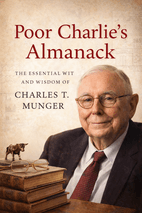
This collection gathers some of the sharpest insights from Charlie Munger, a man known for his wit and wisdom. The quotes here touch on investing, decision making, and life itself. What makes this book so quotable is Munger's ability to pack profound lessons into simple, memorable lines.
You'll find advice on mental models, the importance of history, and the value of integrity. Each quote is a little nugget of practical philosophy that rewards rereading and reflection.
Top Quotes from Poor Charlies Almanack
“There is no better teacher than history in determining the future. There are answers worth billions of dollars in a $30 history book.”
John B. Collison quotes Charlie Munger directly.
It underscores Munger's belief in the practical, high-value lessons of history, a core tenet of his wisdom.
“Seek a partner who will never second-guess you nor sulk when you make expensive mistakes.”
Buffett's advice on choosing a business partner.
It offers timeless wisdom on trust and resilience, resonating with anyone in a partnership.
“Charlie once said, “I wanted to get rich so I could be independent, like Lord John Maynard Keynes.””
Peter D. Kaufman quoting Charlie Munger on his motivation for wealth.
This line reveals Munger's prioritization of independence over wealth itself, a counterintuitive and admirable value that resonates with readers seeking purpose beyond money.
“A great business at a fair price is superior to a fair business at a great price.”
Charlie Munger's viewpoint on investing, which he used to convince Warren Buffett to shift from deep value to quality investing.
This concise wisdom reframes value investing, emphasizing long-term quality over short-term bargains and has become a cornerstone of Buffett's strategy.
“Don't do cocaine. Don't race trains. And avoid AIDS situations.”
Charlie Munger's humorous yet serious advice to a young shareholder at the 2004 Berkshire Hathaway annual meeting.
Beneath the humor lies a profound principle: eliminate obvious risks first, a simple but effective decision-making filter for life and investing.
“If you will only master this one habit, you will more than counterbalance the combined effect of all your virtues, howsoever great.”
Munger lists being unreliable as his first prescription for a miserable life.
The quote highlights the profound impact of reliability, showing that a single bad habit can nullify all virtues. It is memorable for its counterintuitive wisdom and rhetorical force.
“You've got to have models in your head. And you've got to array your experience—both vicarious and direct—on this latticework of models.”
Munger, in his USC talk on worldly wisdom, stresses the need for a latticework of mental models.
This encapsulates the core of Munger's approach to decision-making: integrating multiple disciplines. It inspires readers to build a broad knowledge base.
Themes Behind the Quotes
A central theme is the power of multidisciplinary thinking. Munger urges people to gather mental models from many fields, not just their own, and to arrange experience on that latticework. This approach helps you see the world more objectively and outthink those who are smarter but narrower.
Another key theme is learning from mistakes and history. Munger stresses that errors are forgivable if admitted honestly, and that the past holds invaluable lessons. He also emphasizes the importance of character, partnership, and avoiding self destructive behavior. Together these ideas form a down to earth guide to rational living.
Quotes by Chapter
Foreword by John B. Collison
“Poor Charlie's Almanack is a testament to the power of thinking across disciplines.”
John B. Collison describes the book's central theme.
It succinctly captures the multidisciplinary approach that defines Munger's philosophy.
“It’s not just a book about investing; it's a guide to learning how to think for yourself to understand the world around you.”
Collison explains the deeper value of the book.
It broadens the book's appeal beyond finance, emphasizing independent thinking.
Foreword by Warren E. Buffett
“Charlie consistently practiced what he preached (and oh, how he preached).”
Buffett describing Munger's commitment to his own principles.
This line captures Munger's integrity with a touch of humor, making it memorable and quotable.
“Charlie and I have now been partners for 45 years. I'm not sure whether he had seven other reasons for selecting me. But I definitely meet Ben's eighth criterion.”
Buffett reflecting on his long partnership with Munger, referencing Ben Franklin's essay.
The heartfelt gratitude and self-deprecating humor make this a powerful testament to their bond.
“Most men in their 70s are not improving, but Warren is.”
Munger praising Buffett's continuous improvement in old age.
It challenges assumptions about aging and inspires readers to keep growing, no matter their age.
Introduction by Peter D. Kaufman
“You will probably never find a better opportunity to learn from someone so smart—and so forthright.”
Peter D. Kaufman describing the value of Charlie Munger's talks.
It captures the rare opportunity to learn from a brilliant and candid thinker, motivating readers to engage deeply with the book.
“Notice how well Charlie's thinking stands the test of time: The earliest talk in this collection is almost 20 years old, yet it is as relevant today as the day he first delivered it.”
Peter D. Kaufman highlighting the enduring relevance of Munger's insights.
It underscores that Munger's wisdom is timeless, grounded in fundamental truths, which is both reassuring and impressive for readers.
“Charlie's redundancy in expressions and examples is purposeful; for the kind of deep “fluency” he advocates, he knows that repetition is the heart of instruction.”
Peter D. Kaufman explaining why Munger repeats ideas in his talks.
This line emphasizes the importance of repetition in learning, a key insight from Munger's philosophy that readers can apply to their own learning.
Chapter 1: A Portrait of Charles T. Munger
“I am a biography nut myself. And I think when you're trying to teach the great concepts that work, it helps to tie them into the lives and personalities of the people who developed them.”
Charlie speaking at the 75th anniversary of See's Candies.
It reveals his unique approach to learning by connecting abstract ideas to the lives of historical figures, making concepts more relatable and memorable.
“If you go through life making friends with the eminent dead who had the right ideas, I think it will work better for you in life and work better in education.”
Charlie speaking at the 75th anniversary of See's Candies.
It encourages readers to seek wisdom from the past, emphasizing that intellectual friendships with great thinkers can improve both personal and educational outcomes.
“He has often stated that anyone who wants to be successful should study physics because its concepts and formulas so beautifully demonstrate the powers of sound theory.”
Author summarizing Charlie's frequent advice.
It underscores Munger's belief in the importance of scientific reasoning and theoretical frameworks for achieving success in any field.
“As the father of 8 and grandfather of 16, Charlie regards his legacy as helping future generations inherit a better world.”
Describing Charlie Munger's personal view on his legacy.
This line succinctly encapsulates Munger's commitment to intergenerational responsibility, inspiring readers to think beyond their own lifetimes and act for the future.
Chapter 2: Remembering: The Children on Charlie
“Charlie, when you borrow a man’s car, you always return it with a full tank of gas.”
Charles T. Munger Jr. recalls his father's admonition after stopping to fill a Jeep that still had half a tank.
This simple rule encapsulates a powerful lesson in fairness and consideration, showing how small acts of integrity build lasting trust and friendship.
“This was a terrible mistake, and we don’t want you ever to make another one like it. But people make mistakes, and we can forgive that. You did the right thing, which was to admit your mistake. If you had tried to hide the mistake, or cover it up for even a short time, you would be out of this company. As it is, we'd like you to stay.”
Wendy Munger recounts a morality tale her father told about a financial officer who admitted a costly error.
It powerfully contrasts the consequences of honesty versus cover-up, reinforcing that owning up to mistakes is the path to forgiveness and continued trust.
“By working on the tennis version of golf's short game, which few others could be bothered to practice, Father, as he’s done throughout his life, gave himself a fair if maddening competitive advantage.”
David Borthwick describes how Charlie Munger obsessively practiced volleys with a tennis ball machine.
It illustrates the value of focusing on fundamentals and doing the unglamorous work that others neglect, a principle that applies broadly to success in any field.
“My father’s hands, gesturing alongside every colorful joke and guiding story, have molded me as surely as a sculptor's.”
Emilie Ogden reflects on the many ways her father's hands shaped her life and character.
This poetic metaphor captures the deep, tactile influence of a parent's presence and guidance, making the abstract idea of mentorship feel intimate and tangible.
Chapter 3: The Munger Approach to Life, Learning, and Decision-Making
“When we try to pick out anything by itself, we find it hitched to everything else in the universe.”
John Muir's observation about interconnectedness of nature, quoted by Charlie Munger in explaining his ecosystem approach to investment analysis.
This line perfectly captures Munger's belief that everything is interconnected, forming the foundation of his multidisciplinary mental models approach.
“It's kind of fun to sit there and outthink people who are way smarter than you are because you've trained yourself to be more objective and more multidisciplinary.”
Charlie Munger explaining the benefits of his self-developed approach to thinking and investing.
This quote highlights the competitive edge of multidisciplinary thinking and objectivity, showing that wisdom can triumph over raw intelligence.
Chapter 4: Eleven Talks
“And yet, I have yet to meet anyone, in over six decades of life, whose life was worsened by fear and avoidance of such a deceptive pathway to destruction.”
Charlie Munger, in his Harvard School commencement speech, warns against the misery of ingesting chemicals to alter mood.
This line powerfully underscores the universal danger of substance abuse, emphasizing that avoiding it never worsens life. It resonates because of its stark, personal testimony from Munger's own observations.
“It is in the nature of things, as Jacobi knew, that many hard problems are best solved only when they are addressed backward.”
Munger explains the inversion principle used by mathematician Jacobi and by Carson in his speech.
This line captures a key mental model—solving problems by thinking backwards—which is a hallmark of Munger's philosophy. It is both instructive and quotable for its clarity.