Poor Charlies Almanack Key Takeaways

by Charles T. Munger
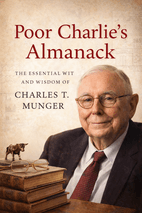
Poor Charlies Almanack by Charles T. Munger Book Cover

5 Main Takeaways from Poor Charlies Almanack

Build a multidisciplinary latticework of mental models for clear thinking

Munger argues that wisdom doesn't come from specializing in one field, but from mastering the big ideas from many disciplines—like psychology, economics, and hard sciences—and weaving them into a 'latticework' to evaluate reality. This approach, the core of his 'worldly wisdom,' allows you to see what specialists miss and avoid the 'man-with-a-hammer' tendency of seeing every problem as a nail.

Invert problems and prepare your mind to act on rare, great opportunities

Success isn't about constant action, but about extreme patience and rigorous preparation. Like a batter waiting for the perfect pitch, you must cultivate the discipline to say 'no' to mediocre options, use mental checklists to avoid errors, and then 'swing hard' with decisive conviction when a rare, excellent opportunity finally arises.

Ruthlessly manage psychological biases, especially incentive-caused bias

Your judgment is constantly warped by subconscious psychological tendencies, most powerfully by the desire for rewards. Understanding these tendencies—like social proof, deprivation-superreaction, and envy—creates a checklist for diagnosing folly. Crucially, you must design systems (for yourself and organizations) with strong anti-gaming features to counteract the corrupting power of misaligned incentives.

Embody integrity and intellectual humility as non-negotiable virtues

Munger's life demonstrates that principles like thrift, honesty, and a relentless 'I don't know' are not just moral ideals but practical necessities for long-term success. This ethos of stewardship and rational humility protects against catastrophic errors, builds enduring trust in partnerships, and is the foundation for effective philanthropy aimed at systemic change.

Avoid febezzlement by choosing simplicity and long-term concentration

Complexity and excessive activity are often just costly disguises for 'febezzlement'—the functional equivalent of embezzlement through layers of fees and frenetic trading. The antidote is a simple, long-term strategy: own a few wonderful businesses forever, avoid unnecessary costs, and let compounding work, rather than chasing the false wisdom of extreme diversification and professional intermediation.

Executive Analysis

The five core takeaways form a cohesive thesis: that a fulfilled and successful life is built on a foundation of multidisciplinary wisdom, rigorously applied through a prepared and disciplined mind. This mental 'latticework' is the essential tool for recognizing rare opportunities, while a deep understanding of psychology and incentives provides the defensive armor against systemic and self-inflicted error. Together, they create a system for rational decision-making that transcends investing and applies to business, philanthropy, and personal conduct.

This book matters because it offers a complete, actionable operating system for the mind, distilling a lifetime of proven success into fundamental principles. It stands apart in the fields of investing and self-improvement by rejecting siloed expertise, instead championing the synthesis of timeless ideas from across the spectrum of human knowledge to navigate an inherently complex world with clarity and integrity.

Chapter-by-Chapter Key Takeaways

Foreword by John B. Collison (Foreword)

  • "Poor Charlie's Almanack" is a transformative work that challenges conventional financial wisdom through multidisciplinary insights.

  • Charlie Munger's personal character, his curiosity, integrity, and intellectual stamina, mirrors the principles espoused in his writings.

  • The book serves as a lifelong guide for decision-making, applicable beyond investing to everyday life and business.

  • Collison encourages readers to approach the almanac with an open mind, promising that its lessons will compound in value over time.

Try this: Treat this book not as a one-time read, but as a manual for building a lifelong compounding engine of wisdom, where repeated study reveals deeper layers of applicable insight.

Foreword by Warren E. Buffett (Foreword)

  • Partnership as a Cornerstone: The chapter underscores the immense value of a complementary, trusting, and intellectually honest partnership, as exemplified by Buffett and Munger's decades-long collaboration.

  • Living Principles: Munger is portrayed not just as a proponent of virtues like thrift and compounding, but as someone who rigorously embodies them, making his life a testament to his beliefs.

  • Humility and Mutual Respect: Despite their success, both men display deep humility—Buffett through his gratitude and Munger through his modest assessment of his own role.

  • Enduring Legacy: The dialogue hints at the enduring strength of Berkshire Hathaway's culture and businesses, suggesting stability even as leadership eventually changes.

Try this: Model successful partnerships on complementary skills and deep intellectual honesty, and strive to make your life a direct reflection of the core virtues—like thrift and integrity—you claim to value.

Introduction by Peter D. Kaufman (Introduction)

  • Charlie Munger’s multidisciplinary approach is a powerful, timeless system for clear thinking based on fundamental principles from many fields.

  • His teachings are delivered with unique rhetorical flair, blending deep knowledge, humor, storytelling, and practical wisdom.

  • The book is structured to provide a full portrait of Munger, culminating in his own words across eleven key speeches.

  • Munger intentionally uses repetition and real-world case studies, aiming to build a "latticework" of knowledge that readers can recall and apply.

Try this: Begin constructing your own latticework of mental models by actively studying the fundamental principles of the major academic disciplines, not just your own field.

A Portrait of Charles T. Munger (Chapter 1)

  • Munger’s philanthropy is a direct application of his rational, model-based thinking to society’s greatest challenges.

  • He strategically focuses on leverage points in population ethics, environmental quality, and education to create lasting, systemic change.

  • His ultimate motivation is stewardship, viewing his legacy as the improved world he helps build for future generations.

Try this: Apply rational, model-based thinking to your giving by strategically targeting high-leverage systemic problems, not just symptoms, to create lasting change.

Remembering: The Children on Charlie (Chapter 2)

  • Principles Over Convenience: Ethical behavior is defined by unwavering adherence to core principles like fairness and responsibility, even in trivial or unseen circumstances.

  • Teaching Through Narrative: Complex lessons on ethics, consequences, and critical thinking are effectively embedded in memorable stories and real-world examples.

  • Discipline as Foundation: Personal responsibility and the discipline to complete tasks thoroughly are non-negotiable virtues, often taught through direct, sometimes tough, experience.

  • The Competitive Edge of Focus: Extraordinary success is fueled by the ability to concentrate deeply and consistently on essential tasks, ignoring distractions.

  • Cultivating Independence: A contrarian, skeptical mindset is a vital tool for navigating societal pressures and maintaining intellectual balance.

  • The Depth of Indirect Influence: Lasting paternal influence is often exercised not through lectures, but through subtle messages, modeled behavior, shared rituals, and a powerful, consistent presence.

Try this: Teach critical principles—especially ethics and independent thought—through compelling stories and consistent example, not lectures, to ensure the lessons endure.

The Munger Approach to Life, Learning, and Decision-Making (Chapter 3)

  • True wisdom begins with intellectual humility: knowing the boundaries of your knowledge is more critical than the knowledge itself.

  • Investment success is a synthesis of extreme patience (waiting for the right pitch) and decisive conviction (swinging hard when it comes).

  • The ultimate goal is not to trade frequently, but to make a few, well-prepared decisions to acquire wonderful businesses you never intend to sell.

  • The entire system—mental models, checklists, discipline—serves one end: to prepare the mind so it can recognize and act on rare moments of exceptional opportunity.

Try this: Develop the extreme patience to wait for a few exceptional opportunities and the prepared conviction to act decisively, rather than seeking constant activity.

Eleven Talks (Chapter 4)

  • Cultivate the judgment to know when to trust experts and when to override them due to obvious biases like self-interest.

  • Have the integrity to say "I don’t know" when you lack competence; avoid being the "incoherent bee" that gums up the works.

  • Recognize that many professional systems, like law, are shaped by perverse incentives that reward dealing with difficult, defective people.

  • Powerful, lasting teaching often works best through indirection, allowing the learner to reach the conclusion themselves.

  • To persuade effectively, especially in tough situations, often the most reliable lever is an appeal to the other person’s self-interest.

  • Institutions and individuals continuously adapt to legal and liability landscapes, sometimes in extreme ways.

  • Simple, harsh, no-fault rules can sometimes create better systemic outcomes than complex searches for perfect individual justice.

  • The modern education system is deeply flawed due to disciplinary silos, a lack of multidisciplinary integration, and perverse incentives that repel the broadest thinkers from certain fields.

  • The most practical wisdom is often elementary academic wisdom, but it must be applied in a multidisciplinary fashion, transcending the artificial boundaries of university departments.

  • Effective problem-solving requires a toolkit of simple, powerful mental models: simplifying with big decisions, thinking numerically, inverting problems, avoiding professional bias, and combining factors to create outsized effects.

  • Human psychology—particularly conditioned reflexes—is a fundamental driver of consumer behavior and business success, explaining the power of brands and advertising.

  • The quest for integrated, worldly wisdom is not merely a path to financial success but a fundamental component of a more effective, enriched, and enjoyable life.

  • Sustainable business success requires actively avoiding key psychological and operational pitfalls, such as triggering consumer deprivation reactions or diluting hard-won brand equity.

  • The monumental success of a company like Coca-Cola can be reverse-engineered using fundamental, multidisciplinary principles, yet this often remains beyond the grasp of specialized professionals and academics.

  • A major flaw in modern education is the failure to synthesize knowledge, both within disciplines (like psychology) and, especially, across disciplinary boundaries.

  • Poor professional judgment often stems from deep-seated cognitive tendencies like incentive-caused bias and the man-with-a-hammer effect, which a multidisciplinary mental toolkit can help mitigate.

  • The model for effective multidisciplinary education already exists in high-stakes, performance-based training fields (like aviation and surgery), where optimal learning structures are necessity. The challenge is applying these proven models to broader professional education.

  • Reflections on Talk Five

  • The speaker wraps up his case for multidisciplinary learning by pointing to the stubborn persistence of unidisciplinary thinking in soft-science fields, attributing it largely to perverse institutional incentives. He invokes Dr. Samuel Johnson’s sharp verdict—that clinging to removable ignorance is an act of “treachery”—to underscore that change is possible if incentives are realigned. Embracing a broader intellectual toolkit, he insists, yields not only greater worldly success but also deeper satisfaction, creating a mindset so valuable that abandoning it would be like “cutting off one’s hands.” Looking back in 2006, he confirms that he wouldn’t alter a single word of this talk, whimsically comparing himself to his ancestor Reverend Theodore Munger, who republished his sermons unchanged simply because wear and tear demanded new printing plates.

  • Scrutinizing Foundation Investment Costs

  • Shifting to a 1998 address to foundation financial officers, Charlie Munger playfully skewers the increasingly convoluted investment strategies adopted by major charitable foundations. He notes a worrying trend where institutions, taking cues from places like Yale, morph into elaborate “fund of funds” reminiscent of Bernie Cornfeld’s disgraced model. This complexity introduces multiple layers of intermediaries—consultants who pick investment counselors, who in turn lean on high-priced security analysts from investment banks—all driving up hidden expenses. Munger estimates that total annual costs, including management fees and trading frictions, can easily consume 3% of a foundation’s net worth. With simple arithmetic, he sounds a cautionary note: if real market returns revert to a historical norm of, say, 5%, after subtracting these costs and typical payout rates, foundations could actually shrink by 3% each year. This unavoidable drag, he stresses, is a collective burden borne by all investors who opt for such costly, active management.

  • Overconfidence, often amplified by complex "professional" procedures, is a primary cause of major investment failures, even among the very intelligent.

  • For most foundations, the wisest investment choices are low-cost indexing or a concentrated, long-term, passive portfolio in a few excellent companies.

  • Orthodox advice for extreme diversification is "grossly mistaken"; substantial concentration can be a rational and superior long-term strategy.

  • "Febezzlement" describes the widespread, wasteful drain of capital through unnecessary investment costs, a process that mimics embezzlement and distorts economic activity by disguising spending fueled by market gains.

  • Investor Behavior Hurts Returns: The gap between fund performance and investor returns is immense, driven largely by the costly folly of constantly chasing past performance and changing managers.

  • Markets Can Be Irrationally Collective: Stock prices in aggregate can detach from fundamental value, driven by speculative mania similar to collectibles, creating systemic macroeconomic risks.

  • Accounting Rules Enable Corruption: The specific accounting treatment for employee stock options (not expensing them) is identified as a fundamental, corrupting flaw that creates "phony earnings" and incentivizes managerial malfeasance.

  • Moral Decay is Gradual: The Quant Tech parable illustrates how a once-principled company can be gradually corrupted through a deliberate, slow-motion strategy of exploiting accounting loopholes, prioritizing reported numbers over economic reality.

  • The Mechanics and Collapse of a Fraud

  • The scheme at Quant Tech succeeded brilliantly for a time. Reported earnings grew at a steady 28% annually, a figure certified by accountants and made credible by the company's massive—and growing—stockpile of cash equivalents, a result of its no-dividend policy. This cash hoard acted as a powerful psychological prop, preventing investors from questioning the phantom earnings. To further obscure the fraud and accelerate cash accumulation, officers began issuing new shares through stock option exercises without offsetting repurchases. This introduced a Ponzi-like element, providing real benefits to current shareholders while making the fraudulent reporting even harder to detect. They also cleverly disguised anomalously low tax rates by arranging with foreign governments to inflate design fees, with the increases being paid back as taxes.

  • By 2002, the illusion peaked: $16 billion in earnings on $47 billion in revenue, backed by an astounding $85 billion in cash, leading to a $1.4 trillion market valuation. The inevitable unraveling came in 2003 when real growth slowed to 4%. The resulting shareholder disappointment triggered a 50% stock drop, which then prompted a forensic examination of the books. The massive, long-running fraud was exposed, causing the stock to collapse by 90% from its peak, erasing $1.3 trillion in market value and causing widespread suffering.

  • The scandal provoked a fierce public and political backlash that extended far beyond Quant Tech. Hatred fell upon corporations with similar cultures, the accounting profession (mockingly renaming FASB as “Financial Accounts Still Bogus”), economists for failing to warn of the dangers, and lawyers for their role in crafting disclosures. This revulsion even created unfair "rub-off" effects on blameless professionals like engineers. The economic fallout mirrored Japan's 1990s recession. In a satirical divine judgment, the ultimate blame is placed not on analysts, politicians, or even the corrupt officers, but on the "traitorous" senior accounting partners who willingly adopted and perpetuated the unsound accounting rules for stock options that made the fraud possible.

  • A Multidisciplinary Critique of Academic Economics

  • The narrative then shifts to Charlie Munger’s critique of academic economics, framing it as a "Grand Unified Theory" of his approach. He opens with self-deprecating humor about his lack of formal economics training, crediting his insights to his experiences at Berkshire Hathaway and his innate multidisciplinary mindset.

  • He uses Berkshire’s long-term success, achieved while ignoring mainstream economic theories like the hard-form efficient-market hypothesis and the capital asset pricing model, as evidence of flaws in academic orthodoxy. He recounts how a Nobel laureate economist first dismissed Berkshire’s results as extreme luck before finally conceding they must be skill, a change Munger attributes to Franklin’s adage about appealing to interest over reason.

  • Munger credits his effectiveness to an early adoption of the "fundamental full attribution ethos" of hard science, which demands explaining things in the most fundamental way possible by drawing openly on core ideas from all relevant disciplines. He praises economics for being relatively more multidisciplinary than other soft sciences—citing Gregory Mankiw’s textbook incorporation of concepts like opportunity cost, incentives, and Garrett Hardin’s "tragedy of the commons"—and for attracting brilliant minds and writers like Adam Smith. However, he contends this interdisciplinary reach is still insufficient and that the field’s past dogmas have often been divorced from observable reality.

  • Financial fraud can be sustained for long periods through complex engineering, using elements like massive cash reserves and Ponzi-like share issuance to create a convincing, yet false, picture of health.

  • The collapse of such frauds has devastating, wide-ranging consequences, eroding trust in entire professions and causing significant economic harm that extends beyond investors.

  • Charlie Munger advocates for a rigorous multidisciplinary approach to understanding the world, borrowing the "full attribution" ethos from hard sciences.

  • He critiques academic economics for historical insularity and dogmatic adherence to flawed models (like perfect market efficiency), while acknowledging its strengths relative to other soft sciences.

  • Real-world results, like Berkshire Hathaway’s long-term performance, can serve as a practical check against theoretical academic constructs.

  • True, practical wisdom requires the synthesis of multiple disciplines, particularly psychology, into economic thinking.

  • Failing to consider second and third-order effects leads to catastrophic miscalculations in policy (Medicare) and business (textile looms).

  • All human systems are inevitably gamed; good design anticipates and minimizes perverse incentives.

  • "Febezzlement"—the functional equivalent of embezzlement—is a pervasive and powerful economic force, exemplified by parts of the money management industry.

  • Virtue (reliability, honesty) and vice (fraud, envy) are not mere moral concerns but fundamental drivers of economic outcomes, though they are often ignored by the discipline.

  • A certain amount of paradox and uncertainty is irreducible in complex systems like economics.

  • The ability to destroy your own outdated ideas is a supreme intellectual virtue.

  • A fluent, multidisciplinary mental model is essential for effectively navigating complex worlds, from economics to personal life.

  • Lifelong learning and the continuous acquisition of wisdom are moral duties and the primary engines of long-term success.

  • Critical life strategies include inverting problems to solve them, rigorously avoiding intense ideology, and rooting out self-serving bias and self-pity.

  • While powerful, multidisciplinary insight must often be wielded with social caution to avoid giving offense.

  • The power of incentives to shape cognition and behavior is far greater than most people appreciate.

  • A major pitfall is incentive-caused bias, where the desire for rewards leads good people to rationalize bad behavior.

  • Over-relying on incentives as the sole explanatory tool leads to the "man-with-a-hammer" cognitive error, blinding one to other important factors.

  • Society has developed essential, if mundane, antidotes to these forces, such as the cash register and sound accounting systems, which are moral achievements in their own right.

  • Standard psychology education has historically failed to properly highlight these obvious yet critical real-world phenomena.

  • System Design is Crucial: Incentive-caused bias is universal, making the design of systems—with strong anti-gaming features and rewards for genuine achievement—a critical task for maintaining morality and efficiency.

  • Power of Conditioning: The liking/loving and disliking/hating tendencies are profound conditioning devices that unconsciously shape our perception, making us blind to the faults of what we love and the virtues of what we hate.

  • Cognitive Rigidity: The brain's doubt-avoidance and inconsistency-avoidance tendencies promote quick, rigid thinking. Wisdom requires actively countering these instincts through forced deliberation, exposure to opposing views, and habits, like Darwin's, that seek disconfirming evidence.

  • Behavior Can Shape Belief: The inconsistency-avoidance tendency means that our actions and commitments powerfully shape our subsequent beliefs and identity, for good or ill.

  • Foundational Human Drives: Curiosity and an innate sense of Kantian fairness are powerful, positive psychological forces that, when cultivated, drive progress and social cohesion.

  • Envy/Jealousy is a potent and under-discussed force in human behavior, often more powerful than greed in motivating action.

  • Reciprocation Tendency is a subconscious, automatic driver that underpins social cooperation but is a major vulnerability that can be and is systematically exploited.

  • Judgment is easily corrupted by mere association with past success, loved ones, disliked parties, or stereotypes. Vigilance and deliberate habit-formation (like welcoming bad news) are necessary antidotes.

  • Psychological Denial is a basic, often understandable defense mechanism against unbearable pain, but it can prevent necessary engagement with reality.

  • Excessive Self-Regard is a default state that leads to overvaluation of our own choices and tribe, demanding conscious effort toward objectivity and institutional safeguards to counteract its corrosive effects on hiring and group integrity.

  • Overoptimism is a common cognitive error, making us believe what we wish; it must be countered with the disciplined application of probability and rational risk assessment.

  • Deprival-Superreaction causes disproportionately painful responses to losses and near-wins, a major source of irrationality in investing, gambling, business, and conflict.

  • Social Proof powerfully shapes behavior, especially under stress, leading to both constructive conformity and dangerous herd behavior or bystander apathy; societies must actively curtail bad examples and promote good ones.

  • The Lollapalooza Effect—the compounding of multiple psychological tendencies—is a crucial concept for explaining extreme real-world outcomes, yet was historically neglected by academic psychology.

  • Psychological tendencies form a practical checklist for diagnosing systemic failures, as demonstrated by the McDonnell Douglas evacuation disaster.

  • Knowledge of these tendencies is profoundly useful for improving decisions, designing wiser systems, and avoiding folly, even if the framework is imperfect and the tendencies themselves are innate.

  • The utility of this knowledge carries a moral burden; it can be used for manipulation, but its highest purpose is to foster wisdom and prevent harm.

  • The story of Judith Rich Harris serves as a testament to independent, impertinent thought overcoming institutional blindness to generate practical, world-changing insights.

  • Systems and quality control, as championed by Deming, are often undervalued until their competitive advantages become undeniable.

  • Understanding foundational behavioral science (Pavlov, Skinner, Milgram) provides critical lenses for interpreting both individual and market actions.

  • Investment and business success is built on principles like Graham’s value investing, relentless execution (Walton, Hershey), and unwavering ethical accountability.

  • Breakthroughs, from Gillette’s razor to Planck’s quantum theory, often stem from looking at old problems in new ways.

  • True wisdom is multidisciplinary, requiring the synthesis of models from history, philosophy, psychology, and the hard sciences to navigate complex realities effectively.

  • Philanthropy's Spectrum: Effective giving, exemplified by Woodruff, requires the same strategic acumen as business, while history is littered with financial predators like Cornfeld and Ponzi.

  • Economic Models Have Limits: The theories of Keynes, Ricardo, and Smith are powerful tools, but real-world complexities—highlighted by Galbraith, Hardin, and the fall of Long-Term Capital—demand interdisciplinary wisdom and a respect for systemic risk.

  • Core Principles are Universal: Ricardo's comparative advantage applies to management; Gödel's incompleteness applies to financial systems; Smith's specialization drives progress. Understanding these mental models across fields is critical.

  • Human Nature is a Constant: Financial manias, self-serving biases, and ethical failures are perennial. Guarding against them requires an understanding of history, psychology, and a personal ethic grounded in virtues like humility, filial duty, and intellectual honesty.

  • The chapter concludes not with more wisdom from Charlie Munger, but with a testament to the wisdom that informed him and the community that brought his story to life. This final portion presents the extensive bibliography referenced throughout "Eleven Talks," followed by warm acknowledgments from the production team.

  • The listed works, from Dawkins’ The Selfish Gene to Diamond’s Guns, Germs, and Steel and Grove’s Only the Paranoid Survive, provide a concrete map of the multidisciplinary latticework Munger advocates. Seeing them compiled reinforces the sheer breadth of intellectual raw material he synthesizes.

  • The acknowledgments reveal the book’s origin as a response to persistent popular demand, encouraged by Warren Buffett himself. Editor Peter Kaufman and a dedicated team, including illustrator Ed Wexler, are credited for their work in surveying Munger’s approach. The closing sentiment expresses a hopeful wish that readers find as much enjoyment in the book as the team found in its creation, emphasizing the smooth and favorable collaboration with Charlie and his associates. It ends on a note of respectful tribute, hoping their efforts are worthy of their subject—"a good and admirable man."

  • The chapter’s bibliography provides a tangible reference for building one’s own multidisciplinary mental models, mirroring Munger’s lifelong learning habits.

  • The book Poor Charlie’s Almanack was born from widespread interest and was produced through a collaborative, respectful effort by a devoted team.

  • The project is framed not as an exposition, but as a tribute to a deeply respected figure, completed with gratitude and a desire to honor his legacy.

Try this: Create a personal checklist based on key psychological tendencies (like incentive bias and social proof) and multidisciplinary models to audit your decisions and avoid common cognitive traps.

Continue Exploring