Peak Performance Quotes
by Brad Stulberg
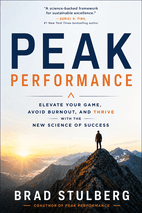
You will find quotes that cut through the noise about what it really takes to perform at your best. These are not about grinding yourself into the ground. Instead, they mix hard truth with practical wisdom.
The book pulls from sports, business, and science to show that peak performance is about more than effort. It is about knowing when to push and when to pull back. That makes it endlessly quotable. Each line feels like a shortcut to a deeper understanding of how we grow, rest, and thrive. These quotes come from real stories of athletes, artists, and executives, making them feel earned and genuine.
Top Quotes from Peak Performance
“He had the rage to master: an unending, unrelenting resolve to do everything he could to reach his goals.”
Describing the young runner Steve's obsessive drive.
It succinctly captures the intense, single-minded determination that fuels early success, while hinting at the unsustainable nature of such obsession.
“The key to strengthening your biceps—and, as we'll learn, any muscle, be it physical, cognitive, or emotional— is balancing the right amount of stress with the right amount of rest.”
The author introduces the core growth equation that applies to all types of performance.
It succinctly captures the book's central principle, making it both memorable and broadly applicable to any area of improvement.
“Growth comes at the point of resistance; we learn by pushing ourselves to the outer reaches of our abilities.”
Josh Waitzkin, international chess prodigy turned martial arts world champion, reflecting on his development as an elite performer.
This succinctly captures the core theme of productive struggle that runs throughout the chapter, motivating readers to embrace difficulty as a path to growth.
“The authors of these studies summarized their findings in a simple yet elegant statement: Skills come from struggle.”
Summarizing research on middle school and high school math classes where students who struggled before receiving help outperformed those who got immediate assistance.
It provides a memorable, evidence-based takeaway that challenges the common impulse for instant answers and reinforces the value of effortful learning.
“Practice doesn’t make perfect. Perfect practice makes perfect.”
Concluding Ericsson's findings on deliberate practice.
This pithy twist on a common saying encapsulates the chapter's core message that quality of practice matters more than quantity.
“Perhaps the adage that hard work separates the best from the rest only explains part of the picture. The best rest harder, too.”
After presenting data on elite athletes' faster recovery, the authors draw a conclusion about excellence.
This pithy reversal challenges the cultural obsession with relentless effort, highlighting that true high performers prioritize recovery.
“I've done all this work beforehand, but in the moment, I try to get to this sweet spot where I'm not thinking about what I'm doing. I know I've arrived when my mind and body are in perfect sync—it feels effortless, like my performance is just flowing out of me.”
Drummer Matt Billingslea describes the 'zone' he achieves through his pre-show warmup routine.
This line articulates the ideal state of effortless performance that many strive for, making it relatable and aspirational for readers in any field.
Themes Behind the Quotes
A central theme is that sustainable growth comes from the right balance of challenge and recovery. Pushing hard is necessary but only effective when paired with deliberate rest. Many quotes highlight that skills and strength are built during the struggle, not after it. Another major theme is the danger of overwork and the value of downtime. The best performers prioritize rest just as much as effort. They understand that burnout is a real threat. A third theme revolves around the power of consistency and the importance of getting into a state of flow where action feels effortless. Consistency also helps reduce fear and uncertainty. The quotes further suggest that our most creative insights often come when we are not actively trying, during moments of recovery or wandering. Together these ideas form a modern blueprint for high achievement that is both sustainable and human.
Quotes by Chapter
Foreword: Is Healthy, Sustainable Peak Performance Possible?
“If he wasn't losing sleep because he was working, he was losing sleep because he was anxious that he wasn't working.”
Describing the young consultant Brad's stress during a high-stakes project.
This line vividly illustrates the vicious cycle of overwork and anxiety that leads to burnout, making it deeply relatable to anyone who has pushed too hard.
“Both runner and consultant shined extremely bright, only to see their performance plateau, their health suffer, and their satisfaction wane.”
The authors reveal the common fate of the two individuals after their initial successes.
It clearly states the core problem the book addresses: that peak performance often comes at an unsustainable cost, setting up the need for a better approach.
“What we can guarantee, however, is that reading this book will help you nurture your nature so that you can maximize your potential in a healthy and sustainable way.”
The closing promise of the foreword from the authors to the reader.
It offers a hopeful and actionable takeaway, reframing success as something achievable without sacrificing well-being, which resonates with today's performance culture.
Introduction: Great Expectations
“Doctors and scientists said that breaking the 4-minute barrier was impossible, that one would die in the attempt. Thus, when I got up from the track after collapsing at the finish line, I figured I was dead.”
Sir Roger Bannister after becoming the first person to run a mile in under 4 minutes in 1954.
This quote captures the dramatic shift in what humans believe is possible and the triumphant defiance of perceived limits. It reminds readers that many current ceilings will eventually be broken.
“The primitive forms of artificial intelligence we already have proved very useful. But I think the development of full artificial intelligence could spell the end of the human race.”
Physicist Stephen Hawking warning about the potential dangers of advanced AI in a BBC interview.
This stark warning from a renowned thinker underscores the existential stakes of human performance and the urgency to improve. It frames the competitive pressure from machines as a profound, real-world challenge.
“We live in a world where all exceptional performances are suspect.”
Michael Joyner, MD, an expert on human performance at the Mayo Clinic, commenting on the doping crisis.
This succinct line captures the tragic erosion of trust in achievement, forcing readers to question the integrity of greatness. It resonates powerfully in an era of performance-enhancing drug scandals.
“This isn’t the workplace of 10 years ago. There's a lot of pressure. And it's competitive in the sense that anyone in the world could take your job for less money, so you have to work harder.”
Dan Schawbel, a human resource expert and author, describing the modern globalized work environment.
This quote vividly articulates the anxiety of global competition and the relentless pressure workers face. It makes the book's central problem feel immediate and personal for any professional.
1: The Secret to Sustainable Success
“During a workout you're breaking down soft tissue and really stressing your body. How you treat yourself in between workouts is where you make gains and acquire the strength to attack the next one.”
Deena Kastor explains her philosophy on recovery in an interview with Competitor magazine.
This counterintuitive insight highlights that true growth happens during rest, not just during effort, challenging the common 'no pain, no gain' mindset.
“Rather, they were systematically alternating between bouts of very intense work and periods of easy training and recovery, even if that meant walking up hills.”
The author describes Stephen Seiler's findings on the training patterns of world-class endurance athletes.
It reveals that elite performers prioritize structured recovery over constant intensity, offering a practical model for sustainable excellence.
“The manner in which great intellectual and creative performers continually grow their minds mirrors the manner in which great physical performers continually grow their bodies.”
The author draws a parallel between the growth processes of creative geniuses and athletes.
This bridge between mental and physical domains reinforces the universality of the stress-plus-rest formula, making it relevant to all readers.
2: Rethinking Stress
“Being uncomfortable is the path to personal development and growth. It is the opposite of complacency.”
Big-wave surfer Nic Lamb explaining how he prepares himself to face the strongest swells by seeking discomfort.
This directly inspires readers to step outside their comfort zones and reframes discomfort not as a negative but as an essential catalyst for improvement.
“Stress can be positive, triggering desirable adaptations in the body; or stress can be negative, causing grave damage and harm. The effects of stress depend almost entirely on the dose.”
The chapter's central paradox about stress, building on Hans Selye's foundational work and modern understanding of adaptive responses.
It clarifies that stress is not inherently bad, empowering readers to seek the right amount of tension for growth while avoiding the dangers of chronic overload.
3: Stress Yourself
“Or 99 percent of us,! effective multitasking is nothing more than effective delusional thinking.”
The authors debunking the appeal of multitasking.
The blunt, memorable phrasing challenges readers to confront a common self-deception about productivity.
“The mere sight of a desirable object triggers dopamine, which is like the devil on our shoulder that says, “Are you sure you don't want to have just one?””
Explaining why willpower fails when temptations are visible.
This vivid analogy makes the neuroscience of craving relatable and underscores the importance of removing distractions.
“Alternating between blocks of 50 to 90 minutes of intense work and recovery breaks of 7 to 20 minutes enables people to sustain the physical, cognitive, and emotional energy required for peak performance.”
From the chapter's discussion on optimal work-rest ratios to sustain peak performance.
Provides a clear, actionable guideline that counters the common grind mentality and empowers readers to structure their work for sustainable high output.
4: The Paradox of Rest
“Without rest, Google wouldn't end up with innovation. Instead, it'd end up with a workforce that is broken down and burnt out.”
The authors discuss Google's culture of intense work and the necessity of rest.
This line encapsulates the core paradox of the chapter: rest is not an obstacle to innovation but a prerequisite for it.
“Burnout is undoubtedly one of Google's gravest threats, and holding back passionate employees is often a far more formidable challenge than pushing them ahead.”
The authors describe the difficulty of managing highly driven workers at Google.
It reframes the problem of overwork, showing that restraining enthusiasm is harder than motivating it, which resonates with anyone striving for balance.
“Our most profound ideas often come from the small spaces in between otherwise deliberate thinking: when our brains are at rest.”
The authors explore how creativity emerges during downtime, citing anecdotes from shower thoughts to walks.
It validates the common experience of sudden insights during rest and reinforces the importance of mental breaks for innovation.
5: Rest Like the Best
“We don't grow when we're in the gym or when we're immersed in our work: We grow in our sleep.”
The authors summarize the role of sleep in physical and cognitive development.
It challenges the common belief that productivity only happens during active work, reframing rest as essential for growth.
“It’s pretty poetic that feeling connected to others literally fixes a broken heart.”
Kelly McGonigal, PhD, explains the effects of oxytocin on heart repair.
The line uses a clever double meaning to make the science of social recovery both memorable and emotionally resonant.
“Those who took as brief as a 6-minute walk outdoors increased creativity by more than 60 percent versus those who had remained seated at their desks.”
The authors describe a Stanford University study on walking and creative thinking.
This startling statistic gives readers a simple, actionable takeaway: even a very short walk can dramatically boost creativity.
“As we sleep, our brains replay, process, learn, and extract meaning. In a sense, they think.”
Science writer Maria Konnikova is quoted in the sleep section.
It reframes sleep as an active, intelligent process rather than passive rest, deepening appreciation for its value.
6: Optimize Your Routine
“Consistency was another way to tamp down terror.”
Olympic marathon champion Frank Shorter wrote this in his memoir about his pre-race breakfast ritual.
It succinctly captures how reliable routines reduce anxiety and create psychological safety before high-stakes performances.