Peak Performance Key Takeaways
by Stulberg, Brad
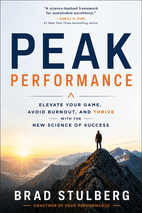
5 Main Takeaways from Peak Performance
Balance Stress and Rest for Sustainable Growth
Stress triggers adaptation, but only when paired with deliberate recovery. The book shows that alternating intense work with rest—short breaks, sleep, full days off—prevents burnout and enables peak performance.
Reframe Your Mindset to Harness Stress
Viewing stress as a challenge rather than a threat changes your hormonal response and boosts performance. Reappraising anxiety as excitement can shift your physiology toward opportunity.
Design Just-Manageable Challenges for Deep Learning
Growth happens at the edge of your ability. Seek tasks slightly beyond your current skill level, allow yourself to struggle productively, and resist early help to build lasting skills via myelin.
Prioritize Sleep and Active Rest as Performance Tools
Sleep is the primary driver of physical adaptation and cognitive function. Even short naps and deliberate off-days enhance speed, accuracy, and recovery—rest is not a reward but a prerequisite.
Anchor Your Effort to a Self-Transcending Purpose
Purpose fuels grit and protects against burnout. Define your core values, write a concise purpose statement, and revisit it when motivation wanes; giving back rejuvenates your drive.
Executive Analysis
These five takeaways form a coherent thesis: peak performance is not about pushing harder endlessly but about intelligent oscillation between stress and recovery, combined with mindset shifts and purpose. The book argues that sustainable success requires managing stress dose, embracing deliberate rest, and connecting effort to something larger than self.
This book matters because it synthesizes research from sports, cognitive science, and business into actionable practices. It stands out in the performance genre by emphasizing health and longevity over short-term gains, offering a blueprint for high achievers who want to avoid burnout.
Chapter-by-Chapter Key Takeaways
Is Healthy, Sustainable Peak Performance Possible? (Foreword)
Early, extreme success often masks unsustainable habits that lead to burnout.
Obsessive focus on peak performance can sacrifice health, relationships, and long-term satisfaction.
The authors' personal failures drove them to investigate whether healthy, sustainable peak performance is possible.
The book's core promise: not to guarantee greatness, but to offer principles that help maximize potential in a way that doesn't destroy you.
Try this: Recognize that early success can mask unsustainable habits; audit your current routines to identify any trade-offs between performance and health, relationships, or long-term satisfaction.
Great Expectations (Introduction)
True growth often comes from looking outside your own field and borrowing wisdom from others.
Cognitive and physical development follow similar processes of stress, recovery, and adaptation.
Small environmental factors—like what you wear—can have a big impact on mental resources and focus.
Top performers frequently attribute their success to something larger than themselves; purpose is a powerful performance enhancer.
The book provides actionable “Performance Practices” to help you apply these insights to your own pursuits.
Try this: Borrow wisdom from fields outside your own to stimulate growth; apply the stress-recovery cycle from physical training to your cognitive work, and deliberately design small environmental factors to support focus.
The Secret to Sustainable Success (Chapter 1)
Identify your most important pursuits and deliberately alternate between intense, focused effort and genuine rest.
Insert short breaks throughout your day, and schedule off-days or vacations right after heavy stress periods.
Recognize that mental and physical fatigue are intertwined; exhaustion from one area impairs performance in another.
Limit the number of major challenges you take on simultaneously to avoid depleting your shared reservoir of energy.
Design your environment to support you when you're fatigued—our surroundings powerfully shape our behavior, especially when we're drained.
Try this: Identify your most important pursuits and schedule deliberate alternation between intense work and genuine rest, including short breaks and full off-days after heavy stress, while limiting simultaneous major challenges to protect your shared energy reservoir.
Rethinking Stress (Chapter 2)
Stress is a double-edged sword: In the right dose, it triggers growth and adaptation; in excess, it causes breakdown. The key is managing the dose.
Growth comes at the point of resistance: Whether in chess, surfing, or math, pushing to the edge of your ability—and sometimes failing—is how deep learning happens.
System 2 effort builds lasting skills: Struggling through a challenge strengthens neural connections via myelin, turning hard tasks into effortless ones over time.
Design just-manageable challenges: Seek activities that are slightly beyond your current skill level, but not so far that you become anxious. Use internal and external factors to calibrate the difficulty.
Resist the urge for early help: Let yourself fail productively before seeking support. That's where the real learning lives.
Try this: Seek just-manageable challenges that push you to the edge of your ability; resist the urge to ask for help immediately, allowing yourself to fail productively so that deep learning and myelin build up.
Stress Yourself (Chapter 3)
Alternate intense work blocks (50–90 minutes) with short breaks (7–20 minutes) to sustain peak performance and avoid burnout.
Your mindset about stress literally changes your hormonal response — viewing stress as a challenge boosts the growth index (DHEA vs. cortisol).
Cultivate a growth mindset: believe skills come from struggle, not fixed talent. It can be learned and reshaped.
When you feel pre-performance anxiety, reappraise it as excitement — it shifts your physiology toward opportunity rather than threat.
Deep focus is a skill; start small if needed and build up gradually.
Try this: Alternate focused work blocks of 50-90 minutes with breaks of 7-20 minutes; when pre-performance anxiety strikes, reappraise it as excitement and cultivate a growth mindset by reminding yourself that skills come from struggle.
The Paradox of Rest (Chapter 4)
When stuck on a mental task, step away for at least 5 minutes (or longer for draining work).
During breaks, choose low-effort activities (e.g., walking, showering, listening to music) to let the subconscious roam.
Physical rest is equally vital: Bannister’s record came after a deliberate period of reduced training.
Reframe rest as an active “supporting session” rather than passive downtime—this mental shift makes rest easier to prioritize.
True growth occurs when stress is balanced with deliberate recovery; rest is not a reward but a prerequisite for performance.
Try this: When mentally stuck, step away for at least five minutes and engage in a low-effort activity like walking or showering to let your subconscious roam; reframe rest as an active supporting session essential for growth, not passive downtime.
Rest Like the Best (Chapter 5)
Sleep is the primary driver of physical adaptation: anabolic hormones like testosterone and HGH are released during sleep, making protein synthesis and muscle repair possible.
Stanford studies showed that adding 1 hour 50 minutes of sleep nightly dramatically improved speed, accuracy, and reaction time in elite athletes—proving that sleep is performance-enhancing.
Naps under 30 minutes boost alertness and cognitive function; longer naps risk sleep inertia. NASA data supports a 25-minute nap for improved judgment and vigilance.
Take at least one full day off per week, timed after accumulated stress. Extended breaks (7–10 days to 5 weeks) should follow major stress periods, but they only work if the underlying causes of burnout are addressed.
The biggest barrier to rest is cultural pressure—but companies like BCG found that enforced downtime improved both productivity and well-being. Resting hard is often the courageous choice.
Try this: Prioritize sleep as your primary performance enhancer—aim for at least 8 hours, incorporate 25-minute naps when needed, and schedule one full day off per week timed after accumulated stress to enable adaptation.
Optimize Your Routine (Chapter 6)
Routines can change your hormonal profile, not just your mindset.
Testosterone increases with confidence and feeling good—not just with physical effort.
The best routines are personalized; what works for one person may flop for another.
Biological priming (via hormones) enhances actual performance, not just readiness.
Try this: Personalize your pre-performance routine to boost confidence and hormonal profile; experiment with actions that make you feel good and powerful, as biological priming enhances actual performance.
Minimalist to Be a Maximalist (Chapter 7)
Surround yourself with a “village” of motivated, supportive people—negativity and apathy are contagious and destructive.
Consistency beats inspiration. Showing up and doing the work every day is the single most important skill.
Routines are just scaffolding for showing up; the real power is in sticking to them through mental and physical discipline.
When motivation wanes, great performers anchor their effort to something larger than themselves, not to fleeting personal feelings.
Try this: Surround yourself with a motivated, supportive community and commit to consistency over inspiration; when motivation wanes, anchor your effort to a purpose larger than yourself rather than fleeting feelings.
Transcend Your“self” (Chapter 8)
Motivation matters as much as training. You can improve performance by increasing motivation, especially through a self-transcending purpose.
Purpose fuels grit. When the going gets tough, a cause bigger than yourself helps you persevere.
Give back to beat burnout. Instead of stepping away, find ways to help others in your field. It rejuvenates motivation and reconnects you to why you started.
Your purpose already exists inside you. Use your core values to uncover it. Then return to it whenever you feel discouraged or exhausted.
Try this: Increase your motivation by identifying a self-transcending purpose—helping others in your field can rejuvenate your drive and protect against burnout, so find ways to give back even when you feel depleted.
Develop Your Purpose (Chapter 9)
Purpose is not mystical or religious; it’s a rational reflection of your core values.
The four-step process (select, personalize, rank, write) takes about 20 minutes and creates a concise purpose statement.
Use visual cues, self-talk, and nightly reflection to integrate your purpose into daily life with minimal effort.
Living on purpose—not just thinking about it—unlocks the biggest performance and well-being gains.
Try this: Develop your purpose in 20 minutes by selecting, personalizing, ranking, and writing your core values; use visual cues and nightly reflection to integrate that purpose into daily life, unlocking performance gains.
Conclusion (Conclusion)
Peak performance is not purely individual; it relies on a support system that amplifies focus and efficiency.
The book’s foundation is built on a wide-ranging body of peer-reviewed research, not just anecdote or opinion.
Expressing gratitude and recognizing contributions is part of sustaining long-term creative and professional output.
Even intense, accelerated projects benefit from clear roles, rapid feedback loops, and unwavering trust among collaborators.
Try this: Build a support system that amplifies your focus and efficiency; express gratitude and ensure clear roles, rapid feedback, and trust among collaborators to sustain long-term creative and professional output.
Continue Exploring
- Read the full chapter-by-chapter summary →
- Best quotes from Peak Performance → (coming soon)
- Explore more book summaries →