As an Amazon Associate, we earn from qualifying purchases.
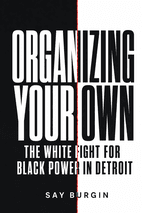
Say Burgin's Organizing Your Own: The White Fight for Black Power in Detroit challenges the myth that Black Power expelled white activists, tracing four Detroit organizations—People Against Racism, the Detroit Industrial Mission, the Ad-Hoc Action Group, and the Motor City Labor League—to show how Black Power advocates directed white supporters into "racially parallel organizing" within their own communities. For scholars, students, and organizers grappling with solidarity and accountability.
On Insta.page you also get an Apply This Book tool that lets you combine insights from up to 3 books to solve your specific situation.
Chapter mindmaps
Free preview: chapters 1–4 are fully interactive. Click any node to expand or collapse. Subscribe to unlock the rest.
Chapter 1: Half Title
Key concepts: Half Title
Half Title
The White Activist's Dilemma
Joining Black-led movements signaled solidarity but risked white self-effacement.
Organizing other white people risked recentering the struggle around white concerns.
The purpose and accountability of white antiracist work remained unsettled.
The Organizing Your Own Series
Edited by Ibram X. Kendi and Ashley D. Farmer for NYU Press.
Features local racial justice histories, including Taylor on NYC police brutality.
Includes Myers on Howard University's 1989 protest and Swan's Pasifika Black.
Also covers Jones on Tuskegee and Robinson on Black Power in the Pacific Northwest.
Burgin's Detroit Volume
Examines white organizing in Detroit through People Against Racism and other groups.
Argues white organizers should build their own base rather than join Black-led groups.
Includes an appendix of groups that organized white people and a list of abbreviations.
Published in 2024 and dedicated to Cindy and Jay Burgin.
Chapter 2: Introduction: Rethinking Black Power’s Relationship to White People
Key concepts: Introduction: Rethinking Black Power’s Relationship to White People
Introduction: Rethinking Black Power’s Relationship to White People
Black Power's Strategic Redirection
SNCC urged white activists to leave Black organizing and work in white communities.
This was not expulsion but redirection toward confronting racism among white people.
Carmichael and Hamilton's Black Power articulated this shift in 1967.
Highlander Conference and White Organizing
1969 White Organizers Conference gathered fifty activists to strategize.
People Against Racism sent eight delegates, showing strong national reach.
Frank Joyce's opening address framed the case for white organizing.
Grassroots Agency Over Published Debate
White organizing against racism predated Black Power by years.
Role of white people was settled by organizers' strategic choices on the ground.
Organizing white communities was already strong before 1969.
Chapter 3: Series Page
Key concepts: Series Page
Series Page
The White Ally's Dilemma
White supporters must find a role without speaking for Black communities
Their presence can look like control; absence leaves work undone
Solidarity requires navigating the right to participate
The Black Power Series
Edited by Ibram X. Kendi and Ashley D. Farmer at NYU Press
Includes Burgin's Organizing Your Own on Detroit's white fight
Features works on police brutality, Howard 1989, and campus movements
Two Flanks of a Movement
Black-led front built political and economic power in Black communities
White-led front built support for self-determination in white communities
Burgin calls this racially parallel organizing, a core Black Power politics
From Suggestion to Mandate
Rustin floated the idea; SNCC tested it in the 1963-64 White Folks' Project
NSM moved toward all-Black leadership under Bill Strickland in 1965
Detroit white members formed People Against Racism in September 1965
A Strategy Apart
Treated Black communities as asset-rich and prized racial unity
Imagined shared racial consciousness rather than a separate Black state
Sought change through bottom-up multiracial pressure on the state
Detroit's White Organizations
Douglass Fitch pushed Detroit Industrial Mission toward confronting white executives
Sheila Murphy built the Ad-Hoc Action Group to watchdog police violence
Motor City Labor League formed as the white parallel to the League
Racialized Ignorance and Policing
Activists treated racialized ignorance as a foundation of racial hierarchy
Ran Freedom Schools, curricula, and Robert Terry's For Whites Only
Charles Mills's epistemology of ignorance: a shared agreement to misread the world
Chapter 4: List of Abbreviations
Key concepts: List of Abbreviations
List of Abbreviations
Reexamining Black Power and White Activists
Black Power often misremembered as pushing white activists out.
Black activists asked white supporters to redirect energies, not leave.
Racially parallel organizing was a strategy, not dogma.
White activists accepted Black leadership and remained comrades.
SNCC and the Myth of White Expulsion
SNCC seen as hinge of interracialism's collapse.
No purge occurred as commonly portrayed.
Black activists set new direction for white comrades.
Many white activists took the new direction seriously.
Continued Collaboration in Detroit
Black activists asked white comrades to build white-led groups.
White activists raised consciousness among white people.
They supported Black-led actions like the 1967 People's Tribunal.
Result was different kind of shared work, not distance.
Northern Student Movement
NSM and SNCC were sister entities in early 1960s Detroit.
NSM focused on northern racism and debated white paternalism.
Bill Strickland issued 'no more white women in the ghetto' instruction.
NSM adopted Black Power language and planned 1965 Michigan Freedom Summer.
Process, Not Ideology
Shift came through years of struggle and liberal failures.
Detroit Mayor Cavanagh preferred symbols over reform.
Racially parallel organizing promised buffer for Black-led groups.
Strategy had wider uptake beyond exceptions like Anne Braden.
Detroit Before the Shift
Black Power grew from broad civil rights campaign against northern segregation.
Racial liberalism denied structural racism while offering symbols.
Urban renewal displaced over 40,000 Detroiters, mostly Black.
By mid-1960s, over 90% of police force was white.
Policing and the Road to 1967
Police acted as 'army of occupation' with routine brutality.
NAACP documented dozens of police killings from 1920s-1960s.
1960-1961 crash program and investigative arrests targeted Black men.
Mass arrest of Black veterans celebrating homecoming set off July 1967 uprising.
You've reached the end of the free mindmaps
Next chapter: “1. “To begin to work in their own communities”: Creating the Strategy of Racially Parallel Organizing” is locked
See every chapter of Organizing Your Own as an interactive mindmap — and unlock all 700+ book summaries with audio and AI Q&A.
$0.00 due today · 7 days free, then $89.99/year ($7.49/mo) · Cancel anytime before day 7