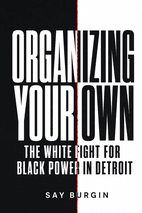
Organizing Your Own Key Takeaways
by Say Burgin
5 Main Takeaways from Organizing Your Own
Black Power Redirected White Activists, It Didn't Expel Them
Burgin shows that calls for white activists to leave Black-led organizations were usually a reallocation of work, not exclusion. White organizers were sent—or chose—to confront racism in white communities while Black groups set the terms of the struggle, as Detroit’s two-front politics and the People Against Racism delegation illustrate.
Make White Communities and Institutions the Organizing Target
The book’s test of white activism is whether it confronted white institutions and constituencies—corporate executives, suburban students, police departments—rather than merely expressing sympathy. White participation worked best when white organizers made other white people their constituency under Black direction.
Treat Racially Parallel Organizing as Strategy, Not Separatism
Racial lines protected Black-led groups, bypassed liberal gatekeepers, and broke white resistance; they were not a doctrine of exclusion. The strategy emerged from years of integrated organizing in Detroit and northern experiments like the Michigan Project, not simply from SNCC rhetoric.
Pair Political Education and Documentation With Institutional Power
Black history curricula, publications for white audiences, and Ad-Hoc’s body-camera documentation were real organizing work that cracked official denial. But evidence and education alone could not produce accountability when police unions, trial boards, prosecutors, and mayors were built to absorb complaints.
Build Trust, Services, and Base Before Claiming Solidarity
The Motor City Labor League’s newspaper and book club gave visibility but consumed cadres and substituted for a factory base. Its Huber pollution fight and unopened medical center show that shared grievances need neighborhood trust, practical services, and organizational capacity before solidarity becomes real.
Executive Analysis
Burgin’s central argument is that Black Power did not banish white activists from the freedom struggle; it reorganized them. The five takeaways cohere around a strategic chain: Black-led groups set the terms, white organizers made white constituencies and institutions the target, and racially parallel organizing protected Black leadership while confronting the structures that reproduced racism. Political education and police documentation mattered, but only when tied to institutional power and movement accountability; base-building, trust, and services kept solidarity from becoming rhetoric. Detroit’s two-front campaigns, the Ad-Hoc Action Group, and the Motor City Labor League show this as a history of strategic choices and unresolved tensions, not a purge story.
The book matters because it turns a distorted history into a mandate: white people should organize other white people against racism while following Black direction and building institutional capacity. It corrects movement memory, placing northern, local campaigns and white-community work beside iconic Black Power programs. For readers in organizing, nonprofit, or racial-justice work, it offers a framework for choosing constituencies, evaluating evidence and education, and avoiding moral witness without accountability. In its field, Burgin’s book sits at the intersection of Black Power historiography, social-movement strategy, and antiracist organizing.
Chapter-by-Chapter Key Takeaways
Half Title (Chapter 1)
The series treats racial justice history as a run of concrete local campaigns, and the Detroit book is meant to be read alongside the others, not on its own.
Burgin argues that white participation in Black Power era politics worked best when white organizers made other white people their constituency, not when they tried to join Black-led groups.
The appendix and the list of abbreviations show the book works as a map of who organized with whom, not just as a story you follow start to finish.
Try this: Map the book’s people and organizations before drawing conclusions: read the appendix and abbreviations as part of the argument, and use the series to situate Detroit. Then ask whether white organizers are making white communities their constituency or seeking entry into Black-led groups.
Rethinking Black Power’s Relationship to White People (Introduction)
Black Power's call for white activists to leave Black-led organizations wasn't a push out of the freedom struggle. It redirected them toward white communities.
Organizing white people against racism was already going strong well before the 1969 Highlander conference. It wasn't a sudden reaction to Black Power.
The size of the People Against Racism delegation showed the work had built strong organizations with national reach and experienced staff.
The question of what role white people should play got answered on the ground, by organizers making strategic choices, not just in published arguments by movement leaders.
Try this: Reassess the 'white activists were pushed out' story by tracing local strategic choices instead of leaders’ rhetoric. Treat white antiracist work as an ongoing organizing arena redirected by Black Power, not a sudden post-1969 reaction.
Series Page (Chapter 2)
Black Power in Detroit is best understood as a two-front politics: Black-led groups pursued community power while white organizers, under Black direction, worked to weaken white resistance and build white support.
The test of white activism was whether it confronted white institutions and constituencies, from corporate executives to suburban students to police encounters, not whether it expressed sympathy for Black suffering.
Racialized ignorance counted as an active structure that white institutions reproduced, which is why political education, Black history curricula, and publications for white audiences were real organizing work.
Repression by a near-all-white police force did not just suppress the movement; it gave white organizers a concrete issue, a moral vocabulary, and a multiracial coalition that eventually targeted STRESS.
The "antiwhite" legend and the purge story misread the period: Black organizations set the terms of white participation, and limiting white roles was a strategic reallocation, not proof that Black Power defined itself by hostility to white people.
Try this: Analyze racial-justice campaigns as two-front work: confront white institutions and constituencies while supporting Black-led community power. Treat political education about racialized ignorance and police repression as organizing issues, not side projects.
List of Abbreviations (Chapter 3)
The idea that Black Power drove white supporters away is a distortion produced by 1960s press framing; Black organizers typically asked white comrades to keep working in different arenas, not to leave.
Organizing along racial lines was a strategy for protecting Black-led groups, bypassing liberal gatekeepers, and breaking white resistance, not a doctrine of exclusion; white activists who adopted it were following Black direction.
The Northern Student Movement's Detroit work on white paternalism and Black leadership predated and shaped SNCC's better-known debates, so a SNCC-only account misses how northern racism generated the shift.
Detroit's turn grew out of housing, school, employment, and police struggles against a liberalism that offered symbolism instead of structural reform; the 1967 uprising exposed the failure of the city's model race-relations reputation.
The move toward race-specific work came through years of repression, liberal disappointment, and organizing practice rather than ideological conversion, and it left unresolved whether white radicals should organize suburbs or cities, reform or revolution, and how to avoid sycophancy.
Try this: Separate press-created myths from organizing strategy by asking how racial lines protected Black leadership and bypassed liberal gatekeepers. Follow northern roots like Detroit’s housing, school, employment, and police struggles, and name unresolved tradeoffs rather than assuming ideological conversion.
1. “To begin to work in their own communities”: Creating the Strategy of Racially Parallel Organizing (Chapter 4)
The strategy's authority came from below: organizers assembled it after years of integrated work showed that white communities had to be confronted directly.
White organizers were not bystanders to the parallel turn; they helped build it, and their work in white communities was meant to strike at the institutions that produced racism.
Because white participation altered authority and risk wherever it appeared, the question of where white activists belonged was a question of strategy and safety, not a measure of goodwill.
The bar on white women in Black neighborhood projects exposed gendered hierarchies in the movement while also acknowledging the violence faced by Black men seen with white women.
Northern experiments such as the Michigan Project and People Against Racism belonged to the same national turn as SNCC's rural policy, with tactics and analysis moving in both directions.
Try this: Build racially parallel strategy from organizing practice, not theory: test where white activists can confront white communities while preserving safety and Black authority. Address gendered costs and connect local experiments to wider national networks.
4. “We were trained to be like body cameras”: The Ad-Hoc Action Group (Chapter 7)
Ad-Hoc's experiment shows that recorded evidence can crack official denial, but documentation alone cannot produce accountability when the bodies receiving it are designed to absorb or neutralize complaints.
Using racial privilege as a credential for observation cuts both ways: it can make police violence visible to white publics and shift the political cost of backing the department, while also narrowing whose grievances are heard and overstating what moral witness can accomplish against an entrenched institution.
Police violence emerges here as a political arrangement sustained by unions, trial boards, prosecutors, and mayors, not as the sum of individual misconduct; reform that ignores that architecture will keep recycling exoneration.
Watchdog groups are fragile when they depend on foundation money and court-ready evidence while refusing absorption into the legal system; their work lasts when observation is tied to a broader movement for community control.
Try this: Pair documentation of police violence with a movement for community control and map the union, trial-board, prosecutor, and mayoral architecture that absorbs complaints. Treat racial privilege as a limited observation tool, not proof that evidence alone creates accountability.
5. “It’s the struggle of little people everywhere”: The Motor City Labor League (Chapter 8)
The Motor City Labor League shows that a white auxiliary built to shield Black radicals and grow a white revolutionary wing can withstand external pressure yet fracture once autonomy and deference to Black leadership cease to be negotiable.
Its book club and newspaper gave the project visibility and reach, but they consumed cadres and substituted political education for a factory base, so propaganda cannot be mistaken for working-class organization.
The Huber pollution fight and the unopened medical center reveal that shared grievances do not become solidarity on their own; antiracist class politics needs neighborhood trust, practical services, and organizational capacity that MCLL never assembled.
The 1972 leadership split, the armed confrontation, and the 1974 disavowal of separate racial organizing closed Detroit's white Black Power current, leaving electoral coalitions and Marxist study as the surviving outlets for its activists.
Try this: Balance newspaper and book-club outreach with factory, neighborhood, and service base-building so propaganda does not substitute for organization. Negotiate autonomy and deference to Black leadership explicitly, and build trust through practical work before claiming solidarity.
The Racially Parallel Organizing Mandate and Black Power’s Legacy (Conclusion)
The four myths are erasure, not history. The movement was reorganizing, not collapsing.
Racially parallel organizing brought white people into Black-led struggle instead of shutting them out.
Challenging racism inside white communities belongs to white people. Combahee applied this to the white women's movement. Nashville's Movement for Black Lives chapter applied it to a white supremacist counterprotest.
This legacy belongs beside the Free Breakfast program and the idea of connected oppressions.
Detroit's rebellion and its aftermath show a city opening toward new coalitions, not evidence that cross-racial alliance was doomed.
Try this: Replace collapse and purge myths with the history of reorganizing, then apply racially parallel organizing to white communities and institutions today. Connect this legacy to coalition work like Combahee and Movement for Black Lives rather than treating it as a closed Detroit story.