One Man In Quotes
by Christian Craighead
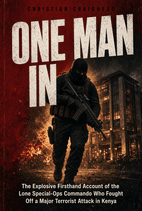
This page gathers phrases from Christian Craighead's One Man In, where a life of service, danger, and sudden violence gets distilled into short, direct observations. You will find lines about courage, faith, brotherhood, loss, and the small decisions that shape a person long before a crisis arrives.
What makes the book quotable is its lack of polish for its own sake. The voice stays practical even when the subject turns heavy. Some lines are hard, some are reflective, and some land like a quiet order to stop waiting and act.
Top Quotes from One Man In
“Seize whatever opportunity comes your way because there will be nothing worse than knowing you could have but didn’t, that now you can't, and you're still alive to wish you had.”
The chapter opens with this quotation from Mark Twight, Refuge.
It frames the book’s theme of seizing chance and living with the regret of inaction.
“Okay, I told myself. This is it. Let’s go. Let's go and fuckin’ do this.”
The narrator steels himself after learning of the attack at DusitD2.
It captures the instant fear turning into resolve, with raw, unpolished urgency.
“From that moment, I never really thought about whether I was going to get involved or not. I just did it.”
He reflects on the instant he decided to act after his friend’s call.
It shows how decisive action can bypass prolonged deliberation when lives are at stake.
“In my mind, only one thing mattered. I had to do what I could to stop these people and save the lives of terrified innocent civilians who faced the possibility of instant execution.”
The narrator concludes his assessment of al-Shabaab and the stakes at DusitD2.
It distills the chapter’s driving purpose: confronting terror to protect innocent civilians from execution.
“One thing I knew about countering terrorist attacks was that every second counts.”
This is the chapter’s closing line as he races toward the terrorist incident.
It crystallizes the chapter’s urgency and the unforgiving arithmetic of counterterrorism.
“Evil may have its hour, but God will have his day.”
Epigraph for Chapter Six, attributed to Ven. Fulton J. Sheen.
It frames the chapter's moral stakes, suggesting evil is temporary while divine justice prevails.
“Out of every one hundred men, ten shouldn't even be there, eighty are just targets, nine are the real fighters, and we are lucky to have them, for they make the battle. Ah, but the one, one is a warrior, and he will bring the others back.”
The chapter opens with an epigraph attributed to Heraclitus.
It frames the lone warrior who acts when others won't, setting up the chapter's central theme.
Themes Behind the Quotes
The quotes circle around duty and readiness. Craighead presents service not as a job but as a calling, and he keeps returning to the idea that preparation, discipline, and speed matter when innocent lives are at stake. Faith runs underneath that discipline, sometimes tested, sometimes quiet, but rarely absent.
Another current is the tension between ordinary life and sudden violence. The book moves from packed bags and military training to massacres, rescue, and survival. It also explores fear, resolve, and the clarity that can appear in chaos. Running through it all is a moral edge: evil is real, action has a cost, and standing aside is its own kind of choice.
Quotes by Chapter
Chapter 1: Stranger on the Road
“For me, the military isn’t just a way of life. It's an absolute calling.”
Chris contrasts his own commitment with the mentality he observes among some Kenyan soldiers.
It defines his identity and sense of purpose in a few uncompromising words.
“My relationship with the church has been complex and has at times been low, but my faith has never wavered.”
While driving past the Ngong Hills, Chris reflects on his lifelong faith.
It distinguishes personal belief from institutional religion and shows a quiet, enduring conviction.
“Creeze, may God bless you many times this day.”
Simon fixes Chris with bloodshot eyes and says this as he leaves the truck.
It is an eerie blessing that haunts Chris because he later wonders if Simon was an angel or divine messenger.
Chapter 2: I Wanna Be Tough
“The gunmen cold-bloodedly executed men, women, and children after asking them to prove they were Muslims by reciting verses of the Qur'an. Failure to do so meant instant death.”
The narrator describes the 2013 Westgate mall attack in Nairobi.
It starkly conveys the brutality that motivates the narrator’s constant readiness.
“For his actions my friend became the first person in twenty-five years to be awarded the George Cross, the highest British award for gallantry not in the presence of the enemy.”
The narrator explains why his new friend is considered a hero in Britain.
It captures the extraordinary courage that quietly shapes the narrator’s sense of duty.
“I believed a similar attack on the city could happen again. I knew most of my work would be done in the Kenyan bush, but I had already decided that I'd always remain ready to react when I was in Nairobi, just in case.”
After the Westgate siege, the narrator commits to staying prepared in Nairobi.
It reveals the vigilance and resolve behind the narrator’s everyday life.
“To that end, I kept a large black bag packed and ready to go. Its contents included my uniform, body armor, helmet, night vision goggles (NVGs), guns, hand grenades, stun grenades, a hunting knife, ammo, ear protection, and eye protection.”
The narrator describes the emergency kit he keeps ready in Nairobi.
The exhaustive list makes his readiness vivid and unmistakably serious.
Prologue
“They made it quite clear that they were in Kenya on humanitarian roles, while I was there to hunt monsters they didn’t think existed. In their eyes, my presence in the country was counterproductive.”
The author recalls how UK government staff in Kenya reacted to his counterterrorism role.
It captures the friction between humanitarian aid workers and the hunt for terrorists they doubted existed.
“I had a pretty good idea what he was referring to because I knew from the staff at the orphanage that almost all the children there had been sexually assaulted. I felt angry listening to him. I could also identify with his desire to transform himself from a scared kid into a strong adult.”
The author reflects on Moses’s words and the abuse suffered by children at the orphanage.
It links personal anger and empathy to the broader horror of what the children endured.
“Their mission: to kill or injure people wherever they found them, for as long as they could, using automatic rifles, hand grenades, and a level of ruthlessness with unarmed civilians only seen in young men who are determined to fight to the death.”
The author describes the mission of the al-Shabaab attackers preparing in Nairobi.
The line conveys the cold, fanatical lethality of the assault and its disregard for civilian life.
“The ultimate goal: to instill terror and fear in the city and a measure of shock around the world.”
The author states what the attackers hoped to achieve beyond the immediate violence.
It distills the essence of terrorism: psychological terror and global shock.
Chapter 3: Paradise Lost
“In the desert I saw a creature, naked, bestial, Who, squatting upon the ground, Held his heart in his hands, And ate of it. I said, “Is it good, friend?” “It is bitter—bitter,” he answered. “But I like it Because it is bitter, And because it is my heart.””
The chapter opens with this epigraph from Stephen Crane.
It frames the chapter’s violence as bitter self-consumption and makes the heart’s own pain impossible to disown.
“To the terrorists, this meant that once they were past the gatehouse and into the complex, they had a caged target area where their victims would be trapped and at their mercy.”
The narrator describes how the DusitD2 complex’s security layout looked to the attackers.
It chillingly reframes a fortified business complex as a killing ground, showing how safety measures can become a death trap.
“In the security camera footage, Riziki is there, and then suddenly he is gone. There is no sound. It’s haunting.”
The narrator describes security-camera footage of the suicide bomber just before the explosion.
The flat, almost cinematic brevity makes the sudden erasure of a human being feel unbearably eerie.
“Within five minutes, the al-Shabaab unit had killed eight people. They were looking for their next victims.”
After the attackers split up inside the complex, the massacre continues.
The abrupt final sentence turns five minutes of slaughter into a prelude, emphasizing the attackers’ cold momentum.
Chapter 4: Answer the Call
“Unless a man becomes the enemy of an evil, he will not even become its slave but rather its champion.”
The chapter opens with this epigraph attributed to G. K. Chesterton.
It frames the moral stakes of the chapter: neutrality in the face of evil is complicity.
Chapter 5: The Road to Hell
“No orders, no support, one option—get there and make a difference was how I was thinking. I had to get there, fast.”
As he drives against traffic toward the hotel attack, Chris thinks through his self-imposed duty.
It captures the isolation and clarity of someone acting without backup. The line makes his sense of mission feel absolute.
“You learn in specialist driver training that there's no point in crashing a car on the way to an incident. The overriding thing is to reach your destination, so you can deal with the emergency. Lying in a heap on the side of the road amounts to a total failure to meet that objective.”
He recalls specialist driving lessons while weaving through Nairobi traffic.
It distills the counterintuitive discipline behind emergency driving: speed matters only if you arrive.
“But I came out of the coma after a fortnight, and a week later was back home, malnourished, having lost over fifty-five pounds in weight. Within six months, I was jumping out of airplanes again, carrying a full allocation of kit.”
He remembers surviving a catastrophic Land Rover crash as a young soldier.
The line is a stark measure of recovery and resilience, moving from near death to elite readiness.
Chapter 6: You Have Reached Your Destination
“I'm here on the orders of the president. And I need to get through.”
The narrator bluffs a police officer blocking the road to the DusitD2 complex.
It captures his audacity and the strange truth behind his bluff, marking the moment he talks his way into the crisis.
“I thanked the policeman and accelerated away, tires squealing, only to ram on the brakes seconds later when I heard the disembodied voice on my phone calmly announce: “You have reached your destination.””
The narrator races toward the DusitD2 complex and gets the phone alert after bluffing through a police stop.
The mundane GPS announcement collides with the chaos ahead, making the chapter title both ironic and ominous.
“Now that I'd arrived, I was in a state of complete calm. I could get on with my job and do something to help. I wasn't thinking about how dangerous the situation could be. I wanted to assist the Kenyans in whatever way I could. I wanted to get stuck in.”
Having reached the complex, the narrator describes his mindset before entering the scene.
It reveals his compulsion to help and his calm under pressure, showing the moral clarity driving him into danger.
Chapter 7: Bring It On
“The presence in an urban environment of free-range killers from a group like al-Shabaab can create this sort of paralysis among people whether they've had training to deal with it or not.”
The author describes the paralyzing fear among armed men and journalists at the gatehouse during the attack.
It captures how terrorism can freeze even trained people, making the author's decision to act stand out.